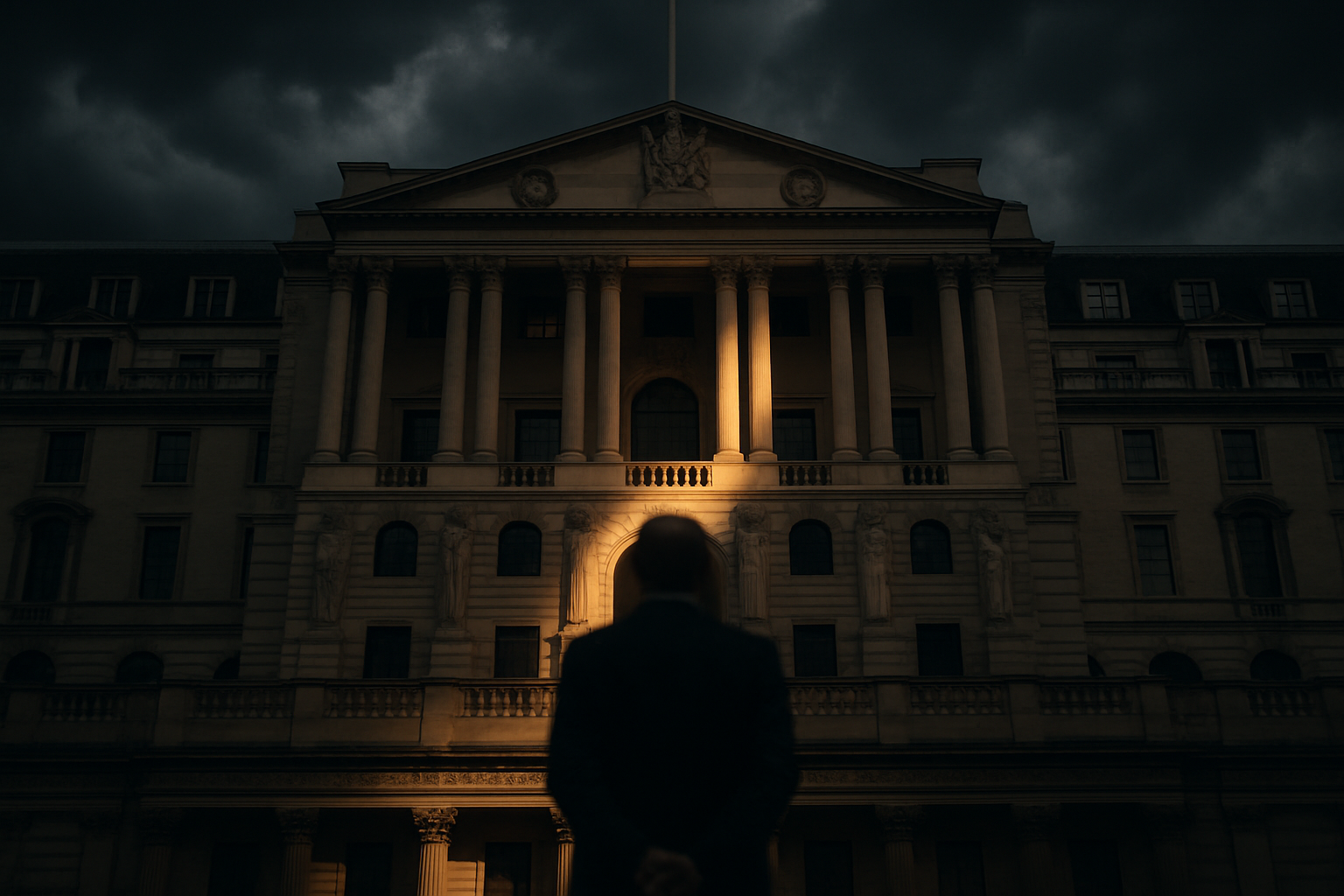
The Bank of England’s Monetary Policy Committee (MPC) voted 7-2 to keep its main interest rate unchanged at 3.75% at its meeting ending 17 June 2026, opting for caution even as headline inflation fell to 2.8% – its lowest level in over three years and within striking distance of the official 2% target. The decision underscores the central bank’s persistent anxiety that the recent decline in price growth may prove temporary, with energy costs and geopolitical risks threatening to push inflation higher again later this year.
The two dissenting members – external MPC member Megan Greene and chief economist Huw Pill – voted to raise the Bank Rate by a quarter-point to 4.0%, arguing that underlying price pressures and lingering second-round effects warranted tighter policy. The remaining seven members, including Governor Andrew Bailey, voted to hold steady, judging that the current stance was appropriate while the economy shows signs of cooling and the labour market softens.
“Taking all risks into account, the Committee judges it appropriate to maintain Bank Rate at this meeting,” the MPC said in its minutes. The statement added that inflation is expected to rise again later in 2026 as earlier energy price increases continue to feed through into household bills and business costs. The Bank is therefore not declaring victory over inflation, despite the sharp drop from the double-digit peaks of 2022-2023.
The policy decision in detail
The MPC’s decision was widely anticipated by financial markets, but the split vote and the accompanying guidance have sharpened the debate over how quickly the Bank can afford to ease policy. The majority view is that maintaining the current rate gives the committee more time to assess whether the disinflation process is durable, or whether the recent fall in CPI reflects temporary factors.
The July 2026 Monetary Policy Report, which will include updated economic forecasts, is now the next major milestone. Until then, the Bank is signalling that it is willing to accept a period of inflation slightly above target – or even slightly below – as long as medium-term expectations remain anchored. The 2.8% headline figure is still more than a third above the 2% target, but the pace of decline has been faster than the Bank itself predicted at the start of the year.
However, the MPC warned that the path back to 2% is not guaranteed. “Underlying price pressures remain elevated in some sectors, particularly in services and in domestically generated inflation,” the minutes noted. “There is a risk that recent energy price shocks and the ongoing conflict in the Middle East could generate second-round effects through wages and prices.”
Two dissenting voices: the hawks’ case
Megan Greene and Huw Pill both argued that a rate rise was necessary to prevent inflation from re-accelerating. Greene, an external member appointed in 2023, has consistently taken a more hawkish stance, warning that the labour market remains too tight and that wage growth – though slowing – is still inconsistent with the 2% target. Pill, the Bank’s chief economist, echoed that view, noting that leaving rates unchanged risked “embedded inflation” that would be more costly to squeeze out later.
Their dissent is notable because it suggests that even after two years of rate increases and a prolonged period of elevated borrowing costs, the MPC is not united in believing the cycle is over. For households and businesses, the message is ambiguous: the majority says “wait and see,” but a vocal minority argues that rates might still need to rise further.
The two hawks’ preferred quarter-point hike would have taken the Bank Rate to 4.0% – still well below the peak of 5.25% reached in mid-2023, but above the current level. Their position reflects a concern that the UK economy may be more prone to inflationary shocks than other advanced economies, partly because of its exposure to European gas markets and the impact of the war in Ukraine.
Inflation is falling, but for how long?
The headline figure of 2.8% is a marked improvement from the 11.1% peak in October 2022, but it masks considerable unevenness. Core inflation – which strips out energy, food, alcohol, and tobacco – remains above 4%, and services inflation is still running at around 5%. These are the indicators the MPC watches most closely when gauging domestically generated pressures.
The Bank’s own forecasts show headline CPI dropping further in the next few months, possibly touching the target for a short period, before rising again in the autumn as the energy price cap adjustments feed through. The Office for National Statistics (ONS) reported last month that the largest downward contributions came from housing and household services, partly reflecting the decline in wholesale gas prices, as well as from food and non-alcoholic beverages.
Nevertheless, the Bank is sceptical that the current disinflation is structural. The MPC minutes stated that “the recent outturns have been broadly in line with the Committee’s expectations,” and that “most indicators of wage growth are still elevated relative to levels consistent with meeting the inflation target.” The reference to second-round effects is key: the Bank fears that if firms continue to raise prices to cover higher labour costs, inflation could become entrenched.
Weakening economy and cooling labour market
The decision to hold rates comes against a backdrop of weakening economic momentum. Recent ONS data showed that UK GDP contracted in the first quarter of 2026, putting the economy on the brink of a technical recession. Business surveys point to shrinking output in both manufacturing and services, with the energy-intensive sectors particularly hard hit.
On the labour market, the MPC described conditions as “cooling,” with “demand for workers not very high right now.” The employment rate has edged down, and vacancies have fallen for the eleventh consecutive month. Yet wage growth – though slowing – remains above 5% in nominal terms, which the Bank still views as inconsistent with its target.
The combination of stagnant output and sticky wage growth presents a classic stagflationary dilemma. If the Bank were to cut rates too early, it might fuel demand and reignite price pressures. If it keeps rates high for too long, it risks deepening the economic downturn. The MPC’s cautious hold is an attempt to navigate that narrow corridor.
The global backdrop: energy and geopolitics
The Bank’s caution is heavily influenced by external factors. The ongoing conflict in the Middle East has disrupted shipping routes in the Red Sea and kept energy prices volatile. While European gas storage levels are high, the risk of supply interruptions remains, and oil prices have drifted upward in recent weeks.
The MPC minutes noted that “the outlook for energy prices remains highly uncertain, and the Committee will continue to monitor developments closely.” This is a reference to the fact that the UK is a net importer of energy, making it vulnerable to price spikes. The Bank’s models assume that energy prices will stabilise, but the committee is not willing to bet on it.
The US Federal Reserve, which held its own rates steady at its June meeting, also signalled caution, lowering its forecast for rate cuts in 2026. The European Central Bank, by contrast, cut rates in April but signalled a slowdown in the pace of easing. The UK’s position is somewhere in between: the Bank Rate of 3.75% is still restrictive, but the MPC is not yet prepared to shift towards accommodation.
Implications for households, businesses, and mortgage holders
For millions of UK households on variable-rate mortgages, the decision means that borrowing costs will remain at their highest level in over a decade. The average two-year fixed rate mortgage has stabilised around 5.5%, but many homeowners who came off cheap fixed deals in recent years have already seen their payments rise sharply. A hold at 3.75% does not make things worse, but it does not ease the pressure either.
Businesses, particularly in retail and construction, are feeling the pinch of high interest rates alongside weak demand. Many are deferring investment and drawing down cash reserves. The British Chambers of Commerce said in a statement that the “hold decision reflects the difficult balancing act the Bank faces,” and called for “clearer signals on the future path of rates to help businesses plan.”
On the positive side, savers have continued to benefit from elevated deposit rates, though these have also begun to edge down as banks anticipate eventual cuts. The Bank’s decision to hold steady gives banks little reason to improve savings rates further.
What happens next: the path forward
Markets are now pricing in a first rate cut in late 2026, possibly at the August or November meeting, depending on the data. The next key release is the July inflation print, due in mid-August, along with updated labour market figures. The MPC will also publish its full economic forecast in August, which will give greater insight into the majority’s expectations for the next two years.
Governor Andrew Bailey has previously said that the Bank would need to see “more persistent evidence” that inflation is under control before cutting rates. The June vote suggests that barring an absolute collapse in price pressures, the committee will wait at least until the autumn.
The two dissenting hawks, Greene and Pill, are likely to continue arguing for tighter policy if wage growth does not moderate further. The 7-2 split could widen or narrow depending on how the data evolves. If inflation surprises on the upside in July, the majority might shift towards a hike; if it falls significantly below target, the hawks might lose their case.
Conclusion: a policy in wait-and-see mode
The Bank of England has again chosen caution over conviction, signalling that the battle against inflation is not yet won even as the enemy appears to be retreating. The 7-2 vote to hold at 3.75% reflects a committee deeply aware that the final mile of disinflation is often the hardest, and that external shocks could easily reverse progress.
For the UK economy, the message is mixed: interest rates will remain restrictive for the foreseeable future, but the peak has likely passed. The risk of a hike is not off the table, but it is becoming less probable as the economy weakens. The real debate is no longer about whether rates will come down, but when – and how fast.
The Bank’s next moves will depend on data that is inherently uncertain. As the MPC itself acknowledged, “the economic outlook remains subject to significant risks, both at home and abroad.” For now, holding steady is the safest course – but that safety could quickly become a trap if the economy deteriorates faster than expected or if inflation proves more stubborn than forecast.