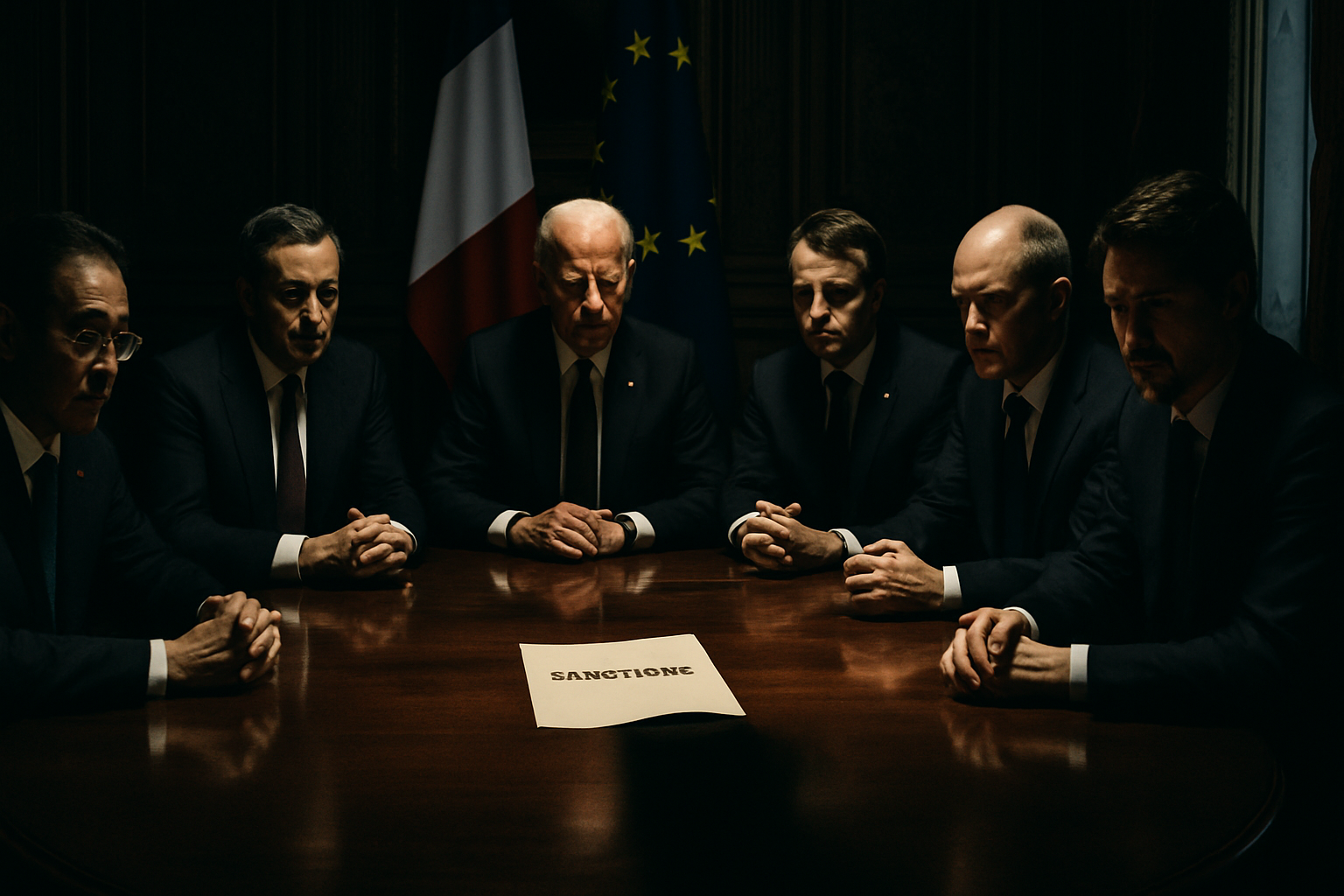
The 52nd Group of Seven summit concluded last week in the French Alpine resort of Évian‑les‑Bains, with leaders issuing a comprehensive joint statement on geopolitical issues that reaffirms their unwavering support for Ukraine and commits to a new wave of economic pressure on Russia. The final communiqué, released on 17 June, explicitly states that the G7 will “strengthen sanctions, including those on the oil and gas sectors,” and will “increase the pressure on the Russian war economy.” This move is explicitly linked to what the leaders describe as “new momentum” on the battlefield in Ukraine, which they say they aim to “support and accelerate.”
The summit, held under the French presidency of President Emmanuel Macron, brought together the leaders of the United States, Germany, the United Kingdom, Italy, Japan, Canada, and the European Union. Ukrainian President Volodymyr Zelensky attended in person, holding bilateral meetings on the sidelines. According to the joint statement, the G7 “commends Ukraine for its resilience and progress on the battlefield in recent months,” and has agreed to increase deliveries of air‑defence capacities, additional systems and interceptors, and long‑range capabilities to Ukraine. The leaders also signalled they are “ready to consider” extending licences to Ukraine to boost its own military production, and pledged support for Ukraine’s energy resilience through the coming winter.
What the new sanctions entail
The G7’s latest sanctions package is centred on tightening restrictions on Russia’s energy exports, particularly oil and gas, and targeting the so‑called “shadow fleet” of oil tankers that Moscow has used to circumvent existing measures. According to Reuters’ summit coverage from 17 June 2026, G7 leaders explicitly framed these new measures as a way to add pressure to Russia’s wartime economy. The joint statement itself underscores that the sanctions are part of a broader effort to constrain the “Russian war economy” and reduce the financial resources available for its military campaign in Ukraine.
The timing of the sanctions tightening is noteworthy. The G7 communiqué states that this push is being coordinated alongside an emerging U.S.–Iran deal to reopen the Strait of Hormuz, which G7 leaders say they support and see as a way to help diversify global energy routes and reduce vulnerability to chokepoints. This suggests a strategic linkage: while squeezing Russian energy revenues, the G7 aims to ensure alternative supply routes remain open, thereby stabilising global energy markets and preventing price spikes that could undermine domestic political support for the sanctions.
The European Union, which participates in the G7 as an institutional member, is expected to play a key role in implementing the new sanctions. The EU has already been at the forefront of previous sanctions rounds, and the G7 has previously agreed on a plan to mobilise €50 billion (approximately $54 billion) backed by revenues from frozen Russian central bank assets. That mechanism, announced earlier in 2024, is now being operationalised, with the new sanctions fitting into that framework.
Why this matters now
The G7’s decision to tighten sanctions and expand military aid comes at a critical juncture in the war. Russian forces have made incremental gains in eastern Ukraine in recent months, but Ukraine’s military has also demonstrated resilience and launched counter‑operations that have regained some territory. The G7 statement’s reference to “new momentum” on the battlefield reflects assessments that Ukrainian forces have been able to exploit weaknesses in Russian logistics and air defence, and that further Western support could lock in those gains.
For the G7 leaders, the summit in Évian was also an opportunity to project unity on an issue that has sometimes exposed divisions, particularly regarding the pace and scope of military aid. French President Macron, as host, has made sustaining support for Ukraine a central pillar of his G7 presidency, which he oriented around reducing global economic imbalances and maintaining pressure on Moscow. The final communiqué reflects a broad consensus, but the presence of U.S. President Donald Trump added a layer of complexity. Trump has publicly downplayed the Ukraine war as having “no impact” on the United States, yet his administration signed onto the sanctions‑tightening language and backs a large Ukraine funding and frozen‑assets package via the G7. This apparent contradiction has drawn scrutiny, but the summit outcome suggests that, at least at the leader level, a unified front was maintained.
Background and context
The G7 has been a primary forum for coordinating Western responses to Russia’s full‑scale invasion of Ukraine, which began in February 2022. Over the past four years, the group has imposed successive rounds of sanctions targeting Russia’s energy sector, financial system, military‑industrial complex, and individuals close to President Vladimir Putin. The measures have included an oil price cap, an embargo on seaborne Russian crude oil and petroleum products, bans on technology exports, and asset freezes on the Russian central bank.
However, the effectiveness of these sanctions has been debated. Russia has adapted by redirecting energy exports to China, India, and other markets, often at discounted prices, and by building a “shadow fleet” of aging tankers that operate outside Western insurance and financial networks. The new G7 measures aim to close these loopholes by targeting the shadow fleet more directly, potentially through ship‑to‑ship transfer bans, tighter insurance rules, and secondary sanctions on entities that facilitate such trade.
The diplomatic backdrop also includes the stalled peace talks and the ongoing debate over whether to provide Ukraine with longer‑range weapons and fighter jets. The G7 statement’s pledge to increase deliveries of “long‑range capabilities” signals a willingness to cross thresholds that were previously considered red lines by some allies, such as Germany and the United States. This may reflect a shift in risk calculus, as Western intelligence assessments suggest that Russia’s own long‑range strike capabilities are being degraded.
Different perspectives
The G7’s decisions have drawn a mix of support and criticism from various quarters.
Ukrainian perspective: President Zelensky, who attended the summit in person, welcomed the new commitments. The Ukrainian government has consistently called for more air defence systems, long‑range missiles, and a tighter enforcement of sanctions to cut off Russia’s revenue streams. Kyiv views the G7’s reference to “new momentum” as validation of its battlefield strategy and hopes that the pledged arms will allow it to sustain offensives into the winter.
Russian perspective: The Kremlin has denounced the G7 summit as an act of aggression and illegitimate interference in its internal affairs. Russian state media has portrayed the sanctions as a desperate attempt by a declining West to prop up a failing Ukrainian state. Russia’s economy has shown resilience, with GDP growth driven by wartime industrial production and energy sales to non‑Western buyers. However, economists warn that the cumulative effect of sanctions, combined with the new measures, could gradually erode Russia’s fiscal stability, particularly if global energy prices decline.
Domestic political views in G7 countries: In Western capitals, support for continued Ukraine aid is not uniform. In the United States, President Trump’s ambivalent rhetoric has fuelled uncertainty among allies, although his administration’s signing of the G7 statement suggests that at least some key officials and military advisors remain committed to the current policy. In Europe, populist and far‑right parties in several countries have called for a reduction or cessation of aid, arguing that the war is draining national budgets and risk provoking escalation with Moscow. The G7 communiqué attempts to counter such narratives by emphasising that supporting Ukraine is an investment in European security and that the economic costs of inaction would be higher.
Global South perspectives: Many countries in Africa, Asia, and Latin America have adopted a neutral stance, refraining from joining Western sanctions while also not actively supporting Russia. The G7’s push to tighten sanctions may be seen by some as a unilateral move that risks further fragmenting the global economy and complicating food and energy trade. The mention of the U.S.–Iran deal to reopen the Strait of Hormuz appears designed to address concerns about energy market stability, but it also highlights the selective nature of the G7’s approach to global energy governance.
Impact and implications
The immediate impact of the G7’s new sanctions is likely to be incremental rather than transformative. Russia has already weathered multiple rounds of sanctions, and its economy has partially adapted. However, the focus on the shadow fleet could disrupt a significant portion of Russia’s oil export logistics, potentially forcing it to sell at even steeper discounts or cut production. The G7’s willingness to consider licences for Ukraine to boost its own military production is a notable shift, indicating a longer‑term approach to building Ukraine’s defence industrial base rather than relying solely on donations.
The broader geopolitical implications are significant. The G7’s explicit linkage of sanctions to battlefield momentum suggests a strategic aim to create a self‑reinforcing cycle: more weapons help Ukraine gain territory, which in turn justifies more sanctions that weaken Russia’s ability to reconstitute its forces. This approach, while logical on paper, carries risks. It assumes that Ukraine can sustain offensive operations and that Western publics will tolerate the economic costs of elevated energy prices and inflation.
The U.S.–Iran deal on the Strait of Hormuz, mentioned in the G7 communiqué, adds another layer. If implemented, it could reduce the risk of a major supply disruption, thereby allowing the G7 to tighten sanctions on Russia without triggering a global oil price shock. Iran, for its part, may see this as an opportunity to normalise its relations with the West, though the details of the emerging deal remain unclear.
What happens next
The G7’s decisions in Évian‑les‑Bains are political commitments, not legally binding treaties. The actual implementation of the new sanctions will require legislative and regulatory action by individual member states and the European Union. The EU, in particular, is expected to begin work on a new sanctions package in the coming weeks, which will need unanimous approval from all 27 member states. This process could be contentious, especially as some member states, such as Hungary and Slovakia, have previously resisted tough energy sanctions.
The United States, under President Trump, will also need to issue executive orders or work with Congress to implement the new measures. Given Trump’s previous scepticism about the war, the speed and scope of U.S. implementation will be closely watched. Some analysts have suggested that Trump’s signature on the G7 statement may be a tactical move to maintain leverage, and that the actual enforcement could be uneven.
For Ukraine, the immediate priority is to secure the promised air defence systems ahead of the winter, as Russia has resumed strikes on energy infrastructure. Zelensky’s presence at the summit and the G7’s explicit winter resilience pledge suggest that a coordinated plan is in place, but its execution depends on logistical and political will.
Looking ahead, the G7’s strategy will be tested in the autumn and winter of 2026. If Ukrainian forces continue to make gains and Russian revenues shrink, the pressure on Moscow could intensify. Conversely, if the sanctions fail to bite and Ukraine’s offensive stalls, the G7 may face a difficult choice between escalating further or pushing for a negotiated settlement. The Évian summit has set a clear direction, but the road ahead remains fraught with uncertainty.
In summary, the G7 leaders have used their French summit to signal a unified and reinforced stance on Ukraine, tightening sanctions on Russia’s energy sector and expanding military aid. The move is tied to a perceived battlefield opportunity, but its success hinges on effective implementation, global energy market stability, and sustained domestic political support across the member states. The coming months will reveal whether this latest round of pressure is enough to tip the balance in Ukraine’s favour or merely another step in a prolonged, grinding conflict.