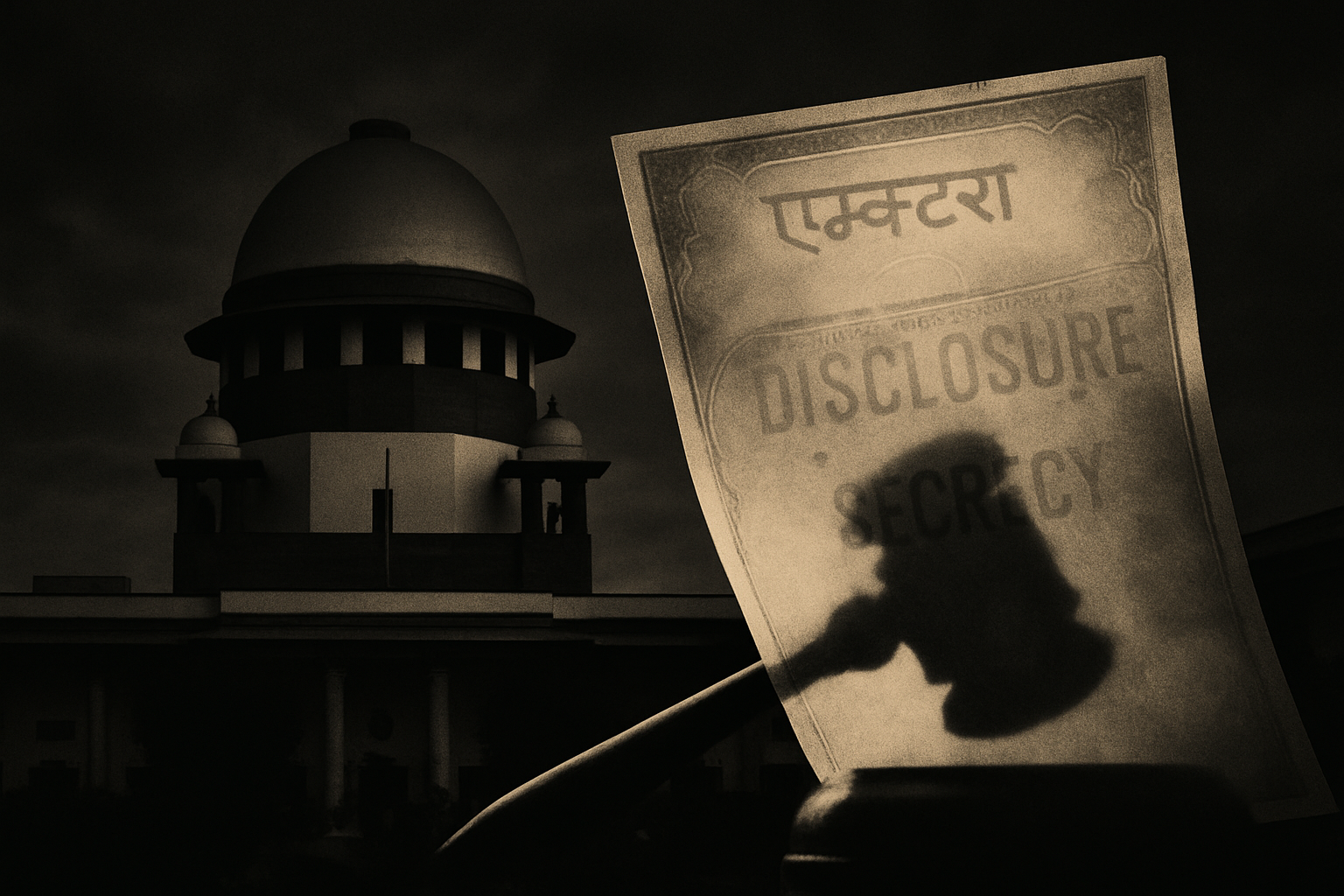
The Supreme Court Holds the Line: Transparency in Political Funding Remains Enforced
In a significant reaffirmation of its earlier landmark judgment, India’s Supreme Court has firmly upheld and enforced its orders requiring full public disclosure of electoral bond data, rejecting attempts to dilute, delay, or re‑seal the information. As of mid‑2026, the court’s stance keeps the spotlight on political funding transparency, ensuring that donor‑party linkages remain publicly accessible and that the now‑struck‑down electoral bonds scheme continues to fuel debate and litigation over campaign finance in the world’s largest democracy.
The apex court’s consistent position—maintained through a series of post‑verdict orders—means that the State Bank of India (SBI) remains bound to share complete purchaser and encashment data with the Election Commission of India (ECI), and the ECI continues to host and update disclosure files on its website. This transparency framework, which emerged from the landmark February–March 2024 judgment, has become a central pillar in ongoing disputes about political corruption, corporate influence, and the integrity of India’s electoral process.
#### What Is Happening Now: The Current State of Play
The electoral bonds scheme stands struck down as unconstitutional, and the Supreme Court’s disclosure directions remain fully operative. Civil society groups, led by the Association for Democratic Reforms (ADR), are actively using the disclosed data to press for further reforms, litigate related issues, and highlight patterns of alleged quid‑pro‑quo funding and shell‑company donations. The Union government—under Prime Minister Narendra Modi and the Bharatiya Janata Party (BJP), which was by far the largest beneficiary of electoral bond donations—is operating in a legal environment where anonymous large‑scale corporate donations through the scheme are no longer available. However, the political and legal reverberations continue.
Key elements of the disclosure order are intact. SBI was and remains bound to share complete records of who purchased electoral bonds and which political parties encashed them. The ECI publishes this data on its website, making bond purchase and redemption information from April 2019 to early 2024 publicly accessible. The court has rejected attempts by the government or affected parties to re‑seal the information or limit its scope. With the judgment’s core transparency mandates enforced, the debate has now shifted to follow‑on accountability: the use of electoral bond data in investigations into alleged corruption, extortion, or policy‑for‑funds trades, which is now feeding into enforcement actions and political narratives.
A secondary litigation track concerns precisely this accountability—how the disclosed data can be used by investigative agencies and what obligations exist for political parties and donors. The Supreme Court’s ongoing supervision of the matter ensures that the transparency regime remains alive and central to conversations about political corruption and campaign finance reform.
#### Key People and Institutions: Who Is Driving the Process
Judiciary and the Court
At the heart of the enforcement stands Chief Justice of India Dr Dhananjaya Y. Chandrachud, who headed the five‑judge Constitution Bench that struck down the electoral bond scheme in February 2024. He authored or led the key opinions enforcing disclosure and the voter’s right to information. The other judges on that bench—Justices Sanjiv Khanna, B.R. Gavai, J.B. Pardiwala, and Manoj Misra—remain senior Supreme Court justices shaping follow‑up orders on compliance and related cases. Their collective commitment to transparency has withstood political pressures and procedural challenges, ensuring the judgment’s practical impact.
Petitioners and Civil Society
The Association for Democratic Reforms (ADR) is the primary petitioner challenging electoral bonds. As a leading election transparency NGO, ADR has been analysing the disclosed datasets and filing further applications as new discrepancies and patterns emerge. The Communist Party of India (Marxist) [CPI(M)], a co‑petitioner that challenged the scheme’s constitutionality, supported full disclosure of donors and recipients. Senior advocate Prashant Bhushan, who argued against the scheme, has publicly highlighted issues such as shell companies and suspected extortionary patterns revealed in the bond data.
State Institutions
The State Bank of India (SBI), India’s largest state‑owned bank and the sole authorised issuer and redeemer of electoral bonds, was directed to stop issuing bonds and to hand over full records of purchases and encashments to the ECI. SBI is still under judicial scrutiny for its initial delay in complying with the court’s orders. The Election Commission of India (ECI), the constitutional body overseeing elections, is responsible for publishing the electoral bond data supplied by SBI and is now the custodian of a politically explosive transparency database.
Political Leadership
Prime Minister Narendra Modi and Amit Shah, the senior BJP leader and Union Home Minister, have been central to political defences of the now‑invalidated scheme. The BJP, as the largest beneficiary of electoral bond donations before the judgment, faces continued scrutiny as the disclosed data reveals the scale of corporate funding it received. Opposition leaders have repeatedly invoked the bond data to question the government’s integrity and demand further investigations.
#### Why This Matters: Background and Context
The electoral bond scheme was introduced by the Modi government in 2018, ostensibly to clean up political funding by enabling anonymous donations through bank instruments. In practice, it allowed unlimited corporate donations without disclosure to the public, effectively creating a system of opaque political finance. Critics argued that it empowered the ruling party—which received the bulk of donations—and enabled corporations to influence policy without accountability.
In February 2024, a five‑judge Constitution Bench of the Supreme Court unanimously struck down the scheme as unconstitutional, holding that anonymous political funding violated the voter’s right to information under Article 19(1)(a) of the Constitution. The court directed SBI to disclose all details of bond purchasers and recipients to the ECI, which would then publish the data. After initial delays and resistance, SBI complied, and the ECI released a massive dataset covering bonds worth more than ₹12,000 crore (approximately $1.4 billion at the time) issued between April 2019 and early 2024.
The disclosure revealed that the BJP had received nearly half of all bond donations, with many donations coming from companies that were subsequently investigated by enforcement agencies or received government contracts. The data also showed that a significant portion of donations came through shell companies or entities with little known business activity, triggering suspicions of money laundering and extortion.
The government and the BJP initially defended the scheme, arguing that it brought donations into the formal banking system and reduced black money in politics. However, the Supreme Court’s ruling and the subsequent disclosures have left the government on the defensive, with opposition parties and civil society organisations demanding accountability for the donors and questioning the scale of corporate influence on policy.
#### Impact and Implications: A Divided Landscape
For Political Funding and Elections
The judgment has fundamentally altered the landscape of political finance in India. The era of anonymous corporate donations through electoral bonds is over. Political parties must now rely on other sources—individual donations, electoral trusts, and perhaps more transparent crowdfunding. The transparency forced by the court has made it harder for corporations to secretly fund political parties, but it has not eliminated the problem. Large donations that predated the scheme or that are routed through other vehicles continue to exist, but the scale of opacity has been greatly reduced.
For the Ruling Party and the Government
The BJP, as the largest beneficiary, faces ongoing reputational damage. The disclosed data has been used by opposition parties to allege that the government traded policy favours for donations. While no criminal charges have been filed specifically based on the bond data, several enforcement agencies—including the Enforcement Directorate (ED) and the Income Tax Department—have begun using the data to investigate suspicious donations. The government’s political defence of the scheme has become increasingly untenable as more details of the money flows emerge.
For Civil Society and Judicial Independence
The Supreme Court’s steadfast enforcement of its judgment has bolstered confidence in judicial independence and the court’s ability to check executive overreach. The transparency mandate demonstrates that even when the government and the ruling party benefit from a scheme, the judiciary can step in to safeguard constitutional rights. ADR and other civil society groups have welcomed the court’s stance and are pushing for further measures, such as real‑time tracking of political donations and stricter corporate disclosure requirements.
For Opposition Parties
Opposition parties, which had long campaigned against the electoral bond scheme, are now using the data to press for an independent investigation into donations made by companies linked to government contracts and regulatory favours. However, the opposition also faces scrutiny: some opposition parties received significant bond donations, albeit far less than the BJP. The data has revealed that even smaller parties accepted money from controversial sources, raising questions about their own accountability.
#### Different Perspectives: Balancing the Views
Government and BJP Perspective
Officials have argued that the electoral bond scheme was well‑intentioned and that its annulment has created uncertainty. They contend that the data released by the ECI represents only a partial picture—bonds bought before April 2019 (when disclosure became operational) remain largely unknown. They also claim that the court’s judgment has not ended political funding abuse, as cash donations and other opaque methods persist. Some BJP leaders have accused the opposition of selectively highlighting bond data to target the ruling party while ignoring the fact that bonds were a legal instrument at the time.
Civil Society and ADR Perspective
ADR and its allies maintain that the court’s ruling is a historic victory for transparency and democracy. They argue that the disclosed data has already exposed the deep connections between corporate donors and political power, and that the government’s attempts to delay or dilute the disclosure order show a lack of commitment to clean politics. They are pressing for further reforms, including a cap on corporate donations, strict penalties for shell companies that donate to political parties, and the creation of a central public register of all political donations above a certain threshold.
Legal and Constitutional Experts
Legal scholars have praised the Supreme Court for upholding the fundamental right to information and for demonstrating that no law—however expedient—can override constitutional principles. They note that the judgment sets a precedent for other countries grappling with opaque campaign finance. Some experts caution, however, that the enforcement of the order has not been fully smooth; the initial delay by SBI and subsequent legal challenges show the limits of court‑centric reform. Without a supportive political environment, the data may remain in the public domain but without effective follow‑up action.
Corporate and Business Community
The business community has largely stayed silent publicly, but behind the scenes there is concern about the implications of the disclosure for corporate governance. Companies that donated through electoral bonds now face questions from shareholders and the media. Those with contracts with the government worry about potential investigations. Some business leaders argue that the bonds provided a legitimate channel for firms to support democracy without fear of political retaliation, and that the end of the scheme may push donations back into the unregulated cash economy.
#### What Happens Next: The Road Ahead
The Supreme Court’s enforcement of the disclosure order is not the final word. Several important legal battles are pending:
In conclusion, the Supreme Court’s unwavering enforcement of its electoral bond disclosure order has ensured that transparency remains the central framework for political funding in India. It has forced a recalibration of the relationship between money and politics, exposing the vulnerabilities of an opaque system and empowering citizens with information. Yet, the real test lies ahead: whether the data will lead to meaningful accountability, whether political actors will adapt to a more transparent environment, and whether the judiciary will continue to play its role as the guardian of constitutional rights in the face of persistent challenges. For now, the court has held the line, and the rest is up to the institutions of democracy.