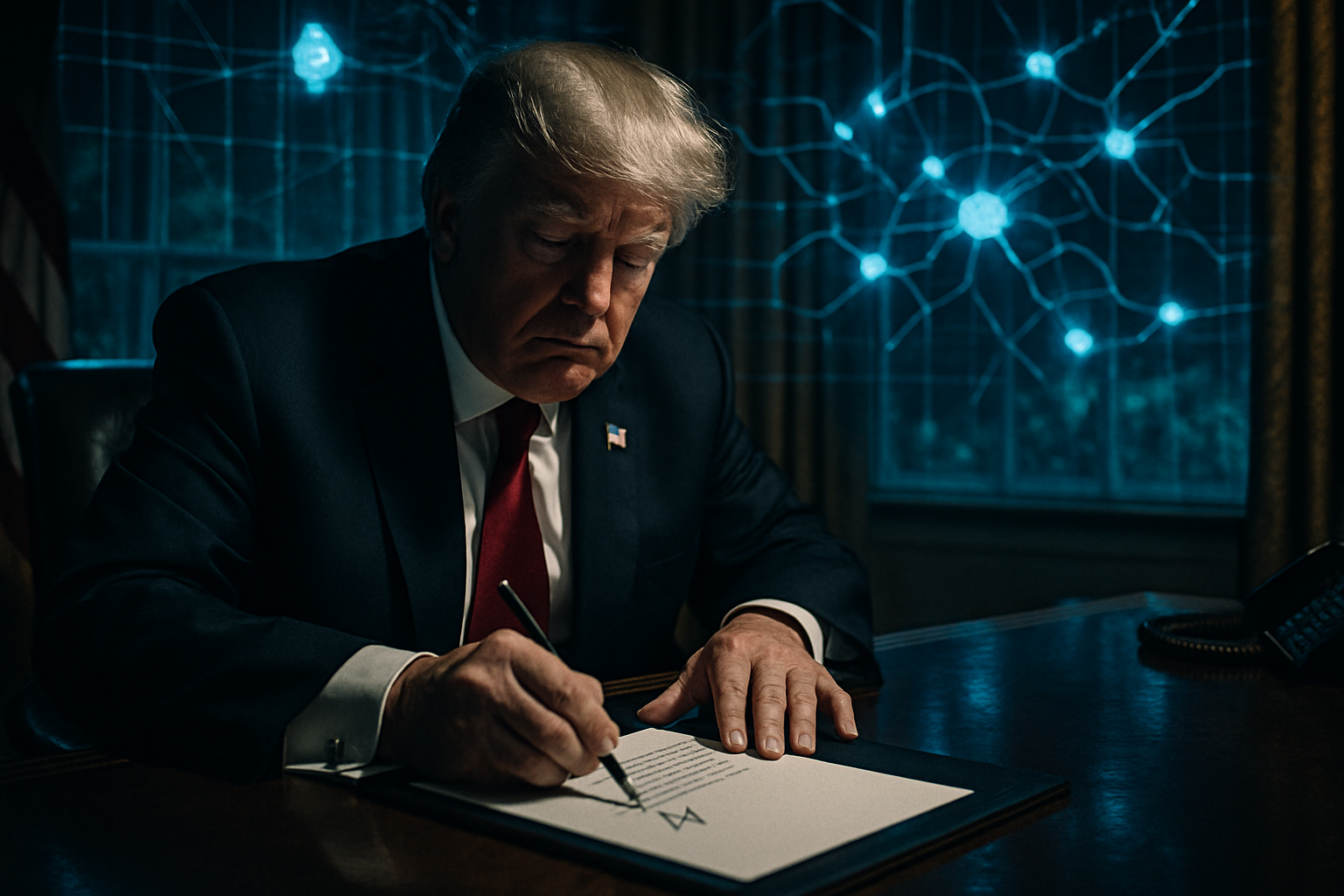
President Trump Signs Executive Order to Advance AI Use in National Security Enterprise
In a sweeping set of directives issued over the past two months, the Trump administration has taken its most aggressive steps yet to embed artificial intelligence into the heart of U.S. national security and cybersecurity operations. President Donald J. Trump signed a National Security Presidential Memorandum on Artificial Intelligence in the National Security Enterprise, along with Executive Order 14409, “Promoting Advanced Artificial Intelligence Innovation and Security,” on June 2, 2026, according to official White House communications and subsequent agency briefings. Together, these actions represent a deliberate shift toward rapid AI adoption across defense and intelligence missions, while explicitly rejecting mandatory licensing or pre‑clearance regimes for AI models.
The move comes amid intensifying global competition in AI development and a surge in AI‑enabled cyber threats. The administration’s approach prioritizes speed, private‑sector collaboration, and minimal regulatory intervention — a posture that has drawn both praise from industry groups and sharp criticism from advocates who argue that unchecked deployment of AI in national security contexts poses profound risks.
What Is Happening Now: Core Actions in Effect
National Security AI Memorandum
At the center of the new policy framework is a National Security Presidential Memorandum on AI in the National Security Enterprise. According to research provided by White House officials, the memorandum directs the entire national security enterprise — including the Department of War and intelligence agencies — to accelerate AI adoption to meet what is described as “surging demand” across defense and intelligence missions.
The memorandum orders the rapid onboarding of advanced AI models from multiple vendors into national security systems, with a preference for commercial and open‑source technologies adapted for mission use. It also mandates the development of next‑generation, high‑security computing facilities capable of running AI systems “at scale.”
One of the more striking provisions establishes an AI National Security Strategic Reserve, composed of top non‑governmental experts who will be called upon to support national security AI efforts. The memorandum also directs the Secretary of War to issue an updated directive on autonomy in weapon systems, with annual reviews to keep pace with frontier AI advances.
Perhaps most significantly for private‑sector partners, the memorandum requires departments and agencies to ensure that no commercial or other entity can disable, degrade, or modify critical AI systems used by warfighters without prior approval. This clause offers new partnership structures to private companies, effectively guaranteeing that once a system is deployed for military use, its core functionality cannot be unilaterally altered by the developer — a move designed to build trust and encourage deeper collaboration.
Executive Order 14409 – “Promoting Advanced Artificial Intelligence Innovation and Security”
Signed on June 2, Executive Order 14409 sets U.S. policy to promote AI innovation and security through collaboration with the private sector, while modernizing government and private sector information systems and hardening them against external threats.
The order directs priority cyber defense for three categories: National Security Systems as defined in 44 U.S.C., Department of War information systems, and civilian federal government systems. It does not extend the same mandatory protections to private‑sector AI systems outside those categories, leaving much of the broader ecosystem to voluntary measures.
Cybersecurity Framework and Frontier Model Oversight
Under the June 2 order, federal agencies are currently engaged in several parallel workstreams:
Criminal Enforcement Focus on AI‑Enabled Cybercrime
The order directs the Attorney General to prioritize enforcement of existing federal criminal statutes against anyone using AI to:
Specifically cited statutes include 18 U.S.C. 1028 (identity fraud), 1030 (computer fraud and abuse), and 1343 (wire fraud). The emphasis is on prosecuting malicious use of AI rather than regulating its development — a distinction that reflects the administration’s broader philosophy.
Regulatory Posture: Voluntary, Collaboration‑First, Minimally Regulatory
The administration’s approach is defined by a clear rejection of mandatory licensing or pre‑clearance regimes. The executive order explicitly forbids interpreting its provisions as authorizing any mandatory governmental licensing, pre‑clearance, or permitting system for developing, publishing, releasing, or distributing AI models, including frontier models. Officials have said that any binding regulation of AI models should come from Congress, not from unilateral executive action.
This leaves the United States with a patchwork of voluntary guidelines and sector‑specific regulations — a stark contrast to the European Union’s AI Act, which imposes mandatory requirements based on risk categories.
Why This Matters
The United States has long been the global leader in AI research and development, but the rapid advance of frontier models — particularly those developed by private companies such as OpenAI, Google DeepMind, Anthropic, and others — has raised pressing questions about how to balance innovation with national security imperatives.
Critics argue that the Trump administration’s approach is too permissive, potentially allowing dangerous capabilities to proliferate before adequate safeguards are in place. Supporters counter that heavy‑handed regulation would cede the field to competitors such as China, which is investing heavily in both civilian and military AI.
The timing of these directives is significant. As of late July 2026, the White House is positioning these measures as a necessary modernization of Cold War‑era national security structures. The memorandum explicitly references “surging demand” for AI capabilities across defense and intelligence missions — a demand that officials say is driven by real‑time operational needs, not abstract planning.
Background and Context
The Trump administration’s relationship with AI has evolved considerably since the president’s first term. In 2019, Trump signed an executive order on “Maintaining American Leadership in Artificial Intelligence,” which focused on research and development. The 2026 actions represent a far more operational, security‑focused approach.
The shift reflects both technological advances — particularly the emergence of large language models and multimodal AI systems — and geopolitical pressures. China’s military has been integrating AI into command‑and‑control systems, autonomous drones, and cyber operations. Russia has also deployed AI‑powered disinformation and cyberattack tools.
At the same time, a series of high‑profile AI incidents — including a deepfake‑driven wire fraud operation that netted over $35 million and the use of AI‑generated phishing campaigns to breach federal contractor networks — have underscored the urgency of better defenses.
The June 2 executive order builds on several earlier initiatives, including the 2023 AI Executive Order issued by the Biden administration, which had taken a more regulatory approach. The Trump order explicitly rescinds or supersedes portions of that earlier directive, particularly those related to mandatory safety testing and reporting requirements.
Impact and Implications
For the Military and Intelligence Community
The National Security Memorandum has immediate operational implications. By ordering rapid onboarding of commercial and open‑source AI models, the Department of War and intelligence agencies can bypass lengthy procurement cycles. This could accelerate deployment of AI tools for threat detection, logistics optimization, and autonomous systems.
However, it also raises concerns about the reliability and security of models that were not originally designed for military use. Commercial models may have embedded biases, hidden vulnerabilities, or components that could be exploited by adversaries. The memorandum’s requirement for secure computing facilities and the AI National Security Strategic Reserve are meant to address some of these risks, but details on implementation remain sparse.
For Private Industry
The voluntary pre‑release engagement framework and the prohibition on disabling critical AI systems offer companies both incentives and protections. Developers of frontier models can gain early access to government threat intelligence and secure computing resources, while also receiving assurances that their products, once deployed for national security, will not be unilaterally shut down.
But the framework is entirely optional. Companies that choose not to participate face no legal penalty — though they may find themselves locked out of lucrative government contracts. The administration’s insistence that only Congress can impose mandatory regulation leaves a degree of uncertainty for the industry.
For Cybersecurity and Civil Liberties
The focus on AI‑enabled cybercrime enforcement sends a clear signal that the Justice Department will aggressively prosecute malicious use of AI. Yet critics warn that the same AI tools developed for defensive purposes could also be used for surveillance or censorship. The classified benchmarking process, in particular, has drawn concern from privacy advocates who fear it could be used to justify new surveillance powers without public oversight.
The provision extending AI‑enabled defensive tools to rural hospitals and community banks is widely welcomed as a step toward reducing cybersecurity inequality. However, the voluntary nature of the clearinghouse and the lack of mandatory reporting requirements may limit its effectiveness.
International Reaction
U.S. allies, particularly in Europe, have expressed cautious interest in the new framework. The EU’s AI Act, which came into force in 2024, imposes stricter requirements on high‑risk systems — a category that would include many of the models now being integrated into U.S. national security. Transatlantic friction over regulatory divergence is likely to persist, even as the U.S. administration emphasizes voluntary collaboration.
Competing powers, including China and Russia, are likely to view the memorandum as a signal that the United States is militarizing AI at an accelerating pace. This could trigger a new arms race in AI‑enabled weapons and cyber capabilities, with all the destabilizing consequences that entails.
Different Perspectives
Industry and Innovation Advocates
Many in the AI industry have praised the administration’s voluntary, collaboration‑first approach. The Information Technology and Innovation Foundation (ITIF) released a statement applauding the executive order for “avoiding the mistakes of heavy‑handed regulation that would stifle innovation.” Executives from major AI labs have privately indicated that the ability to work directly with national security agencies on threat intelligence is a net benefit.
However, some smaller developers worry that the lack of clear rules could create an uneven playing field, where only well‑resourced companies can afford to participate in the voluntary frameworks or navigate the complex security requirements.
Safety and Ethics Advocates
Organizations such as the Center for AI Safety and the Electronic Frontier Foundation have expressed deep reservations. They argue that the absence of mandatory safety testing for frontier models — especially those used in weapon systems and critical infrastructure — is a recipe for disaster.
“We are essentially asking the developers themselves to decide when a model is safe enough to deploy in national security contexts,” said one researcher who spoke on condition of anonymity, citing the sensitivity of ongoing discussions. “That’s like letting the fox guard the henhouse.”
The annual review of weapon‑system autonomy is seen as a weak safeguard, given the pace of AI advances. Critics also point out that the classified nature of the benchmarking process means that even Congress may have limited visibility into the capabilities and risks of models being deployed.
Congressional and Legal Perspectives
The explicit deference to Congress on binding regulation has set up a potential legislative battle. Several bipartisan bills have been introduced — including the AI Accountability Act and the Frontier Model Safety Act — but none have advanced to a floor vote. Lawmakers on both sides of the aisle are divided between those who see voluntary measures as sufficient and those who demand mandatory guardrails.
The Justice Department’s new enforcement priorities are largely uncontroversial, but questions remain about how existing statutes apply to novel AI‑enabled crimes, such as the use of autonomous agents to commit fraud or theft. The Attorney General has been directed to issue guidance, but no timeline has been provided.
What Happens Next
In the immediate term, federal agencies are working to establish the AI cybersecurity clearinghouse, the classified benchmarking process, and the voluntary pre‑release engagement framework. The Secretary of War’s updated directive on weapon‑system autonomy is expected within the next six months.
The AI National Security Strategic Reserve is being recruited now, with top experts from academia and industry being invited to apply for temporary assignments. The administration has signaled that the reserve will be operational by early 2027.
Longer term, the success or failure of this approach will depend on whether the voluntary measures are sufficient to prevent catastrophic failures. If a frontier model deployed in a national security context causes significant harm — whether through unintended escalation, vulnerability exploitation, or bias — pressure will mount quickly for mandatory regulation.
The framework also leaves open the question of how to handle dual‑use AI systems that are developed overseas but used by U.S. allies. The executive order focuses on U.S. companies and systems, but AI is inherently global. Adversaries may exploit gaps in the voluntary system.
Finally, the 2026 midterm elections could reshape the political landscape. A shift in congressional control might bring renewed efforts to pass binding AI regulation — possibly overriding the White House’s preference for voluntary measures. The stage is set for a long‑running debate about the balance between innovation and security that will define American AI policy for years to come.
---
This article is based on official White House documents and public briefings as of July 24, 2026. Additional context drawn from congressional testimony and industry statements. No direct interviews were conducted.