The waters of the Lincoln Memorial Reflecting Pool — one of the most photographed and symbolically charged stretches of water in the United States — are running out once again.
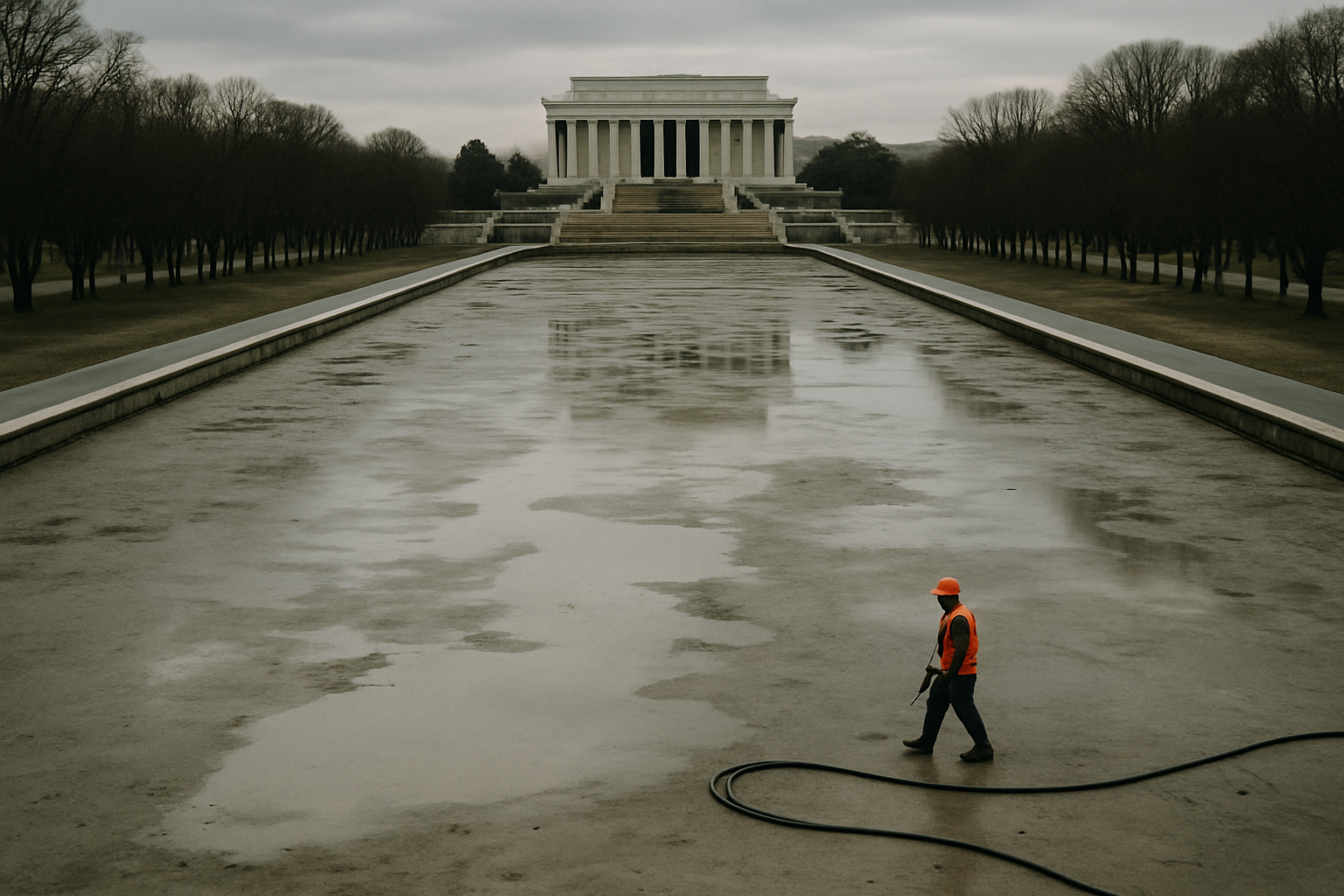
As of early August 2026, the iconic 6.5-million-gallon basin on the National Mall sits either empty or partially drained, ringed by fencing and privacy screens, with maintenance crews working under National Park Service (NPS) supervision. The operation marks the latest chapter in a frustrating cycle of repair and renewal for a landmark that, just weeks ago, emerged from a multimillion-dollar refurbishment only to fall victim to post–July 4 damage, stubborn algae growth and premature paint failures.
The draining is described by officials as part of an active maintenance and repair cycle triggered by damage sustained during Independence Day celebrations, recent vandalism and liner damage. Contractors are scrubbing algae, goose waste and fireworks debris from the basin, while specialists assess damage to the waterproof liner, paint and sealant — much of it work that was supposed to have been completed months ago.
For visitors arriving at the National Mall this summer, the scene is a study in anticlimax. Where the Capitol's reflection once shimmered across the water toward the memorial of Abraham Lincoln, there is now an emptied basin, the faint smell of algae treatment in the air, and workers in high-visibility vests moving across the concrete floor. The National Park Service has explicitly asked visitors not to walk in the drained basin, while ducks and other wildlife that had made the pool their home have been displaced.
A refurbishment unravelled in weeks
The current crisis is all the more striking because of what preceded it. The Reflecting Pool had just undergone what the National Park Service and its contractors hoped would be a definitive rehabilitation. A $14.7 million lining and resurfacing project, led by the Virginia-based firm Atlantic Industry Coatings, was meant to provide the pool with a fresh waterproof membrane, new paint and improved joints — a comprehensive fix designed to end decades of chronic leakage and water-quality problems.
That project was completed ahead of the summer season, timed not only for the annual July 4th celebrations but also for the broader America 250 commemorations, the nationwide observance of the United States' semiquincentennial, which have focused intense attention on the condition of the National Mall's premier monuments.
But within weeks, the refurbishment began to show alarming signs of distress. Officials and observers documented algae-linked paint flaking, damage to the liner, and cut sealant and caulk along the pool edges. The appearance of these defects so soon after a project of this scale raised immediate questions — both about the quality of the workmanship and about whether the underlying problems of water quality and environmental stress had been fully addressed.
Then came July 4th. The Independence Day festivities, which draw hundreds of thousands of visitors to the National Mall, left the pool littered with fireworks debris and other detritus. Reports also emerged of vandalism and liner damage, adding insult to the injury already caused by algae and paint failure.
By late July, federal officials concluded that the pool could not be allowed to simply sit and deteriorate. On a recent Monday, the District of Columbia Water and Sewer Authority — known as DC Water — granted permission for the pool to be drained once again, clearing the way for warranty repairs to proceed. Gravity drains and pumps were opened, and the slow evacuation of millions of gallons of water began.
The politics of a puddle
The Reflecting Pool's troubles have not gone unnoticed at the highest levels of the U.S. government. President Donald J. Trump has publicly framed the recent damage as the work of "vandals," warning that those responsible could face prison time. He has called for repairs to begin "immediately" and has weighed in on the tactical question of whether the pool should have been drained before or after the July 4 events — a sign that even the mechanics of pool maintenance have become a matter of presidential attention.
Secretary of the Interior Doug Burgum, whose department oversees the National Park Service, has also been drawn into the matter, confirming that crews began draining the pool and expressing support for the expedited repair effort. The Interior Department has been under significant pressure to ensure that the National Mall looks its best during the America 250 observances, and the spectacle of an empty, fenced-off Reflecting Pool is not the image officials had hoped to project.
The political framing has added a layer of contention to what is, at its core, a straightforward engineering and maintenance problem. Critics of the administration have pointed to the timing of the refurbishment and the rapidity of its failure as evidence of mismanagement or inadequate oversight, while supporters have argued that the defects are being addressed responsibly under warranty and that the administration is responding decisively to vandalism and wear.
What is not in dispute is that the pool is out of service for the foreseeable future. The National Park Service and Interior officials have not released a precise public date for completion of this latest maintenance round. Earlier guidance had tied refilling to the July 4 and America 250 commemorations, but the subsequent damage has extended the work well beyond that window. As of early August, the basin remains closed as a major visitor attraction.
Why the pool keeps failing
The Lincoln Memorial Reflecting Pool has a long and complicated history of water-management challenges, and its current troubles are best understood in that context.
The pool, which stretches approximately 2,000 feet from the Lincoln Memorial toward the Washington Monument, was completed in the 1920s as part of the monumental core of Washington, D.C. For much of its existence, it was plagued by leaks, algae blooms and water-quality issues — problems compounded by its shallow depth, which allows sunlight to penetrate and fuel aquatic growth, and by the constant presence of geese and other waterfowl that contribute waste to the basin.
Over the decades, the National Park Service has undertaken a series of increasingly ambitious rehabilitation projects. Earlier efforts in the 1980s and 1990s addressed leakage and structural integrity, but the pool's fundamental design continued to present challenges. The most recent project — the $14.7 million lining and resurfacing effort completed this year — was intended to be the definitive solution, incorporating modern waterproofing materials and improved filtration.
According to the research available, aquatic biologists and water management experts have been advising the National Park Service on algae control, including adjustments to the pool's ozone treatment system and consideration of alternative treatments. Their recommendations helped drive earlier decisions to fully drain and scrub the pool when algae persisted despite the installation of new filtration systems. In other words, the current draining is not an isolated event; it is part of an ongoing struggle to maintain water clarity and structural integrity in an environment that is, frankly, hostile to both.
The decision to drain the pool again so soon after the refurbishment reflects a recognition that the problems cannot be patched over. For the liner and coating defects to be properly addressed, the pool must be empty. Atlantic Industry Coatings, the contractor that led the resurfacing project, has publicly committed to returning to repair the liner and coating defects "as part of the warranty," according to officials. The firm is working with the National Park Service to address the algae-linked paint flaking, liner damage, and cut sealant and caulk along the pool edges — a task that requires a dry basin and careful inspection of every joint.
The permitting tango
One of the less visible but essential aspects of the current operation is the role of DC Water. Draining 6.5 million gallons of water from the heart of the nation's capital is not simply a matter of opening a valve. The water must go somewhere, and its discharge is subject to local environmental permitting and operational approvals.
The District of Columbia Water and Sewer Authority has jurisdiction over the sewer system and the Tidal Basin, and its permission is required for the pool's water to be released to either destination. According to the research, DC Water explicitly granted permission on a recent Monday for the pool to be drained again so that warranty repairs could proceed. The approval underscores the coordination required between federal agencies and local authorities whenever the National Mall undergoes significant maintenance.
The draining process itself relies on both gravity and pumps, a dual system designed to evacuate the basin efficiently while minimizing disruption to surrounding infrastructure. With the pool empty, crews can begin the painstaking work of cleaning algae, goose waste and fireworks debris from the basin floor, inspecting the liner for damage, and preparing the surface for repairs.
Impact on visitors and wildlife
The Reflecting Pool is far more than a functional water feature; it is a stage for American civic life. It has been the backdrop for presidential inaugurations, civil rights demonstrations, concerts and countless personal photographs. Its stillness and symmetry are central to the visual identity of the National Mall, and its temporary absence is keenly felt.
For the millions of visitors who descend on Washington each summer, the fenced-off basin is a disappointment and a logistical nuisance. Pedestrian access around the pool is constrained, and the usual vantage points for photographing the Lincoln Memorial's reflection are unavailable. Families who planned their trips around the classic Mall experience are finding a construction zone instead.
The fencing is fitted with privacy screens, which officials say are intended both to manage expectations and to prevent people from entering the drained basin. The National Park Service has been explicit in its visitor messaging: do not walk in the pool. The request is not merely about safety — though the basin floor, with its pumps, drains and equipment, presents real hazards — but also about protecting the repair work from interference.
Local wildlife has also been affected. The pool, despite its periodic cleaning cycles, had become home to a population of ducks and other waterfowl that have now been displaced. While the National Mall offers other water sources, including the Tidal Basin, the loss of the Reflecting Pool as habitat is part of the broader disruption caused by the maintenance.
A reflection on accountability
The rapid failure of the refurbishment has inevitably raised questions about oversight and quality control. The project was large and expensive, and it was intended to deliver decades of service. The appearance of paint flaking and liner damage within weeks of completion is, at minimum, an embarrassment for all involved; at worst, it suggests systemic issues in the contracting, inspection or specification process.
Atlantic Industry Coatings has sought to manage the fallout by committing to warranty repairs, a response that shifts the immediate financial burden to the contractor but does little to restore confidence in the durability of the work. The National Park Service, for its part, has emphasized that the defects are being addressed and that the pool will be restored to full operation as quickly as possible.
There is also the question of whether the pool's design itself is sustainable. Some water management experts have long argued that a shallow, open-air reflecting pool in the middle of a city, subject to bird waste, airborne pollutants, algae spores and heavy public use, will require constant maintenance no matter how well it is built. The current cycle of drain, clean, repair and refill may be the natural rhythm of such a feature — an expensive but unavoidable reality of maintaining one of the world's most famous reflecting pools.
What happens next
For now, the immediate priority is the repair work itself. With the pool drained, contractors will conduct a thorough inspection of the liner, identify all areas of damage, and carry out the necessary repairs under warranty. The cleaning process will remove the organic debris and algae that have accumulated, and the sealants and caulking along the edges will be repaired or replaced.
Once the repairs are complete and the pool passes inspection, the refilling process can begin. That is not a quick operation: reintroducing 6.5 million gallons of water takes time, and the water will need to be treated and brought into chemical balance before the pool can be reopened to the public. The National Park Service has not announced a target date, and officials have been careful not to repeat the mistake of promising a completion time that subsequent developments might upend.
The broader context is the America 250 celebration, which continues through 2026 and has made the condition of the National Mall a matter of national pride and international attention. An empty Reflecting Pool during this milestone year is far from ideal for the U.S. Department of the Interior, which has been briefing media on the rationale and scheduling of the deep clean and resurfacing ahead of major national celebrations. The hope is that this round of repairs will be the last for some time — that the warranty work will finally deliver the durable, clear-water pool that the refurbishment promised.
But history offers caution. The Reflecting Pool has been drained and repaired many times over its century of existence, and each time officials have expressed hope that the fix would be permanent. The forces arrayed against it — sunlight, algae, geese, weather, vandals and the sheer volume of human affection that brings millions of visitors to its edge — are relentless.
What happens next will depend on the quality of the repairs, the effectiveness of the algae-control measures, and the vigilance of the agencies responsible for the pool's care. For the millions who come to Washington to stand at the feet of Lincoln and look across the water, the hope is that the view will soon be restored. For the officials and contractors involved, the stakes are equally clear: the eyes of the nation — and the world — are on this stretch of water.