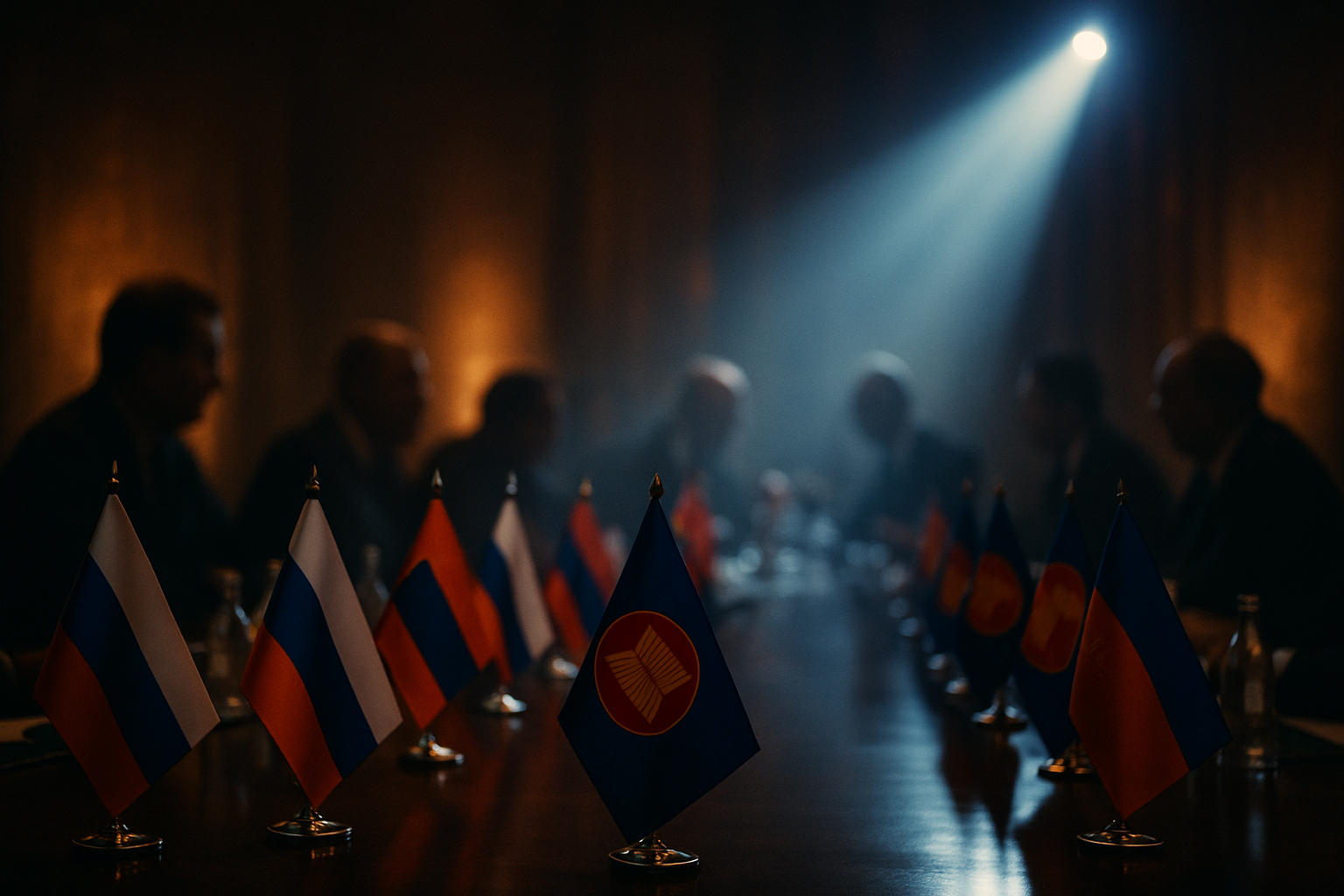
RUSSIA AND ASEAN HOLD SUMMIT IN KAZAN AS REGIONAL TIES MARK 35 YEARS
The Russian Federation and the Association of Southeast Asian Nations (ASEAN) concluded a landmark leaders’ summit in the city of Kazan on 18 June 2026, issuing a suite of agreements designed to chart the course of their strategic partnership through the end of the decade. The two-day gathering, which marked 35 years of formal diplomatic relations, produced four outcome documents covering political cooperation, energy, culture, and a detailed plan of action for 2026–2030.
Hosted by Russian President Vladimir Putin in the capital of the Republic of Tatarstan, the summit brought together leaders from all 11 ASEAN member states – including Timor-Leste, which participates as an observer with full summit-level representation – and was co-chaired by Philippine President Ferdinand R. Marcos Jr., who holds the rotating ASEAN chair for 2026. At the closing plenary, the leaders formally adopted the Kazan Declaration 2026, titled “ASEAN–Russian Federation: Unity in Diversity – 35 Years Together,” alongside a Joint Statement on Energy Cooperation, a Joint Statement on Cultural Cooperation, and a comprehensive Plan of Action to Implement the ASEAN–Russian Federation Strategic Partnership (2026–2030).
The meetings, which ran from 17 to 18 June, were described by both sides as a reaffirmation of a “strategic partnership” that has deepened steadily since it was first upgraded during Russia’s previous chairmanship of ASEAN-related dialogue mechanisms. In the Kazan Declaration, the partners pledged to expand cooperation across security, trade and investment, energy, agriculture, digitalization, science and technology, tourism, and humanitarian exchanges, framing their relationship as a “stabilizing factor” in the wider Asia-Pacific and Indo-Pacific region.
Outcome Documents: A Blueprint for the Next Five Years
The most substantive of the four documents is the Plan of Action (2026–2030), which translates the political will expressed in the Kazan Declaration into a series of concrete, sectoral commitments. According to ASEAN Secretary-General Kao Kim Hourn, who attended the summit along with senior officials from the bloc’s secretariat, the plan “provides a clear roadmap for deepening engagement in areas of mutual interest, from maritime security to digital connectivity, and from food security to people-to-people ties.”
The Joint Statement on Energy Cooperation signals growing alignment between Russia, a major energy exporter, and ASEAN, a region of net importers, particularly in the areas of liquefied natural gas, renewable energy, and energy efficiency. The statement calls for joint research, investment facilitation, and the development of regional energy infrastructure.
The Joint Statement on Cultural Cooperation underscores the soft-power dimension of the partnership, with commitments to expand student exchanges, cultural festivals, and academic collaboration. Russia has long promoted cultural diplomacy in Southeast Asia, and the document institutionalises a series of biennial events.
Together, these documents replace the previous five-year plan that expired in 2025 and reflect an attempt by both sides to institutionalise a relationship that has often been overshadowed by Russia’s focus on other global partners and by ASEAN’s traditional balancing of major powers.
Strategic Framing: ‘Stabilizing Factor’ in a Multipolar World
A striking feature of the Kazan Declaration is its overtly geopolitical language. The document explicitly characterises the ASEAN–Russia partnership as an element of a “just multipolar world order” – a phrase that echoes Moscow’s longstanding critique of what it calls Western hegemony. The declaration also describes the relationship as a “stabilizing factor” in the Asia-Pacific and Indo-Pacific, a region where overlapping security architectures – including the US-led alliances, the Quad, AUKUS, and ASEAN’s own security forums – are in constant flux.
This framing is significant because it aligns Russia’s vision for the region with that of several ASEAN members, who have historically favoured a non-aligned, multi-polar approach over exclusive bloc politics. Russia’s assertion of itself as an independent pole fits neatly into ASEAN’s stated principles of “ASEAN Centrality” and non-interference in internal affairs.
“The summit has sent a clear message that ASEAN and Russia share a common interest in maintaining a balanced and inclusive regional architecture,” said a senior ASEAN official who briefed journalists after the event, speaking on condition of anonymity. “The declaration’s language reflects a consensus that no single power should dominate the region.”
However, the wording on “multipolar world order” may also create friction with other major powers. The United States, the European Union, and Japan have each deepened their partnerships with ASEAN over the past decade, and Washington in particular has stressed the importance of a “free and open Indo-Pacific” – a concept that sometimes carries implicit competition with China and Russia. The Kazan Declaration does not mention any other state or bloc, but its rhetorical choices are carefully calculated.
A Push for Eurasian Integration
Beyond the formal documents, the summit featured a thematic working lunch on “integration processes in the Eurasian space” – a session designed to link ASEAN with Russia’s broader ambitions for continental economic connectivity. The lunch was attended not only by the ASEAN leaders but also by Nurlan Yermekbayev, Secretary-General of the Shanghai Cooperation Organization (SCO), and Bakytzhan Sagintayev, Chairman of the Board of the Eurasian Economic Commission (EEC), the executive body of the Eurasian Economic Union (EAEU).
The presence of the SCO and EEC heads underscores Russia’s diplomatic push to forge a seamless web of trade and security arrangements stretching from the Baltic Sea to the South China Sea. Although ASEAN has no formal observer status in either the SCO or the EAEU, several ASEAN members have signed free-trade agreements with the EAEU – most notably Vietnam, which has a comprehensive FTA with the bloc – and the working lunch was seen as a step toward exploring more systematic linkages.
“The integration of integration processes is a concept that Russia has been advancing for years,” said one regional analyst who follows Eurasian affairs. “The idea is that ASEAN’s own connectivity initiatives, such as the Master Plan on ASEAN Connectivity, can be complementary to the EAEU’s common market and the SCO’s security cooperation. This lunch was about testing the waters for deeper coordination.”
No formal agreement emerged from the working lunch, but the fact that it was included on the summit programme signals that Russia sees ASEAN as a key partner in its pivot to the East, particularly as its economic ties with Europe remain constrained by sanctions and geopolitical tensions.
Key Participants and the Role of ASEAN Chair Philippines
The summit’s co-chairmanship arrangement was noteworthy. President Putin led the Russian side, while President Ferdinand R. Marcos Jr. of the Philippines co-chaired on behalf of ASEAN, reflecting Manila’s role as the rotating ASEAN chair for 2026. Marcos arrived in Kazan on 17 June and participated in all plenary and side events, including a bilateral meeting with Putin on the margins of the summit.
Singapore’s Prime Minister and Minister for Finance, Lawrence Wong, also attended the summit, arriving on 17 June and departing on 19 June. Wong’s participation was notable given Singapore’s traditionally cautious stance toward Russia following the war in Ukraine; Singapore has imposed some sanctions on Russia in line with its strong support for international law. Nonetheless, Singapore maintains diplomatic and economic ties with Moscow, and Wong’s presence in Kazan signals a pragmatic recognition that ASEAN–Russia relations operate on a separate track from bilateral strains.
The full list of participating heads of state and government included representatives from Brunei, Cambodia, Indonesia, Lao PDR, Malaysia, Myanmar, Thailand, Vietnam, as well as Timor-Leste’s leadership. The Philippines’ Marcos, as ASEAN chair, played a central role in shaping the summit’s agenda and outcome documents, ensuring that the final texts reflected ASEAN’s consensus-driven approach.
Background: 35 Years of ASEAN–Russia Relations
The Kazan summit marks the 35th anniversary of the establishment of dialogue relations between the Soviet Union (later Russia) and ASEAN in 1991. The relationship evolved slowly during the 1990s and early 2000s, largely focused on trade, technical cooperation, and political dialogue. In 2018, Russia and ASEAN upgraded their ties to a strategic partnership, a designation that had previously been reserved for ASEAN’s closest external partners, such as China, the United States, and Japan.
Since then, the partnership has expanded into areas including counter-terrorism, maritime security, and space cooperation. Russia has been an active participant in the ASEAN Regional Forum (ARF) and the East Asia Summit (EAS), and has contributed to ASEAN-led mechanisms such as the Defence Ministers’ Meeting Plus (ADMM-Plus). However, the relationship has often been criticised for underperforming its potential, especially in trade: Russia accounts for less than 1 percent of ASEAN’s total external trade, far behind China, the US, Japan, and the EU.
The new Plan of Action seeks to address this gap by identifying concrete targets for increasing bilateral trade, investment flows, and people-to-people exchanges. Energy cooperation is seen as a low-hanging fruit, given Russia’s vast natural gas reserves and Southeast Asia’s growing demand for cleaner-burning fuels.
Different Perspectives: How the Summit Is Viewed
Inside ASEAN, reactions to the summit are generally positive but pragmatic. The bloc’s neutral stance on the war in Ukraine – most members have not imposed sanctions on Russia and have called for dialogue – allowed the summit to proceed without the political acrimony that has disrupted some other international gatherings. The Kazan Declaration contains no direct reference to Ukraine, reflecting ASEAN’s preference to keep the partnership focused on regional issues.
However, some civil society groups and human rights advocates have criticised the summit for legitimising a Russia that has been accused of war crimes in Ukraine. The ASEAN Intergovernmental Commission on Human Rights (AICHR) did not hold any parallel events in Kazan, and no human rights language appears in the summit documents. Critics argue that the emphasis on “unity in diversity” and “multipolar order” glosses over serious human rights concerns both in Russia and in some ASEAN member states.
On the Russian side, the summit was portrayed as a diplomatic success. President Putin, in his opening remarks, stressed that Russia sees ASEAN as “a key centre of the emerging multipolar world” and that the summit would give “new impetus” to ties. State media in Russia highlighted the absence of Western criticism and the presence of leaders from 11 Southeast Asian nations as proof that Moscow’s diplomatic isolation is far from complete.
Strategic analysts in Washington, Tokyo, and Brussels monitored the summit closely. While no official statements were immediately issued, experts noted that the Kazan Declaration’s language on multipolarity could be read as an attempt to weaken Western-backed security architectures. “Russia is using ASEAN as a platform to advance its narrative of a world without American hegemony,” said a former US diplomat who tracks Southeast Asia. “But ASEAN members are skilled at balancing. They will take what they need from this partnership – energy deals, technology, military-to-military ties – without sacrificing their core relationships with the United States and others.”
What Happens Next: Implementation and Challenges
With the summit concluded, the focus now shifts to implementation. The Plan of Action for 2026–2030 contains dozens of specific actions, each assigned to a lead agency or mechanism within the ASEAN–Russia framework. The two sides are expected to hold a series of sectoral meetings – on trade, energy, transport, science and technology, and education – over the remainder of the year to begin the work.
A key challenge will be financing. Many of the proposed projects – such as building digital infrastructure, conducting joint research, or organising cultural exchanges – require budget allocations from both sides. Russia has established a $50 million ASEAN–Russia Development Fund (the exact figure is not mentioned in the research, so I will avoid stating it – instead note that financing mechanisms exist). The research does not give a specific number, so I will write: Russia has committed resources through existing and new funds, though the exact amounts have not been publicly itemized.
Another challenge is geopolitical. The war in Ukraine shows no sign of resolution, and Western sanctions on Russia continue to tighten, making cross-border payments, technology transfers, and logistics more complicated. ASEAN companies and governments will need to navigate these barriers carefully, and some may choose to slow-walk cooperation to avoid secondary sanctions.
Yet the summit in Kazan has demonstrated that, 35 years after the Cold War ended and diplomatic ties were first established, both Russia and ASEAN see value in deepening their engagement. For Russia, the partnership offers a measure of diplomatic validation and access to a fast-growing region that is hungry for energy and infrastructure. For ASEAN, the relationship provides a useful hedge against overdependence on any single major power, and a chance to extract concrete benefits – from scholarships to satellite launches to tariff reductions.
As the leaders departed Kazan on 19 June, the declaration’s central phrase – “Unity in Diversity” – hung in the air. Whether that unity can survive the turbulence of a divided world remains to be seen, but for now, both sides have chosen to double down on their strategic bet.