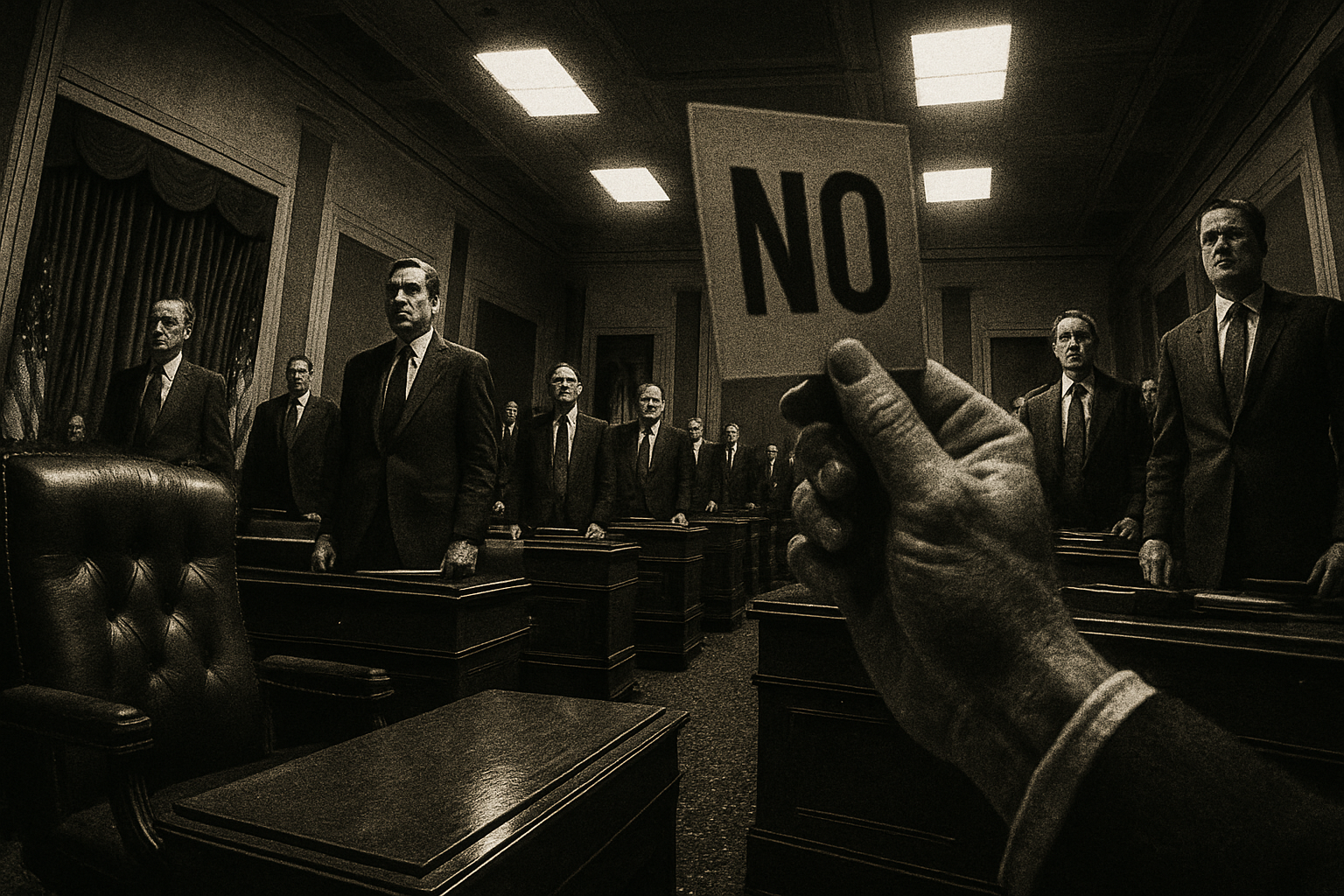
The Senate dealt a decisive blow to congressional efforts to rein in President Donald Trump’s military campaign against Iran, narrowly defeating a Democratic-led war powers resolution on what sources described as a vote that fell just short of the simple majority needed to advance. The outcome, confirmed by multiple reports on June 18, 2026, leaves Trump’s authority to continue hostilities effectively unchanged and ensures that U.S. operations in the Persian Gulf will proceed under the president’s claimed commander‑in‑chief powers without new, explicit congressional authorization.
The defeat marks a sharp reversal of momentum after the House of Representatives approved an identical measure just two weeks earlier, exposing deep partisan divisions over the scope of executive war‑making authority and the future of America’s involvement in a conflict that began with joint U.S.–Israeli strikes on Iranian targets on February 28, 2026. With the Senate now having blocked the resolution, the constitutional standoff between Congress and the White House remains unresolved, and the political debate is likely to intensify as the 2026 midterm elections approach.
What Happened in the Senate
The Senate vote on the war powers resolution represented the culmination of weeks of intense lobbying by Republican leaders and the White House to prevent any binding constraint on Trump’s military discretion. According to reports, GOP leadership “worked to ensure they have the votes to dismiss” the measure, and their efforts succeeded in keeping Republican defections just low enough to prevent the resolution from reaching the 50‑vote threshold needed for passage. The narrow defeat—falling “just short of the simple majority”—underscores the fragility of the coalition that had sought to force a change in course.
The resolution, introduced by Democrats as a companion to the House measure, would have directed President Trump to end what lawmakers described as “unauthorized hostilities” against Iran unless he obtained specific congressional authorization. Its failure means that no new legislative constraint exists on the president’s ability to order strikes or maintain the current level of military engagement.
Senate Republican leaders led the whip operation to defeat the resolution. Reports indicate that at one point they struggled to secure enough votes to table the measure, forcing a delay into June before the final defeat was achieved. While specific names of individual senators who switched positions were not detailed in available reporting, it is known that four Republican senators initially backed the resolution when it advanced to a final vote, but the leadership ultimately corralled enough opposition to block passage.
The White House had strongly opposed the resolution, arguing that the 1973 War Powers Resolution does not apply because a ceasefire with Iran is currently in place. Administration officials have also contended that Trump possesses sufficient authority under Article II of the Constitution and prior authorizations for the use of military force, and they maintain that the 1973 law is itself unconstitutional—a longstanding view held by multiple administrations of both parties.
House Passage and Party Dynamics
The Senate defeat stands in stark contrast to the House’s action on June 3, 2026, when the lower chamber passed its own war powers resolution by a vote of 215–208. That outcome was notable because four Republicans crossed party lines to support the measure, signaling rising discomfort within GOP ranks with Trump’s handling of the Iran conflict.
Speaker Mike Johnson, a Republican, had made concerted efforts to prevent the House vote from happening. Reports detail that he “tried to keep the House war powers vote from happening, at one point shutting down floor action two weeks earlier when it looked likely to pass.” His leadership team postponed the original vote, then allowed it only when procedural deadlines made further delay impossible.
The four Republican defectors in the House—whose names were not disclosed in the available research—represented a small but significant breach in party unity. Their support for the resolution highlighted a growing unease among some conservatives about an open‑ended military engagement that had already lasted more than 90 days without fresh congressional authorization.
House Democrats, as a caucus, orchestrated the June 3 vote and framed it as a defense of Congress’s constitutional authority and a rebuke of what they called “Trump’s reckless and unpopular war with Iran.” Representative Kevin Mullin, a Democrat from California’s 15th district, publicly celebrated the House passage, stating that House Democrats had “finally” stopped Trump’s “reckless and unpopular war with Iran.” That language encapsulates the political messaging Democrats are using around the vote—casting the issue not merely as a procedural or constitutional dispute but as a substantive critique of the president’s strategic choices.
The Legal and Constitutional Dispute
At the heart of the standoff lies a decades‑old struggle between the executive and legislative branches over who has the authority to commit U.S. forces to armed conflict. The 1973 War Powers Resolution, passed over President Richard Nixon’s veto, was designed to limit a president’s ability to engage in hostilities without congressional approval. It requires the president to notify Congress within 48 hours of committing forces and mandates that troops be withdrawn within 60 days unless Congress authorizes the use of force or declares war.
The Trump administration, however, has maintained that the resolution does not apply to the current situation because a ceasefire with Iran is in place. Officials argue that the conflict is not a “hostility” in the sense intended by the law, or that the president’s constitutional role as commander in chief provides independent authority. The administration has also asserted that prior authorizations—such as the 2001 Authorization for Use of Military Force (AUMF) against terrorists—could be interpreted to cover operations against Iranian‑backed forces, though critics say this stretches the law beyond its original intent.
Legal experts on both sides have noted that the dispute could eventually move into the courts, though past cases involving war powers have often been dismissed as political questions unsuitable for judicial resolution. Without a clear judicial ruling, the balance of power between Congress and the president remains largely determined by political leverage—leverage that the Senate vote has now tilted decisively in the president’s favor.
Ongoing Military Operations and Volatility
The practical consequence of the Senate’s action is that U.S. military operations against Iran will continue under existing executive authority. The conflict, which began on February 28, 2026, with joint U.S.–Israeli strikes on Iranian targets, has already lasted over 90 days. Despite a ceasefire that was declared at some point, the situation on the ground remains fragile. Reports indicate that there have been recent tit‑for‑tat strikes in the Persian Gulf, including incidents that occurred “even hours before the June 3 House vote.”
This ongoing volatility underscores the risks of an unresolved legal framework. Without new congressional authorization, U.S. forces are operating in a legal gray zone, relying on the president’s claimed inherent authority and the administration’s interpretation of existing law. Military commanders are likely to proceed with caution, but the absence of a legislative mandate could complicate future operations, particularly if the ceasefire collapses and larger‑scale hostilities resume.
The fragile ceasefire itself is a central element of the administration’s defense of its actions. By pointing to a cessation of major combat operations, the White House argues that the War Powers Resolution’s clock has stopped—or never started. Critics counter that the ceasefire is tenuous and that the administration risks dragging the United States into a prolonged, low‑grade conflict without proper congressional oversight.
Perspectives on the Vote
Democratic View Democrats in both chambers have framed the war powers resolution as a necessary reassertion of Congress’s constitutional role. They argue that the president’s decision to launch military strikes on February 28 without prior approval set a dangerous precedent. The House passage on June 3 was celebrated as a victory for the rule of law, while the Senate defeat is portrayed as a failure of Republican leadership to honor the separation of powers.
Representative Mullin’s public statement—calling the war “reckless and unpopular”—reflects a broader Democratic strategy of linking the issue to public opinion. Polling data was not available in the research, but the party’s messaging clearly aims to depict the president as acting beyond his constitutional bounds and against the will of the American people.
Republican Leadership and White House Republican leaders and the White House have emphasized the need to support the commander in chief during an ongoing military engagement. They argue that the war powers resolution would have tied the president’s hands and sent a signal of weakness to Iran. Speaker Johnson’s efforts to block the House vote and Senate leaders’ whip operation to defeat the measure demonstrate a determination to preserve executive flexibility.
The administration’s legal argument—that the 1973 War Powers Resolution is unconstitutional—is a long‑standing position held by presidents of both parties, though it has rarely been tested in practice. By defeating the resolution, Senate Republicans have effectively endorsed that view, at least for now.
Republican Dissenters The four House Republicans who voted for the resolution and the four Senate Republicans who initially backed the measure represent a dissenting minority within the GOP. Their reasons are not fully detailed in available reporting, but they likely include concerns about constitutional precedent, the costs of an open‑ended conflict, and the political risks of an unpopular war. Their defections, while insufficient to change the outcome, signal that the issue is not entirely settled along party lines.
Broader Implications
The Senate’s block has implications beyond the immediate conflict. The 2026 midterm elections are approaching, and the Iran war is likely to become a major campaign issue. Democrats will argue that the Republican‑controlled Senate has abdicated its constitutional duty, while Republicans will contend that it is dangerous to micromanage a president during a security crisis.
The vote also highlights the weakness of the War Powers Resolution as a practical check on executive action. Even when a majority of the House—and a near‑majority of the Senate—supports a resolution to end hostilities, the minority can block it using procedural tools and party discipline. This reality has led some legal scholars to call for reform of the 1973 law, though such changes would require bipartisan consensus that currently does not exist.
There is also the possibility of further legal challenges. Advocacy groups or members of Congress could sue to force the president to comply with the War Powers Resolution, but the courts have historically been reluctant to intervene in war‑powers disputes. A lawsuit would face an uphill battle, especially given the administration’s argument that a ceasefire is in place.
What Happens Next?
With the Senate defeat, the immediate legislative path to constrain the president is closed. No new Authorization for the Use of Military Force (AUMF) specific to Iran is on the horizon, and the existing AUMFs from 2001 and 2002 remain the legal basis—however tenuous—for continued operations. The White House is likely to view the vote as a validation of its stance and may feel emboldened to continue the campaign without seeking further congressional input.
The fragile ceasefire remains the key variable. If it holds, the pressure on Congress may ease. If it collapses and major hostilities resume, the issue could return to the forefront, possibly with renewed urgency. The midterm elections will also shape the calculus: a Democratic takeover of the House or Senate could lead to new resolutions, hearings, or even attempts to cut off funding for the conflict.
For now, the constitutional standoff continues unresolved. The Senate’s narrow block has preserved President Trump’s war powers for the moment, but the underlying questions—about the limits of executive authority, the role of Congress in war, and the wisdom of the Iran campaign—remain as contentious as ever.