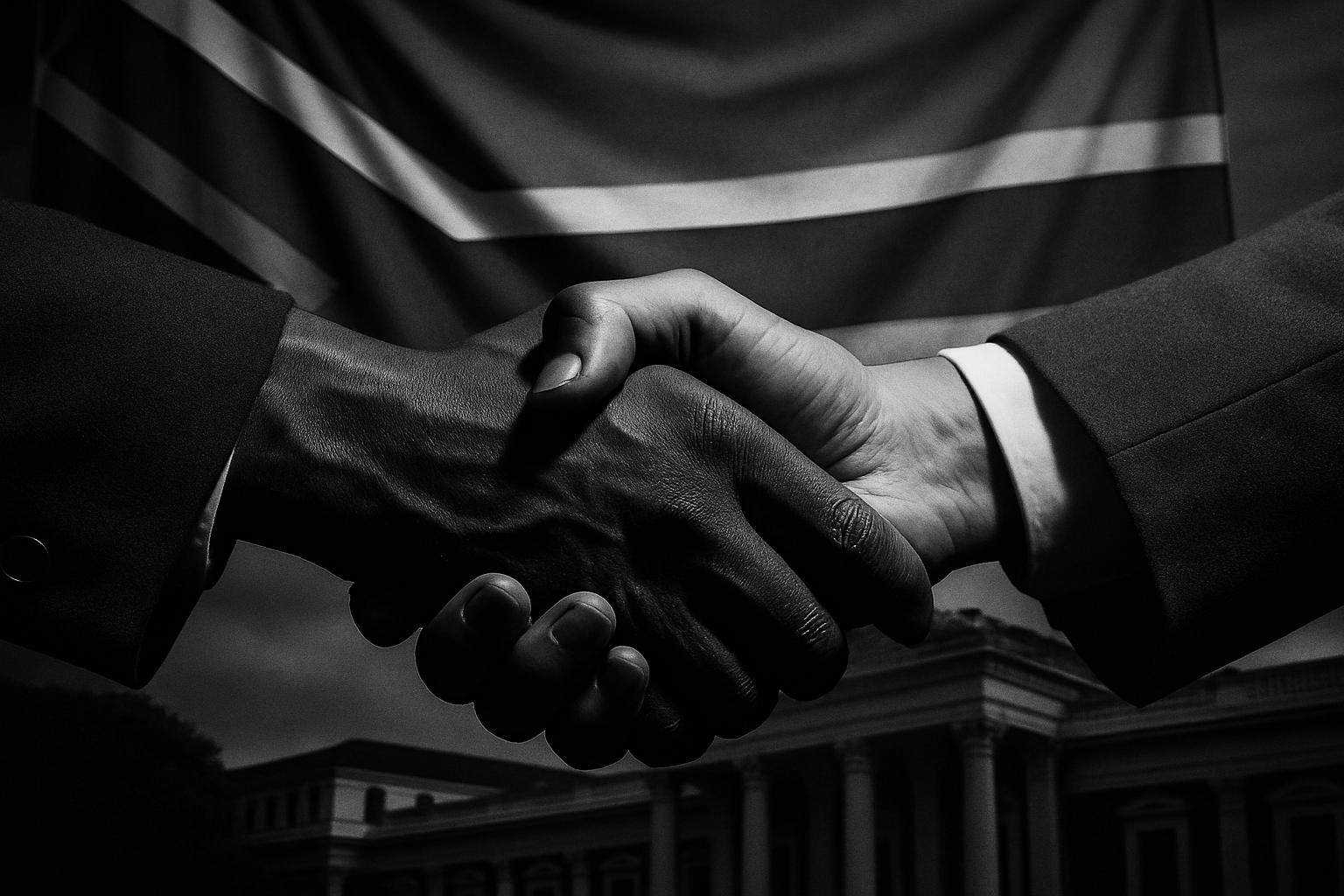
South Africa’s ANC and DA formally sign coalition agreement to form government
For the first time in South Africa’s democratic history, the African National Congress (ANC) and the Democratic Alliance (DA) – long-time political adversaries – have entered a formal power-sharing arrangement at the national level, consolidating a broad Government of National Unity (GNU) that keeps President Cyril Ramaphosa in office while bringing the DA into the executive for the first time since the end of apartheid.
The agreement, signed after weeks of intensive negotiations following the May 29, 2024 general election, marks a dramatic shift in the country’s political landscape. The ANC, which had governed uninterrupted since 1994, lost its parliamentary majority for the first time, falling to around 40 percent of the vote and 159 seats out of 400. The DA, the main opposition with roughly 22 percent of the vote, has now become a governing partner, alongside smaller parties including the Inkatha Freedom Party (IFP) and the Patriotic Alliance (PA).
The arrangement is being publicly framed by its signatories as a platform for “fundamental reform” and pro-growth, pro-investment economic policy. But it has also drawn sharp criticism from more radical opposition forces on both the left and right, who describe it as a “sell-out” that betrays the ideological identities of the parties involved.
What is happening now: the structure of the GNU
As of mid-2026, South Africa is governed by a multi-party Government of National Unity in which the ANC remains the largest party but holds no overall majority. The coalition is anchored by the formal statement of intent signed by the ANC and DA, joined by the IFP and the PA. This arrangement extends beyond the national level: in Gauteng and KwaZulu-Natal provinces, where the ANC also lost outright control, similar coalition governments involving the DA and IFP have been formed.
The most immediate and visible proof of cooperation between the ANC and DA came when the new parliament convened. The ANC nominated Thoko Didiza as Speaker of the National Assembly, and the DA agreed to support her election. In a reciprocal gesture, the ANC backed the DA’s Annelie Lotriet as Deputy Speaker. These appointments were carefully choreographed to demonstrate that the two parties could work together on procedural matters – a necessary first step before negotiating the more contentious details of policy and cabinet posts.
Under the agreement, the DA has been allocated cabinet posts and senior parliamentary positions roughly proportional to its seat share. This includes roles in the National Assembly, the National Council of Provinces, and portfolio committees. The exact distribution of ministries has been a subject of intense bargaining, with the DA seeking key economic portfolios such as finance, trade and industry, and public enterprises – departments that would allow it to influence the very economic reforms it has long advocated.
Key figures and organizations driving the deal
At the center of the GNU is President Cyril Ramaphosa, who was re-elected by the National Assembly as part of the coalition agreement. Ramaphosa, who also leads the ANC, had staked his political credibility on forging a broad unity government after the election results made clear that the ANC could no longer govern alone. The ANC’s National Executive Committee (NEC) endorsed negotiations for a wide GNU and rejected any partner that demanded Ramaphosa’s resignation as a condition of joining – a stipulation that effectively ruled out more radical left-wing parties such as the Economic Freedom Fighters (EFF), which had called for Ramaphosa to step down.
On the DA side, Federal Leader John Steenhuisen announced that “after two weeks of thorough negotiations” the party had signed the statement of intent to form a GNU with the ANC, IFP and others, and that the DA would “now enter national government.” This represented a major strategic shift for a party that had spent decades positioning itself as the ANC’s primary antagonist, often accusing the ruling party of corruption, mismanagement and state capture.
Helen Zille, Chair of the DA Federal Council, added in June 2024 that the partners would negotiate a detailed programme of government over the following six weeks. Zille, a former Premier of the Western Cape and a veteran of South African politics, has been a key figure in steering the DA toward a more pragmatic, coalition-friendly stance – a position that has not been without internal controversy within the party.
The IFP, a conservative, Zulu-based party that secured about 4 percent of the national vote in the 2024 election, also joined the GNU. The IFP has historically governed KwaZulu-Natal in coalition with the ANC in previous years and brings regional credibility and a stabilizing influence in that province. The Patriotic Alliance, a smaller party drawing support mainly from coloured communities, has also been included as a partner at both national and local levels.
Background: how South Africa reached this point
The 2024 general election was a watershed. The ANC’s vote share fell from 57.5 percent in 2019 to about 39.7 to 40 percent in 2024, translating to 159 seats – a loss of 71 seats. This was the first time the party had fallen below 50 percent since the advent of democracy in 1994. The decline was driven by a combination of factors: persistent unemployment, rolling electricity blackouts, corruption scandals, and a sense among many South Africans that the ANC had failed to deliver on its promises of a better life for all.
The DA, meanwhile, increased its vote share slightly to around 22 percent, but not enough to form a government on its own or even in a straightforward coalition with other opposition parties. The arithmetic of the new parliament forced the ANC to seek partners, and the DA – despite their history of bitter rivalry – emerged as the most stable and ideologically compatible option for a broad-based coalition.
The concept of a Government of National Unity is not new to South Africa. After the 1994 elections, the ANC, the National Party and the IFP formed a GNU that lasted until 1996, when the National Party withdrew. That arrangement was designed to manage the transition from apartheid to democracy. The current GNU, by contrast, is a response to a different challenge: how to govern in a fragmented political landscape where no single party commands a majority.
Why this agreement matters
The inclusion of the DA in national government is historically significant. The DA grew out of the Democratic Party, which itself traces its roots to liberal anti-apartheid movements, but it has often been perceived – and criticized – as a party that primarily represents the interests of white, middle-class and coloured voters. For the ANC, sharing power with the DA represents a major ideological departure, given that the DA has long been a fierce critic of ANC policies on affirmative action, land reform, and the role of the state in the economy.
Nevertheless, the two parties share common ground on certain key issues: both are committed to constitutional democracy, respect for property rights, and a market-oriented economy (though the ANC’s commitment to the latter has wavered under pressure from its left flank). The GNU’s stated focus on “fundamental reform” and “pro-growth, pro-investment economic policy” suggests that the DA will push for accelerated liberalization, privatization or restructuring of state-owned enterprises, and measures to improve the ease of doing business.
For international investors and foreign governments, the GNU offers a degree of policy predictability that had been lacking during the latter years of ANC single-party rule. The presence of the DA in government is likely to be seen as a moderating influence, reducing the risk of populist economic policies or expropriation without compensation. Early signals from the coalition include a commitment to fiscal discipline and to addressing the crippling energy crisis that has plagued South Africa for years.
Different perspectives: support and criticism
Unsurprisingly, the GNU has drawn both praise and condemnation from across the political spectrum.
Supporters – including many in the business community and the centrist commentariat – argue that the coalition represents a mature response to the reality of a multiparty democracy. They contend that the ANC and DA, despite their differences, are both committed to the rule of law and constitutional governance, and that their cooperation can deliver the stability and reform that South Africa desperately needs. They point to the successful operation of coalition governments in other countries – such as Germany, India, and Kenya – as evidence that such arrangements can work even between ideologically diverse partners.
Critics on the left, particularly from the Economic Freedom Fighters (EFF) and the radical flank of the ANC’s own trade union and Communist Party allies, see the GNU as a betrayal of the liberation struggle. They argue that the DA’s economic policies – which they characterize as neoliberal and pro-business – will exacerbate inequality and harm the poor. The EFF has accused the ANC of abandoning its commitment to “radical economic transformation” in favor of a partnership with a party that, in their view, represents entrenched white privilege.
On the right, the DA faces its own internal dissent. Some DA members and grassroots supporters view the alliance with the ANC as an unacceptable compromise of the party’s values. They fear that the DA will be tainted by association with an ANC that many still consider corrupt and incompetent. The DA’s more libertarian and conservative factions have warned that the party risks losing its identity and its base if it is seen as propping up the ANC.
The IFP and PA, as smaller partners, have generally welcomed the GNU, seeing it as an opportunity to influence policy and secure resources for their constituencies. The IFP, in particular, has a history of pragmatic coalition-building and is likely to play a mediating role between the ANC and DA.
What happens next
The GNU is still in its early stages. The partners have committed to negotiating a detailed programme of government over the coming weeks and months. Key policy areas that will test the coalition include:
The coalition’s stability will depend on the ability of the ANC and DA to manage these differences without breaking the agreement. Both parties have an incentive to make it work: the ANC knows it cannot govern alone, and the DA sees this as a historic opportunity to prove it can govern responsibly. However, if the partnership becomes too strained – for example, if the ANC’s left flank rebels or if the DA’s base revolts – the GNU could collapse, potentially triggering early elections.
For now, the mood in Pretoria is cautiously optimistic. The signing of the coalition agreement ended months of political uncertainty and provided a clear path forward. The real test will come when the partners must make hard choices on policy. But for the first time in three decades, South Africa has a government that, by design, encompasses both the party of liberation and its most prominent democratic critic. Whether that experiment succeeds or fails will shape the country’s trajectory for years to come.