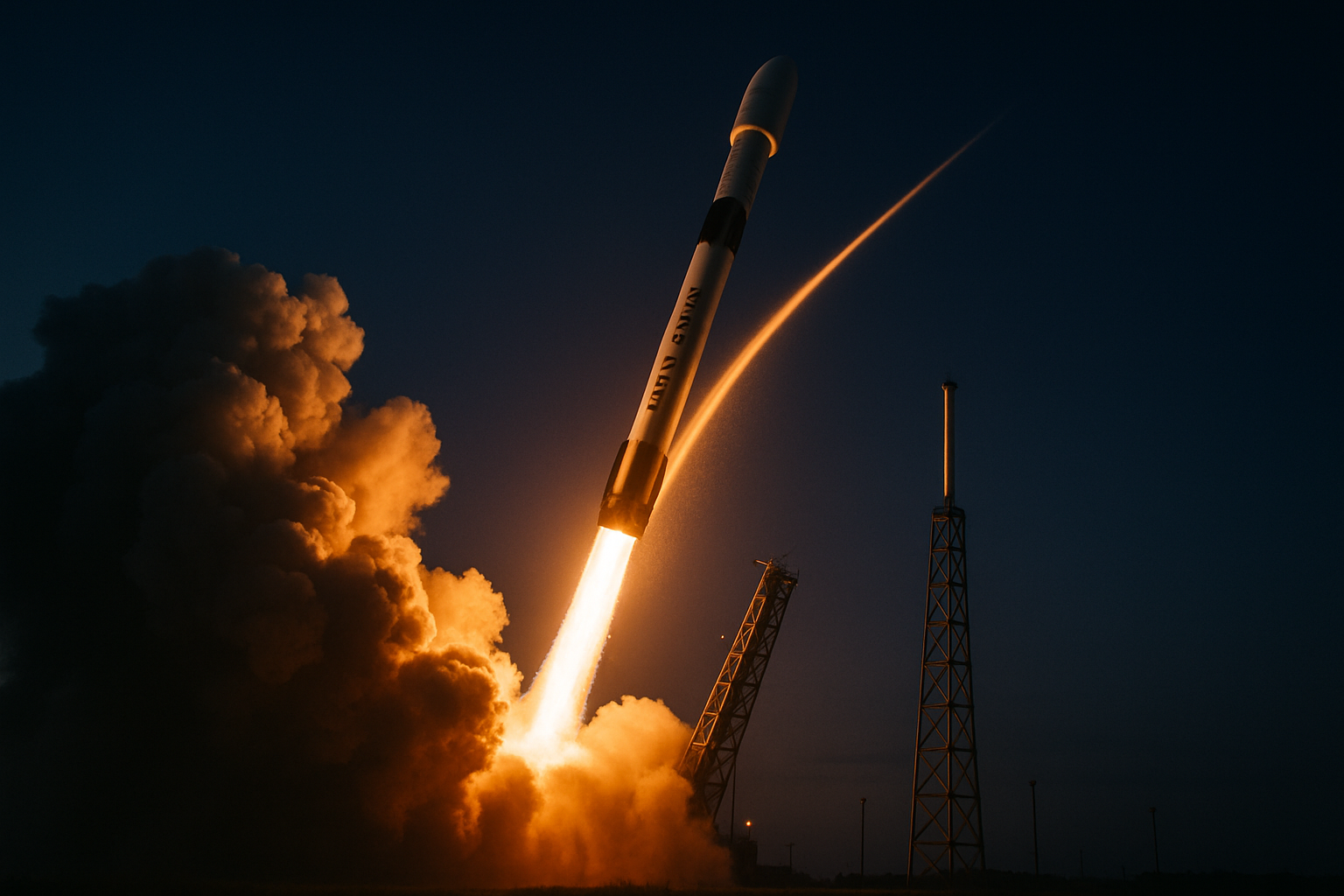
SpaceX has once again demonstrated its trademark operational rhythm, successfully launching another batch of Starlink satellites aboard a Falcon 9 rocket as the company pushes deeper into June 2026 with a high-cadence deployment campaign that shows no signs of slowing. The most recent confirmed mission, Starlink 10‑54, lifted off from Cape Canaveral Space Force Station on June 12 at 8:37 a.m. EDT, carrying 29 V2 Mini Optimized satellites into orbit and marking the 650th flight of a Falcon 9 overall — as well as the 68th Falcon 9 launch of the year. That mission was also SpaceX’s 55th dedicated Starlink launch of 2026 and its 56th overall Starlink mission for the year, reflecting an aggressive operational tempo that has become the new normal for the company. The booster, identified as B1080, completed its 27th flight and landed safely on the droneship A Shortfall of Gravitas, continuing a streak of successful recoveries that underpins the economics of SpaceX’s reusable launch system.
With each new deployment, the Starlink constellation grows larger, and the network’s coverage improves. As of the June 12 coverage, SpaceX reported more than 10,500 Starlink satellites in orbit, a figure that underscores the scale of the buildout and the company’s determination to deliver global broadband internet from low Earth orbit. The June launches are part of a sustained push that has seen missions departing from both Cape Canaveral, Florida, and Vandenberg Space Force Base, California, with boosters routinely returning to droneships or landing zones shortly after liftoff. The latest available listing on SpaceX’s launch manifest, as of June 18, still shows additional Falcon 9 activity scheduled, including the NROL‑179 mission from Vandenberg later that same day and further Starlink launches in the pipeline.
Relentless Launch Cadence Continues
The June 12 launch was far from an isolated event. Just three days earlier, on June 8, SpaceX sent up Starlink 10‑35 from Cape Canaveral at 6:13 a.m. EDT, also with 29 satellites. That mission’s first stage performed a successful landing on A Shortfall of Gravitas after its 35th flight, illustrating just how many times these boosters can be reused. On June 4, the company launched Starlink 10‑43 from the same Florida pad at 6:26:30 a.m. EDT after a one‑day weather scrub, carrying 29 broadband satellites. The booster for that flight, B1090, landed on the droneship after its 12th mission. And on June 15, a Starlink 17‑54 mission lifted off from Vandenberg, achieving nominal orbit insertion with another successful booster landing, according to SpaceX coverage.
This near‑daily rhythm — with multiple launches in a single week from separate coasts — is a hallmark of SpaceX’s current operational posture. The company’s manifest page on June 18 showed additional Falcon 9 missions still scheduled, including an NROL‑179 Mission from Vandenberg, indicating that the cadence has not eased. The cumulative effect is a steady stream of new satellites joining the constellation, each adding capacity and redundancy to a network designed to serve tens of millions of subscribers worldwide.
Starlink Constellation Growth and Implications
The Starlink network is already the largest satellite constellation ever built, and it continues to expand. According to reporting from the June 12 mission coverage, SpaceX disclosed that more than 10,500 Starlink satellites were in orbit at that time. That number has almost certainly grown since, given the June 15 Vandenberg launch and any additional missions that may have occurred between the research cut‑off and today. The satellites launched in June are designated V2 Mini Optimized, a refined version of the second‑generation design that offers improved throughput and reduced mass, allowing more satellites per Falcon 9 flight.
The implications for global internet access are significant. Starlink provides high‑speed, low‑latency connectivity to remote and underserved areas where terrestrial infrastructure is absent or unreliable. As the constellation grows, coverage becomes denser, providing better service in existing regions and opening new ones. The service has been adopted by rural households, maritime operators, aviation customers, and even government agencies. However, the rapid expansion has also drawn scrutiny from astronomers concerned about light pollution and from regulators focused on orbital debris and spectrum allocation. The ongoing buildout makes Starlink a central actor in debates about the future of low Earth orbit.
Falcon 9 Reusability and Booster Milestones
Each Starlink mission also serves as a testament to the viability of rocket reusability — a technology that SpaceX has refined to an industrial scale. The June 12 mission marked the 27th flight of booster B1080, a record‑setting vehicle that has now flown more than two dozen times. The June 8 flight saw a booster complete its 35th mission. These numbers would have been unthinkable a decade ago, yet they are now routine. The droneship A Shortfall of Gravitas is stationed in the Atlantic off Florida’s coast, catching boosters that descend under supersonic speeds and land on an autonomous platform.
Reusability drives down the cost per launch, enabling SpaceX to offer lower prices to customers — including its own Starlink division — and to sustain the high launch cadence that keeps the constellation growing. The ability to reuse boosters multiple times also reduces manufacturing waste and accelerates the pace of space access. Critics, however, note that reusability still requires refurbishment and that the long‑term durability of these boosters remains to be fully proven at the highest flight counts. Nevertheless, the current operations speak for themselves: boosters are flying dozens of times, and failures are rare.
Strategic Importance of the Starlink Network
Beyond its commercial ambitions, Starlink has taken on strategic dimensions. The network has been used to provide emergency connectivity in disaster zones, to support military communications, and to link regions cut off from traditional internet infrastructure. As the constellation reaches global coverage, it becomes a tool for geopolitical influence and resilience. SpaceX has stated that Starlink is designed to operate independently of terrestrial infrastructure, making it resistant to physical attacks or natural disasters that might sever undersea cables or damage ground stations.
The launch campaigns from both coasts also highlight the logistical complexity of maintaining such a high tempo. Cape Canaveral serves the southeastern United States and the equatorial orbit inclination, while Vandenberg is optimized for polar orbits — crucial for covering high‑latitude regions. The ability to launch from both sites simultaneously, with separate teams and recovery assets, underscores SpaceX’s maturity as an operator. The June 18 NROL‑179 mission from Vandenberg, for example, is a national security payload, demonstrating that SpaceX can balance commercial constellation launches with government requirements.
Upcoming Missions and Operational Tempo
Looking ahead, SpaceX’s manifest as of June 18 lists additional Falcon 9 launches scheduled for the remainder of the month. While specific dates and payloads for each mission are subject to change — weather, technical issues, and range availability can cause shifts — the pattern suggests that June 2026 will be one of the busiest months for the company. With 68 Falcon 9 launches already completed by mid‑June, SpaceX is on track to exceed 120 launches for the year, a pace that would dwarf previous records.
The NROL‑179 mission is a notable upcoming launch, carrying a classified payload for the National Reconnaissance Office. Such missions typically require precise orbital insertion and stringent security protocols, yet they are folded into a launch schedule that also includes routine Starlink deployments. This dual‑use capability — servicing both commercial and government customers on the same rocket family — is a key part of SpaceX’s business model and its strategic importance to the United States.
Perspectives on Sustainability and Space Traffic
While the expansion of Starlink is widely lauded for its potential to bridge the digital divide, it is not without controversy. Astronomers have repeatedly raised concerns about the brightness of the satellites interfering with ground‑based optical and radio observations. SpaceX has responded by introducing visors, coatings, and operational adjustments such as rolling the satellites to reduce reflectivity. The company has also worked with the astronomical community to share ephemeris data so that observatories can avoid satellite trails. Nonetheless, the sheer number of satellites — now exceeding 10,500 — means that the impact on the night sky is significant.
From an orbital debris perspective, Starlink satellites are designed to be fully disposable at end of life, performing a controlled burn‑up in the atmosphere. However, the density of the constellation raises questions about collision risk in the event of a malfunction or an unexpected maneuver. SpaceX has argued that its automated collision‑avoidance system and the satellites’ maneuverability keep risk low. Industry observers generally agree that the Starlink fleet is among the best‑managed in terms of debris mitigation, but the scale of the operation means even a small failure rate could add to the orbital junk problem.
Regulatory bodies, including the U.S. Federal Communications Commission and the International Telecommunication Union, continue to monitor the constellation’s impact on spectrum sharing and orbital slots. Some competitors have called for greater oversight, citing concerns about market dominance. SpaceX has responded by licensing its technology and services to other operators in some regions, but the core Starlink business remains a tightly controlled asset.
What Happens Next
The immediate future is clear: more Starlink launches, more booster landings, and a gradual approach toward full operational capability. SpaceX has previously indicated that the first‑generation constellation required around 12,000 satellites for complete global coverage, and the company has received regulatory approval for up to 42,000 satellites in the Gen2 constellation. While the current buildout has not yet reached those numbers, the pace suggests that several thousand more satellites will be launched over the next year. The V2 Mini Optimized satellites are designed to be compatible with the next‑generation laser‑based inter‑satellite links and the ground‑user terminals already deployed worldwide.
Long‑term, the high cadence of Falcon 9 launches is also a proving ground for the Starship system, which is expected to eventually take over the bulk of Starlink deployment due to its much larger payload capacity. Starship is still in development, and its test flights have been mixed, but each successful Falcon 9 mission buys time and experience for the larger vehicle. For now, Falcon 9 remains the workhorse, and June 2026 is proving to be yet another month in which it delivers — mission after mission, coast to coast, with the quiet, relentless reliability that has come to define SpaceX’s approach to space access.
As of today’s date, the constellation continues to grow, the launch cadence remains unprecedented, and the impact of that growth — on connectivity, on astronomy, on orbital safety, and on the business of space itself — will continue to unfold. The June 12 launch, the June 15 launch, and the upcoming June 18 mission are not endpoints but waypoints in an ambitious, ongoing campaign that is reshaping humanity’s relationship with low Earth orbit.