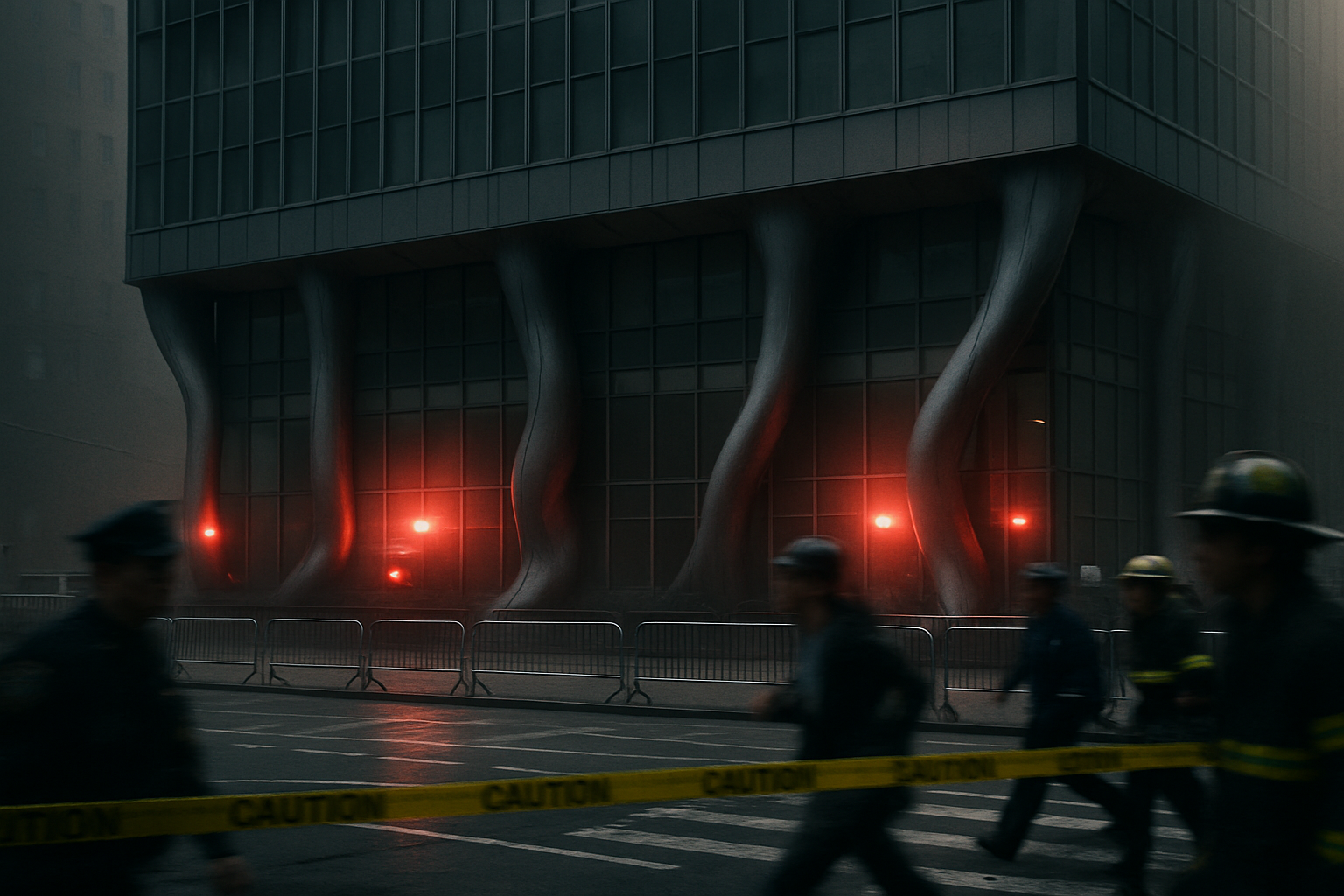
The emergency began with bricks falling from the sky. At 7:57 a.m., a 911 call sent New York City firefighters racing to 235 East 42nd Street, a glass-and-steel tower in Midtown Manhattan that once served as the global headquarters of Pfizer. What they found inside was far more serious than a loose facade: steel columns, the building's load-bearing skeleton, had buckled under the weight of the structure above them.
Within hours, police had sealed off a vast "frozen zone" spanning roughly five blocks by three blocks, shutting down a busy stretch of East 42nd Street and paralyzing traffic in one of the most densely developed corners of the city. Adjacent buildings were evacuated. Onlookers watched as crews worked to determine whether a tower under renovation might come down.
As of early August 2026, the scene has changed dramatically. The building has been declared structurally stable, most streets have reopened, and the incident has shifted from an acute emergency to a meticulous — and increasingly contentious — investigation. But the questions raised by the buckling columns reach far beyond a single construction site. They cut to the heart of New York's ambitious push to convert aging office towers into housing, the pressures of fast-track development, and who is ultimately responsible when a building's design and its reality diverge.
A Morning Emergency on East 42nd Street
The first sign of trouble was masonry. FDNY units responding to the 911 call arrived to find bricks falling from the upper portion of the high-rise, a structure that had been undergoing a massive transformation from office space to luxury residential apartments. What began as an exterior concern quickly escalated when responders assessed the interior and discovered that steel columns inside the building had buckled — a structural failure that, depending on its severity, could threaten the integrity of the entire tower.
The NYPD moved swiftly, establishing the frozen zone across nine city blocks, blocking pedestrian and vehicular traffic, and securing the perimeter while engineers and emergency personnel worked inside. Surrounding buildings were evacuated out of caution, their occupants told to gather until officials could determine whether the danger was contained.
Miraculously, no injuries were reported. At the time of the incident, the building remained an active construction site rather than a functioning residential property. Only construction workers were present inside, and none were hurt. The same cannot be said for the neighborhood's sense of security; a structural failure of this kind, in a building that was meant to become someone's home, sent a visible shudder through a city unaccustomed to seeing its skyline misbehave.
Stabilization: From Emergency to Investigation
In the days that followed, the response shifted from crisis management to damage control and diagnosis. The New York City Department of Buildings (DOB) took the lead on structural oversight, and emergency shoring was installed across multiple floors — roughly between the 18th and 23rd levels — to support compromised areas located between the 21st and 26th floors. Temporary steel columns and posts now hold the weight that the buckled members were designed to carry.
City officials, including Mayor Zohran Mamdani, announced that no further structural movement had been detected once the stabilization work was complete. That declaration was the turning point. Streets that had been sealed off began to reopen the day after stabilization, and the frozen zone was largely lifted. A smaller perimeter remained in place for engineering and investigative work, and a limited number of adjacent buildings were held under evacuation orders pending further safety checks.
Four nearby buildings remained under evacuation orders even as the broader area returned to normal, awaiting the results of engineering assessments. The situation, as officials described it, had moved into a "remediation" phase — a technical, methodical process rather than a race against the clock. The building remains a controlled construction site, with access restricted to personnel involved in the investigation and repair work.
From Pfizer's Headquarters to Luxury Apartments
To understand why this incident matters so much, one has to understand what 235 East 42nd Street was supposed to become. The former Pfizer headquarters, a substantial Midtown tower, is in the midst of one of the largest office-to-residential conversions ever attempted in New York City. The developer, MetroLoft, is transforming the property into roughly 1,600 residential units — a flagship project in a city that has pinned much of its downtown and Midtown revitalization strategy on converting obsolete office buildings into housing.
Office-to-residential conversion is not a niche trend in New York; it is a core policy response to a commercial real estate market that has struggled with vacancy since the pandemic shifted work patterns. Adaptive reuse avoids the carbon cost of demolition, adds housing supply in a city that desperately needs it, and revives districts that would otherwise be hollowed out after business hours.
But conversion projects come with unique engineering challenges. Office buildings are designed to carry heavy floor loads across wide floor plates, and converting them to residential use requires inserting new mechanical systems, rearranging floor plans, and often adding floor area. The project at 235 East 42nd Street involved structural modifications to accommodate new floors — modifications that, according to the project's structural engineering firm, were not fully executed as designed.
After the buckling, the unnamed engineering firm responsible for the structural design made a statement that reframed the entire incident: required steel reinforcements had never been installed on at least three floors, including the 21st floor where the buckling occurred. That admission transformed what might have been treated as a routine construction defect into a potential matter of negligence — or worse.
A Multilayered Investigation
The official response has unfolded on several tracks simultaneously.
The Department of Buildings is conducting a comprehensive investigation into the incident, reviewing structural plans, construction documents, photographic and video evidence, and conducting interviews with contractors and other responsible parties. DOB spokesperson David Maggiotto has publicly detailed the scope of the work, emphasizing that the agency is treating the failure as a serious breach of construction standards.
Alongside the DOB's technical review, Manhattan prosecutors have opened a criminal investigation. The focus, according to officials, is