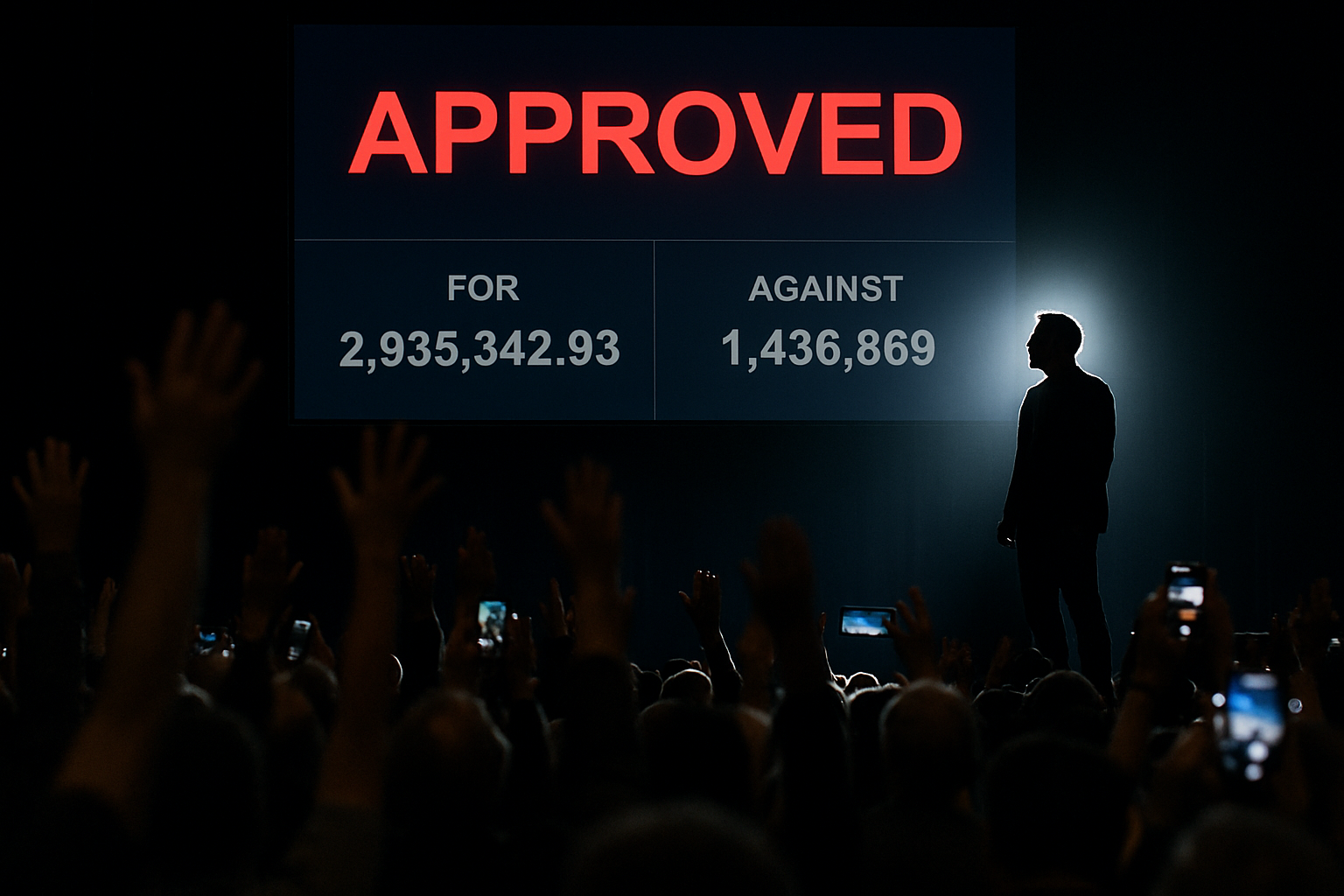
AUSTIN, Texas — Tesla shareholders approved Elon Musk’s $56 billion 2018 compensation package at the company’s annual meeting, but more than two years after that vote, the award remains tangled in legal proceedings and unresolved Delaware law questions. As of June 19, 2026, Tesla has filed paperwork to move toward delivering the stock options to its chief executive, yet the ultimate fate of the payout is far from certain.
The package, originally structured as performance-based stock options tied to aggressive milestones, was reinstated by shareholders at Tesla’s annual meeting in Austin, Texas, on June 13, 2024. Brandon Ehrhart, Tesla’s general counsel and board secretary, announced the vote result at the meeting. However, the approval did not end the legal saga. A different Tesla shareholder filed a new lawsuit within days of the vote, challenging its validity, and the Delaware Chancery Court judge who had voided the original package earlier in 2024 remains positioned to assess whether the second shareholder vote satisfies Delaware business-law standards.
At the same June 2024 meeting, shareholders also approved moving Tesla’s corporate domicile from Delaware to Texas, a jurisdictional shift that Musk had publicly championed. The move reflects a broader corporate-governance trend in which companies are reconsidering their legal homes after high-profile disputes with Delaware’s chancery court system.
By April 27, 2026, Tesla had filed an S-8 registration statement with the U.S. Securities and Exchange Commission to register 303,960,630 shares for Musk under the 2018 compensation plan. At the time of the filing, those shares were valued at over $114 billion, based on a reported share price of roughly $376. The filing indicated that Tesla was taking concrete steps toward administratively executing the award, though the legal overhang continues.
The core factual dispute as of mid-2026 is not whether shareholders voted yes. It is whether the post-vote legal challenge and the Delaware-law questions surrounding the ratification process could still affect how or whether the award is ultimately honored. The original compensation package was voided by Delaware Chancery Court Judge Kathaleen McCormick in January 2024, who found the package excessive under Delaware law. Tesla’s board treated the shareholder vote as a mandate to restore the award and has proceeded with implementation, but the judge could be asked to rule on the validity of the second vote.
The background of the compensation battle
The 2018 compensation package was designed to grant Musk stock options in tranches, each tied to specific performance targets related to Tesla’s market capitalization, revenue, and profitability. At the time of its creation, the package was the largest executive compensation plan ever put to a shareholder vote in U.S. corporate history. Supporters argued it would align Musk’s incentives with the company’s long-term growth and motivate him to stay at the helm of the electric-vehicle maker.
By 2024, Tesla had met many of those targets, making the options worth approximately $56 billion at the time of the shareholder vote. Critics of the package argued that the award was excessively large and that the board lacked independence when negotiating it. Judge McCormick’s January 2024 ruling voiding the package was based partly on those criticisms, finding that the board had not adequately disclosed the process to shareholders and that the compensation was not reasonably tied to performance under Delaware law.
Tesla responded by putting the package to a second shareholder vote in June 2024, arguing that a fresh ratification would cure any procedural deficiencies and demonstrate that shareholders supported the compensation structure. The company also approved the move to Texas, shifting its legal incorporation away from Delaware, where the court had ruled against it.
Key figures and institutions involved
Elon Musk, Tesla’s CEO, is the central figure in the compensation dispute. He is the intended recipient of the 2018 package and has been a vocal critic of Delaware’s judicial system, which he has accused of excessive interference in corporate governance. Musk’s public statements and his role as CEO have made him both the beneficiary and a lightning rod for the controversy.
Tesla’s board of directors has consistently backed the compensation package. In statements around the time of the vote, the board argued that Musk’s continued leadership was strategically important for the company’s competitiveness, particularly in the intensifying global electric-vehicle market. The board characterized the shareholder vote as an endorsement of both Musk and the compensation structure.
Brandon Ehrhart, Tesla’s general counsel and board secretary, announced the vote result at the June 2024 meeting. His role in the process underscores the legal and governance work behind the ratification effort.
Delaware Chancery Court Judge Kathaleen McCormick presided over the original case that voided the package. She remains a key figure because any challenge to the second shareholder vote will likely be heard in her court, and she will have to determine whether the vote meets Delaware’s legal standards for ratification. The Delaware Court of Chancery is the venue where the compensation dispute has played out, and it retains jurisdiction over the matter.
A different Tesla shareholder filed a new lawsuit in the week immediately following the June 2024 vote, challenging the validity of the second ratification. The lawsuit argues that the process was flawed and that the board did not address the specific deficiencies identified by McCormick. That case remains pending.
Why the vote matters
The approval of the pay package is significant for several reasons. First, it affects the personal fortune of the world’s richest person. The $56 billion package, structured as stock options, could make Musk even wealthier if Tesla’s stock continues to perform. Second, the vote sends a signal about shareholder sentiment toward CEO compensation at a time when executive pay is under increasing scrutiny from regulators, institutional investors, and the public.
Third, the legal fight over the package has become a test case for Delaware corporate law. Delaware is the legal home for roughly two-thirds of Fortune 500 companies, and its chancery court’s rulings are influential across the business world. If McCormick ultimately decides that the second shareholder vote does not satisfy Delaware standards, it could set a precedent that makes it harder for companies to use shareholder ratification to override court rulings.
The decision by Tesla shareholders to move the company’s legal incorporation to Texas also has implications. Texas has been actively courting corporations to reincorporate in the state, offering a business-friendly legal environment. Musk’s public criticism of Delaware and his personal move to Texas have accelerated the trend, with other companies considering similar shifts.
Differing perspectives
Supporters of the compensation package argue that Musk’s leadership has been transformative for Tesla. Under his direction, the company grew from a niche electric-car maker into one of the most valuable automakers in the world, with a strong brand and a rapidly expanding product lineup. Proponents contend that the $56 billion package was earned through the achievement of audacious performance targets and that the board was right to seek ratification from shareholders.
Opponents, including the shareholder who filed the post-vote lawsuit, argue that the package is excessive and that the board failed to provide adequate oversight in negotiating it. They contend that Judge McCormick’s original ruling was correct in finding the compensation unreasonable and that the second vote did not fix the underlying flaws in the process. Some governance experts have noted that ratification votes after a court ruling can create legal ambiguity, as shareholders may not have the full information needed to make an informed judgment.
Institutional shareholders have taken varied positions. Some large pension funds and asset managers that criticized the original package have remained skeptical of the second vote, arguing that the board did not adequately explain what had changed. Others have backed the package, citing Musk’s role in Tesla’s success and the board’s argument that losing him could damage the company.
The geopolitical and economic context
Tesla’s move from Delaware to Texas is part of a larger trend in U.S. corporate governance. A growing number of companies have reincorporated outside of Delaware, citing dissatisfaction with the state’s court system and a desire for more flexible corporate laws. Texas has emerged as a popular alternative, offering lower filing fees and a legal environment that is perceived as more favorable to management.
This shift has implications for Delaware, which derives a significant portion of its state revenue from corporate filing fees and franchise taxes. The state has defended its court system as the gold standard for corporate law, but the exodus of high-profile companies like Tesla has prompted some concern about its competitive position.
The wider economic context in mid-2026 includes ongoing volatility in the stock market and uncertainty about the trajectory of interest rates. Tesla’s share price has experienced significant swings over the past two years, driven by changes in electric-vehicle demand, production challenges, and broader macroeconomic conditions. The value of the compensation package, which is tied to Tesla’s stock price, fluctuates with these market dynamics.
What happens next
Tesla’s filing of an S-8 registration statement in April 2026 suggests that the company is moving ahead with implementation of the compensation package, at least administratively. The registration would allow Tesla to issue shares to Musk in connection with the 2018 plan. However, the legal challenge remains active, and Judge McCormick could still issue rulings that block or modify the delivery of shares.
The courts will need to determine whether the shareholder ratification vote satisfies Delaware’s standard for curing a voided compensation award. The plaintiff in the post-vote lawsuit is expected to argue that the vote did not remedy the original defects identified by McCormick, particularly the board’s lack of independence in negotiating the package. Tesla’s legal team will argue that the ratification was proper and that the outcome of the vote should be respected.
A decision from McCormick could take months or longer, depending on the complexity of the case and the pace of litigation. If she rules in favor of the shareholders challenging the vote, the package could be voided again, and the case could be appealed to the Delaware Supreme Court. If she upholds the ratification, Musk would receive the shares, and the matter would likely be closed, barring further appeals.
Separately, Tesla shareholders in November 2025 approved a different compensation plan that could be worth nearly $1 trillion if the company hits ambitious milestones. That plan, which would grant Musk up to 423.7 million additional shares over a decade, is tied to market capitalization targets ranging from $2 trillion to $8.5 trillion. The existence of that later plan underscores the board’s commitment to keeping Musk incentivized for the long term.
For Tesla, the resolution of the compensation dispute is strategically important. Musk’s leadership has been central to the company’s success, but his attention is divided among multiple ventures, including SpaceX, X (formerly Twitter), and his artificial intelligence startup. A prolonged legal fight over his pay could distract the company and create uncertainty about his role.
For corporate governance observers, the Tesla case remains a landmark. It tests the limits of shareholder ratification, the independence of corporate boards, and the authority of the Delaware courts. The outcome will reverberate across boardrooms and courtrooms for years to come.
As of June 19, 2026, the pay package has been approved by shareholders, and Tesla has moved toward implementation. But the legal uncertainty persists, and the final chapter of this saga has not yet been written.