Tesla Shareholders Approve Elon Musk’s Multibillion-Dollar Pay Package at Annual Meeting
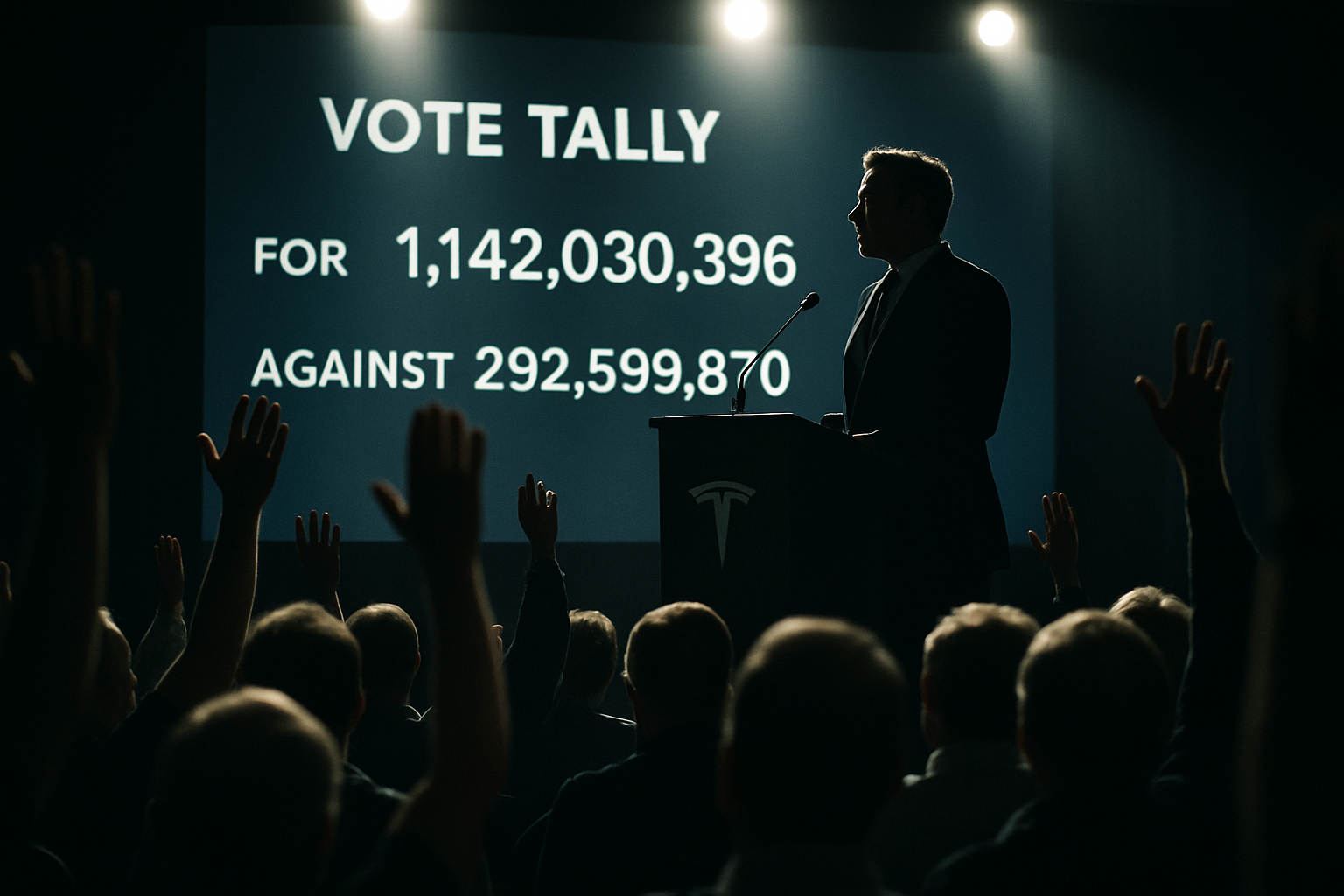
In a decisive vote that reshapes the landscape of executive compensation, Tesla shareholders have approved a new multibillion-dollar pay package for chief executive Elon Musk, backing the proposal with more than 75% of voting shares. The approval, announced at the company’s annual meeting, clears the way for a long-term incentive plan that could award Musk up to 423.7 million additional Tesla shares if the company meets a series of ambitious performance targets over the next decade.
The package, described by analysts as potentially the largest executive compensation plan in corporate history, is designed to tie Musk’s personal wealth directly to Tesla’s future growth. At maximum payout, the plan could be worth roughly $1 trillion—requiring Tesla to reach a market capitalization of $8.5 trillion, more than six times its current valuation of approximately $1.4 trillion. The vote ended weeks of intense debate among investors, governance experts, and the broader business community over whether such a massive reward is necessary to retain Musk or whether it represents an unprecedented concentration of power and wealth in the hands of a single founder-CEO.
The approval marks a pivotal moment for Tesla as it navigates a rapidly shifting global landscape for electric vehicles, robotics, artificial intelligence, and clean energy. With the package now shareholder-approved, the immediate question becomes whether Musk can deliver the extraordinary operational and financial milestones embedded in the plan—including the production of 20 million vehicles and 1 million Optimus humanoid robots—to unlock the full value of the award.
What Happened at the Annual Meeting
At Tesla’s annual shareholder meeting, held on Thursday, June 18, 2026, according to multiple outlets covering the event, investors voted overwhelmingly in favor of the new compensation plan. The exact vote tally showed more than 75% of shares cast backing the proposal, a margin that comfortably exceeded the simple majority required for approval. The strong support came from a combination of institutional and retail investors, though the supplied research does not break down the vote by investor type.
The package is structured as a long-term performance-based incentive spanning ten years and divided into 12 tranches. Each tranche corresponds to a specific combination of market-capitalization and operational milestones. For the full 423.7 million shares to be awarded, Tesla must achieve all 12 tranches, which would require a market capitalization of $8.5 trillion—roughly the combined current market value of the world’s five largest companies—and the production of 20 million vehicles and 1 million Optimus robots, according to one description of the plan in the research.
The new plan replaces or supersedes an earlier 2018 CEO performance award that was structured as stock options tied to market-cap and operational targets. That 2018 plan had a ten-year performance period and was originally valued at around $55 billion at the time of its announcement, but Tesla’s surging stock price in subsequent years made it worth far more. The supplied research notes inconsistencies in dating and framing between sources, with some references to an Implementation Agreement signed on April 21, 2026, and an SEC registration statement filed on April 24, 2026, to deliver shares tied to the earlier award. However, the core fact is clear: shareholders have now approved a new, far larger compensation plan for Musk.
Why This Matters: The Stakes for Tesla and Musk
The approval is significant for several reasons. First, it represents a bet by Tesla’s board and its shareholders that Musk’s continued involvement is essential to the company’s long-term success. Tesla’s board has argued that the package provides the necessary incentives to keep Musk fully engaged and focused on the company’s growth trajectory, particularly as it ventures into new areas such as autonomous driving, robotics, and AI-powered industrial platforms. Without such a massive incentive, board members have suggested, Musk might divert his attention to his other ventures or lose motivation, potentially harming Tesla’s prospects.
Second, the size of the package—potentially worth $1 trillion—has drawn comparisons to the entire market capitalizations of most publicly traded companies. Critics argue that such an outsized award concentrates an extraordinary amount of wealth and control in one individual, especially given that Musk already owns a significant stake in Tesla and retains substantial influence over the board and company strategy. The package also raises questions about corporate governance and the balance of power between shareholders and management, particularly in the context of Tesla’s dual-class share structure, which gives Musk outsized voting power.
Third, the approval comes at a time when global markets are already sensitive to mega-cap valuations and executive accountability. Tesla’s market cap of roughly $1.4 trillion already places it among the world’s most valuable companies, alongside Apple, Microsoft, and Saudi Aramco. To achieve the $8.5 trillion threshold required for full payout, Tesla would need to roughly sextuple its current valuation—a feat that would require sustained consumer demand, massive manufacturing scale, favorable capital market conditions, and unwavering investor confidence in the Tesla growth narrative.
Background: The Evolution of Musk’s Compensation
The new pay package builds on a history of performance-based awards for Musk. In January 2018, Tesla announced a 10-year CEO performance award structured as stock options tied to market-cap and operational milestones. That plan was designed to reward Musk if Tesla reached a series of escalating targets, including market cap thresholds ranging from $100 billion to $650 billion. At the time, Tesla was valued at around $60 billion, and the award was seen as highly ambitious. Over the following years, Tesla’s stock surged, and Musk exercised many of those options, making him one of the richest people in the world.
By early 2026, Tesla had already met several of the 2018 plan’s milestones, and the board began crafting a new, even more ambitious package. The supplied research notes that in April 2026, Tesla filed an SEC registration statement to deliver shares tied to the earlier award, and the company signed an Implementation Agreement on April 21. Then, in the weeks leading up to the annual meeting, Tesla sought shareholder approval for the new plan, framing it as a necessary update to reflect the company’s scaled-up ambitions and to ensure Musk remains incentivized as Tesla pushes into robotics, AI, and global manufacturing expansion.
The new plan’s milestones include not just market-cap targets but also operational metrics: 20 million vehicles (annual production? cumulative? the research is not fully specific), and 1 million Optimus humanoid robots. These figures underscore Tesla’s transformation from a pure electric-vehicle maker into a broader robotics and AI company. The inclusion of Optimus robots—a project Musk has touted as potentially larger than the auto business—signals that the board sees the robotaxi and robotics markets as central to Tesla’s future valuation.
Differing Perspectives: Supporters vs. Critics
Supporters of the package, including Tesla’s board and many retail investors, argue that the plan is both justified and necessary. They point to Musk’s track record of delivering transformative growth: Tesla went from a niche electric-vehicle maker producing fewer than 100,000 cars annually in 2018 to a global manufacturing powerhouse approaching 2 million vehicles per year by 2026. Under Musk’s leadership, Tesla also became the world’s most valuable automaker and a leader in battery technology, energy storage, and autonomous driving software. Proponents contend that without a truly massive incentive, Musk might lose interest or focus, especially given his commitments to SpaceX, Neuralink, The Boring Company, and X (formerly Twitter). The 75% approval vote suggests a majority of shareholders share this view.
Critics, however, including some governance experts and institutional investors, have raised concerns about the package’s size and structure. They argue that $1 trillion in potential compensation is excessive by any standard and that it could distort decision-making, encouraging excessive risk-taking or a focus on stock price at the expense of other stakeholders, such as employees or customers. Some also question whether the milestones—particularly the $8.5 trillion market cap—are realistic, even for a company with Tesla’s ambitions. Achieving that valuation would require Tesla to grow at a compound annual rate of roughly 35% for a decade, outstripping the growth of any previous company in history. Critics warn that such an unrealistic target might lead to short-termism or governance problems if Musk feels pressured to pursue aggressive accounting or product timelines to hit the milestones.
Labor and consumer advocacy groups have also weighed in, noting that the package could exacerbate income inequality and that Tesla’s workforce has faced layoffs and wage stagnation in recent years while executive compensation skyrockets. Some have called for greater transparency in how the milestones are set and verified.
Impact and Implications
The approval has immediate implications for Tesla’s corporate governance and strategic direction. With Musk now holding the potential for an even larger ownership stake—up to 423.7 million additional shares—his influence over the board and company decisions is likely to grow. Tesla’s board, which already includes Musk allies and family members, may find it even harder to challenge his vision or impose checks on his authority. Governance watchdogs have expressed concern that the board’s independence could be compromised, especially given that the package was designed by a compensation committee that includes directors with close ties to Musk.
On the strategic front, the package locks Tesla into a long-term trajectory aimed at massive scale. The operational milestones of 20 million vehicles and 1 million robots imply an enormous ramp-up in manufacturing capacity, likely requiring new factories in multiple regions, major supply-chain investments, and continued innovation in battery technology and automation. The plan also reinforces Tesla’s pivot toward AI and robotics, areas that Musk has championed but that remain unproven at scale. If Tesla fails to meet the milestones—or if market conditions deteriorate—the package could become a source of tension, as Musk may not receive the shares he expects, potentially leading to distraction or litigation.
From a market perspective, the approval sends a signal that Tesla’s shareholders are willing to bet big on Musk’s leadership, even at a time when the broader auto industry faces headwinds from rising interest rates, supply chain disruptions, and increasing competition from Chinese and legacy automakers. The vote may also embolden other tech companies to adopt similarly ambitious compensation structures, particularly those with founder-CEOs who wield outsized influence.
What Happens Next
Now that shareholders have approved the package, Tesla will implement the plan immediately. Musk will become eligible to receive shares as the company reaches the specified milestones over the 10-year performance period. The first tranche may be tied to a near-term market cap threshold or operational target—though the supplied research does not detail the specific order or timing of the 12 tranches. Tesla will also file the plan’s final terms with the SEC, and the company will begin reporting progress against the milestones in its quarterly and annual disclosures.
For Musk, the approval removes a potential distraction. He had previously hinted that he might reduce his involvement with Tesla if the package was not approved, citing the need for “sufficient control” to steer the company toward AI and robotics. With the package secured, Musk is expected to remain deeply engaged in Tesla’s day-to-day operations, particularly around the rollout of the Optimus robot, the expansion of the Gigafactory network, and the development of full self-driving technology.
Investors will now focus on whether Tesla can hit the early milestones. Achieving the first tranche may require the stock to reach a specific market cap—though exact thresholds are not publicly specified in the supplied research. Given Tesla’s current $1.4 trillion valuation, the path to $8.5 trillion is steep, but not impossible if the company continues to grow earnings and if the market assigns multiple expansion for its AI and robotics divisions. Analysts have noted that the milestones effectively create a series of market expectations that must be met over the next decade, providing a clear but ambitious roadmap.
Broader Context: Executive Compensation and Corporate Power
The Tesla vote occurs against a backdrop of growing debate about executive compensation and corporate governance. In recent years, shareholder activists have pushed for tighter links between pay and performance, and many companies have moved toward long-term incentive plans similar to Tesla’s. However, the sheer size of Musk’s package—potentially larger than the GDP of many small countries—has reignited critics’ concerns about wealth inequality and the concentration of economic power.
The package also highlights the unique position of founder-CEOs in the tech sector. Unlike CEOs of more traditional companies, Musk controls a significant portion of Tesla’s voting power (through his shareholdings and the company’s dual-class structure), which made it easier for him to push through the plan. Some governance experts argue that such concentrated control undermines the principle of shareholder democracy, while others counter that it is precisely this combination of ownership and control that has driven Tesla’s innovation and success.
Geopolitically, Tesla’s performance will be closely watched as a bellwether for the electric-vehicle and robotics industries. The company faces fierce competition from Chinese firms like BYD and XPeng, legacy automakers investing heavily in EV transitions, and tech giants such as Apple and Google in autonomous driving. Meeting the milestones will require not only executional excellence but also favorable regulatory environments, particularly for autonomous vehicles and robots.
Conclusion
The approval of Elon Musk’s multibillion-dollar pay package marks a defining moment for Tesla and for executive compensation globally. With more than 75% of shareholders backing the plan, the company has signaled its commitment to Musk’s leadership and his vision of turning Tesla into a trillion-dollar robotics and AI powerhouse. Yet the path ahead is fraught with challenges: Tesla must achieve extraordinary growth in both vehicles and robots, navigate competitive and regulatory headwinds, and maintain the investor confidence that has driven its stock to record highs.
For Musk, the package is a bet on himself—one that could make him the world’s first trillionaire if fully realized. For Tesla’s other stakeholders, it represents both an opportunity and a risk. The next decade will determine whether the package is remembered as visionary reward or excessive gamble, but for now, shareholders have spoken, and Tesla is moving forward with a plan that ties the company’s future inextricably to its founder’s ambitions.