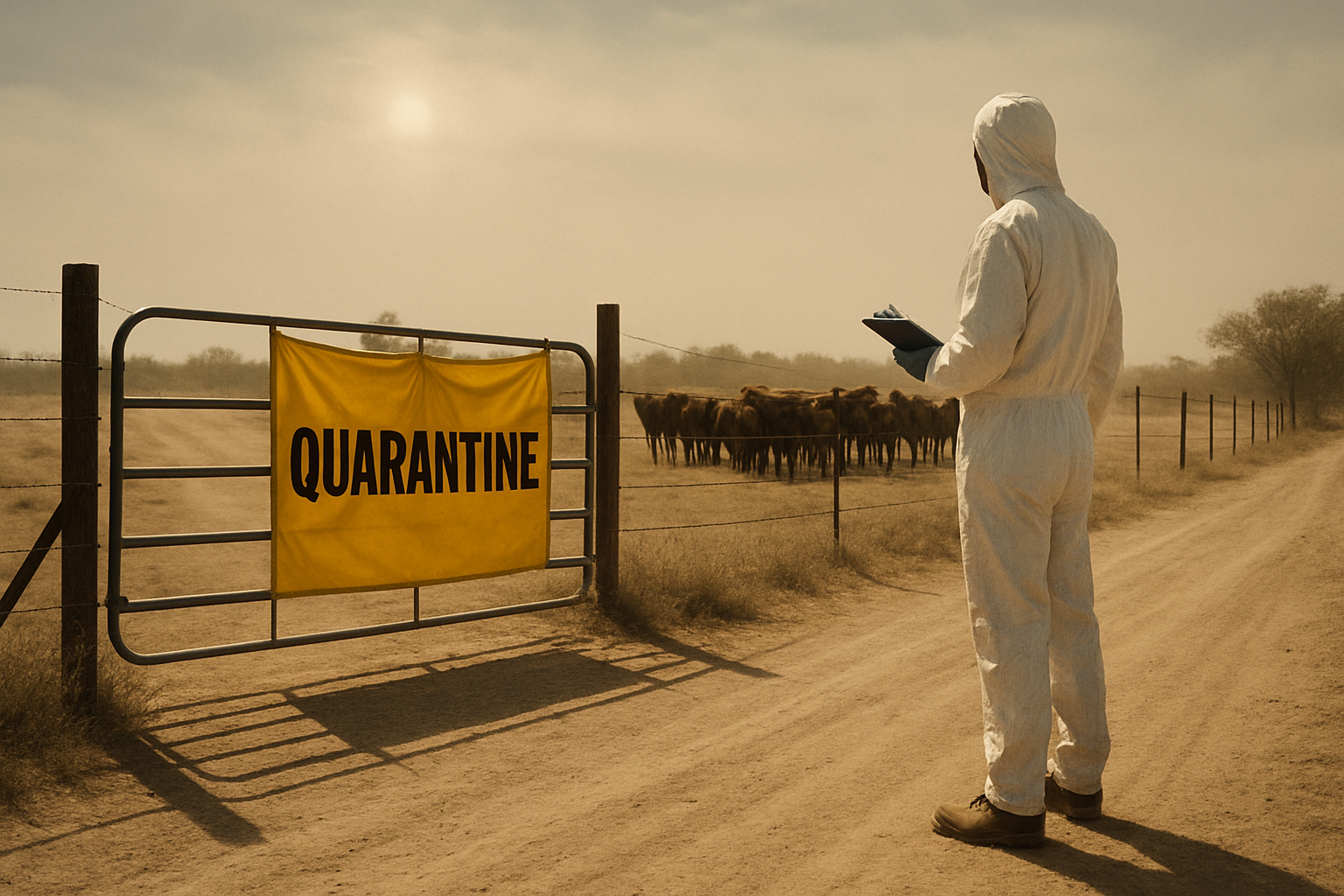
It is a warm late-July morning in the Texas Hill Country, and for ranchers across the state's sprawling rangelands, a familiar summer routine has become anything but routine. Movement permits, veterinary inspections, and strict quarantine orders now govern the transport of cattle, sheep, goats, and even family pets across parts of 21 counties. The cause is not drought, fire, or flood, but a pest many believed had been consigned to the history books generations ago: the New World screwworm.
As of early July 2026, the U.S. Department of Agriculture has confirmed 32 New World screwworm infestations in the United States — 31 in Texas and one in neighboring New Mexico. The most recent confirmed case, a sheep in Crockett County, was reported on July 3. It marked the latest development in what federal officials have described as the first domestic outbreak of this flesh-eating parasite in roughly six decades, and it has triggered an aggressive containment response spanning state lines, federal agencies, and the livestock industry.
The situation is evolving, but the core facts are clear: an ancient scourge has reappeared on U.S. soil, and the response is being measured in quarantines, closed ports, and heightened vigilance from the Rio Grande to the Edwards Plateau.
A parasite that feeds on living flesh
The New World screwworm — scientific name Cochliomyia hominivorax — is not a worm at all, but a parasitic fly. Its name derives from the distinctive, screw-like appearance of its larvae, which infest the living tissue of warm-blooded animals. The adult fly lays eggs at the edges of open wounds — a scratch from barbed wire, a branding cut, a tick bite, the naval of a newborn calf. When the eggs hatch, the maggots burrow into the wound and feed on the animal's flesh, sometimes causing catastrophic tissue damage and, if untreated, death.
Unlike common blowfly maggots that consume dead tissue, screwworm larvae attack living flesh. This distinction is why the pest is so feared by livestock producers and veterinarians. Infested animals may show signs of distress, reduced appetite, and visible, often foul-smelling wounds. Left untreated, a single infestation can be fatal.
The parasite's host range is broad. It affects cattle, sheep, goats, horses, pigs, dogs, cats, and wildlife such as deer. Humans are rarely infested, but it can occur, particularly when an open wound is exposed to egg-laying flies in an affected area. The Centers for Disease Control and Prevention (CDC) has emphasized that there have been no locally acquired human infestations reported in the United States and that the risk to the general public remains very low.
The current state of the outbreak
According to a consolidated tracker based on USDA data, the 31 Texas cases are spread across 12 counties: Crockett, Edwards, Terrell, Zavala, La Salle, Gillespie, Jim Hogg, Medina, Pecos, Sutton, Tom Green, and Uvalde. These counties span a broad swath of West, South, and Central Texas — an indication of how widely the pest has dispersed rather than appearing in a single cluster.
The USDA's dashboard, referenced in national and local reporting, lists six Texas counties with active infestations as of July 7, 2026: Terrell, Crockett, Edwards, Uvalde, Medina, and Jim Hogg. Six other Texas counties, along with one county in eastern New Mexico, are classified as inactive — meaning they have confirmed cases in their histories but no currently infested animals.
An earlier USDA update from June 22 reported 16 domestically acquired animal cases at that time, emphasizing that no human cases had been acquired in the United States. The escalation from 16 to 32 cases in a matter of weeks illustrates the challenge facing containment efforts: the pest is mobile, the landscape is vast, and the fly does not respect county lines.
Quarantines and movement controls: what they mean
The operational heart of the response is the quarantine system administered by the Texas Animal Health Commission (TAHC), the state's primary animal health authority. Under these orders, movement restrictions apply in parts of 21 counties, primarily across West, South, and Central Texas. The restrictions are not blanket lockdowns — instead, they are calibrated to prevent the movement of potentially exposed animals out of designated areas.
Under the quarantine orders, warm-blooded animals cannot leave designated quarantine areas without a certified inspection. A trained inspector or accredited veterinarian must examine each animal — often by looking into its eyes, ears, nose, mouth, and any wounds — to certify it is free of screwworm infestation before a movement permit is issued. Animals found to be infested cannot be sold or processed for meat.
In a significant federal-state measure, all southern ports of entry are currently closed to livestock trade. This cross-border restriction is designed to prevent the introduction of additional infested animals from regions where screwworm remains endemic, notably parts of South America and the Caribbean. The closure has implications for producers who rely on cross-border livestock commerce and underscores the seriousness with which officials view the outbreak.
For livestock owners in affected areas, the practical consequences are immediate. A rancher who normally moves cattle between pastures, ships calves to auction, or brings breeding stock home from a sale must now navigate a permitting process. A single inspection can be a matter of minutes — but scheduling that inspection, coordinating with an accredited veterinarian, and documenting the animal's health status adds time and friction to operations that previously ran on handshake simplicity.
Why this outbreak is different: a six-decade absence
The significance of the current situation cannot be understood without appreciating what came before. New World screwworm was eradicated from the United States in the late 20th century, a triumph of agricultural science that USDA officials have characterized as one of the great veterinary achievements in American history. The initial June case was described by USDA as the first domestic infestation in 60 years.
That eradication was achieved through the Sterile Insect Technique (SIT), a method developed in the 1950s by research entomologists Edward Knipling and Raymond Bushland. The concept was elegant: rear massive numbers of screwworm flies, sterilize the males with radiation, and release them into the wild. Sterile males mate with wild females, which then produce no offspring. Over successive generations, the wild population collapses.
The program involved the systematic release of billions of sterile flies across the southern United States, Mexico, and Central America. A permanent barrier was established at the Isthmus of Panama to prevent re-infestation from South America. The campaign was so successful that screwworm became one of the few insect pests to be eradicated from a continental landmass.
That barrier, however, has weakened over time. In recent years, screwworm outbreaks have been detected in Mexico, Central America, and most notably in Panama, where the biological containment zone has been strained. The reappearance in Texas is consistent with a pattern of northward spread that veterinarians and entomologists warned about long before the first U.S. case was confirmed this spring.
The fact that cases now span 12 Texas counties suggests that the pest has had time to establish a presence before detection, rather than arriving in a single, well-contained incident. USDA officials have acknowledged the challenge of halting spread across large distances in Texas, where livestock operations are often separated by many miles and wildlife — including white-tailed deer — can serve as unsuspecting hosts.
Human health: low risk, but not zero
For residents of affected counties, the most urgent questions often concern personal safety. The CDC has been explicit in its guidance: no locally acquired human infestations have been reported in the United States, and the risk to people remains very low, localized to areas with animal cases and primarily relevant to those in close contact with livestock or wildlife.
But "very low" is not "zero." Human screwworm infestations, while rare, are well-documented historically, particularly in rural communities where open wounds may go untreated and where livestock handling is a daily activity. The CDC has issued clinical guidance for health-care providers, emphasizing that a rash or persistent wound in a person with exposure to affected areas should be evaluated with screwworm in mind, especially if the wound contains visible larvae.
The agency has also noted that the risk is primarily occupational and geographic: ranch hands, veterinarians, wildlife biologists, and others who handle animals or work outdoors in affected zones face a higher, though still low, level of exposure. The general public — including those who live in cities or who do not interact with livestock — faces a negligible threat.
This messaging is important for public officials, who are keenly aware that fear of a "flesh-eating" parasite can quickly outpace the actual risk. Balanced communication is essential to maintain public cooperation without inducing panic.
Economic impact: the cost to ranchers and markets
The economic stakes of this outbreak extend far beyond the direct losses from infested animals. The cattle industry is central to the Texas economy, and Texas is the nation's leading cattle-producing state. Quarantines that restrict animal movement ripple through the supply chain: auction markets in affected areas may see reduced consignments, feedlots may face delays in receiving cattle, and packing plants may adjust schedules and volumes.
The prohibition on selling infested animals for meat removes an avenue of recovery for producers who have lost animals to the pest. For a rancher who discovers screwworm in a herd, the immediate priority is treatment — applying chemical larvicides to wounds and isolating affected animals — but the financial hit can be substantial.
Beyond Texas, the closure of southern ports of entry to livestock trade affects a broader market that includes cross-border commerce with Mexico. The duration of that closure is uncertain, and prolonged restrictions could create supply disruptions and price volatility in the livestock sector.
There is also the question of international trade. The United States is a major exporter of beef and livestock genetics. Trading partners may impose their own sanitary restrictions on U.S. livestock and meat products in response to the outbreak, even though the disease poses no food-safety risk to consumers. The USDA has emphasized that infected animals cannot enter the food supply, but trade policy does not always move at the speed of scientific assurance.
For producers, the experience echoes other recent animal-disease outbreaks. From avian influenza in poultry to brucellosis in cattle, U.S. agriculture has repeatedly learned that the costs of a livestock disease go far beyond the veterinary bill. Business interruption, market uncertainty, and administrative burden often outweigh the direct losses.
The response: agencies and coordination
The response is being led at the federal level by the USDA's Animal and Plant Health Inspection Service (APHIS), which is responsible for case confirmation, surveillance, quarantine coordination, and communication with state partners. APHIS maintains a public portal tracking the current status of New World screwworm, and it has been updating case counts and movement restrictions in near real time.
At the state level, the Texas Animal Health Commission is the primary authority implementing quarantines and working directly with producers, veterinarians, and auction markets. The TAHC's role is critical: while the USDA provides federal authority and resources, state agencies hold the primary legal authority over animal movement within their borders, and it is state inspectors who conduct the certifications that allow animals to move.
New Mexico's involvement, while smaller — one confirmed case in a county on the eastern side of the state — demonstrates that this is not a purely Texas problem. The New Mexico Livestock Board and other state agencies are coordinating with USDA to ensure surveillance extends beyond the primary outbreak zone.
This federal-state partnership is well-established in animal disease response, but it is being tested by the scale and geography of this outbreak. Texas is a vast state, and the confirmed cases span roughly 500 miles from east to west. Surveillance efforts must cover ranchland, wildlife habitat, and areas where livestock density is low but present — a challenging proposition under the best of circumstances.
Perspectives: urgency and caution
Among the stakeholders in this outbreak, there is broad agreement on the fundamentals: the pest must be contained, surveillance must be aggressive, and movement controls are a necessary inconvenience. But there are differences in emphasis.
Producers in affected areas tend to focus on the practical — they want clear rules, fast inspections, and a predictable path to returning to normal operations. Some have expressed frustration with the logistics of the permitting process, particularly in the early weeks of the outbreak when guidance was still evolving.
Officials at USDA and TAHC, for their part, have warned that the situation remains fluid and that current case counts may not capture the full scope of infestations in the wild. The presence of screwworm in wildlife — deer, feral hogs, and other mammals — complicates eradication, because wildlife cannot be inspected or treated with the same certainty as domestic livestock. This is a recognized vulnerability in the response.
Entomologists and veterinary epidemiologists have noted that the reappearance of screwworm was foreseeable, and they caution that eradication — if achieved — will require sustained investment in the biological barrier that once protected the United States. The current outbreak may be containable, they argue, but the conditions that allowed it to occur will remain unless the underlying prevention infrastructure is strengthened.
There is also a broader conversation about climate: screwworm flies thrive in warm, humid conditions, and a warming climate may be expanding the geographic range where the pest can survive and reproduce. While no single weather event can be blamed for this outbreak, the trajectory of the fly's northward movement aligns with what many entomologists would predict under changing environmental conditions.
What happens next
As of late July 2026, the immediate priorities are clear: continue surveillance, identify and quarantine infested premises, certify animal movements, and treat affected animals. The USDA and TAHC are expected to refine the quarantine boundaries as new data emerge, potentially expanding or contracting the designated areas in response to detection results.
A critical test will be the coming weeks — the screwworm lifecycle is short, and summer conditions in Texas are conducive to fly activity and reproduction. If movement controls are effective and surveillance is sufficiently sensitive, the number of new cases should begin to decline over a period of several weeks. If the pest has gained a broader foothold than currently detected, case counts may continue to rise before peaking.
The possibility of eradication is real but not assured. The sterile insect technique that eliminated the pest in the 20th century remains a proven tool, but reviving the infrastructure for sterile fly production and release takes time, money, and coordination with international partners. Officials have not yet announced a timeline for potential sterile-release operations, and the immediate focus is on containment rather than a decisive eradication campaign.
For the ranchers, veterinarians, and communities living with the quarantine orders, the wait is the hardest part. Every animal movement requires paperwork; every wound on every animal requires scrutiny; every unexplained death casts a shadow of uncertainty. The outbreak has made an invisible enemy tangible, and the response has been methodical — but the full picture will only become clear in the weeks and months ahead.
What is certain is that the New World screwworm's return has ended a 60-year winning streak against one of agriculture's most feared pests. The battle is now being fought county by county, wound by wound, and move permit by move permit. The outcome will depend on the vigilance of the people on the ground — the inspectors, the veterinarians, and the producers who must live with the consequences of every decision. The stakes could hardly be higher for Texas agriculture, and the resolve to see this through is still being tested.