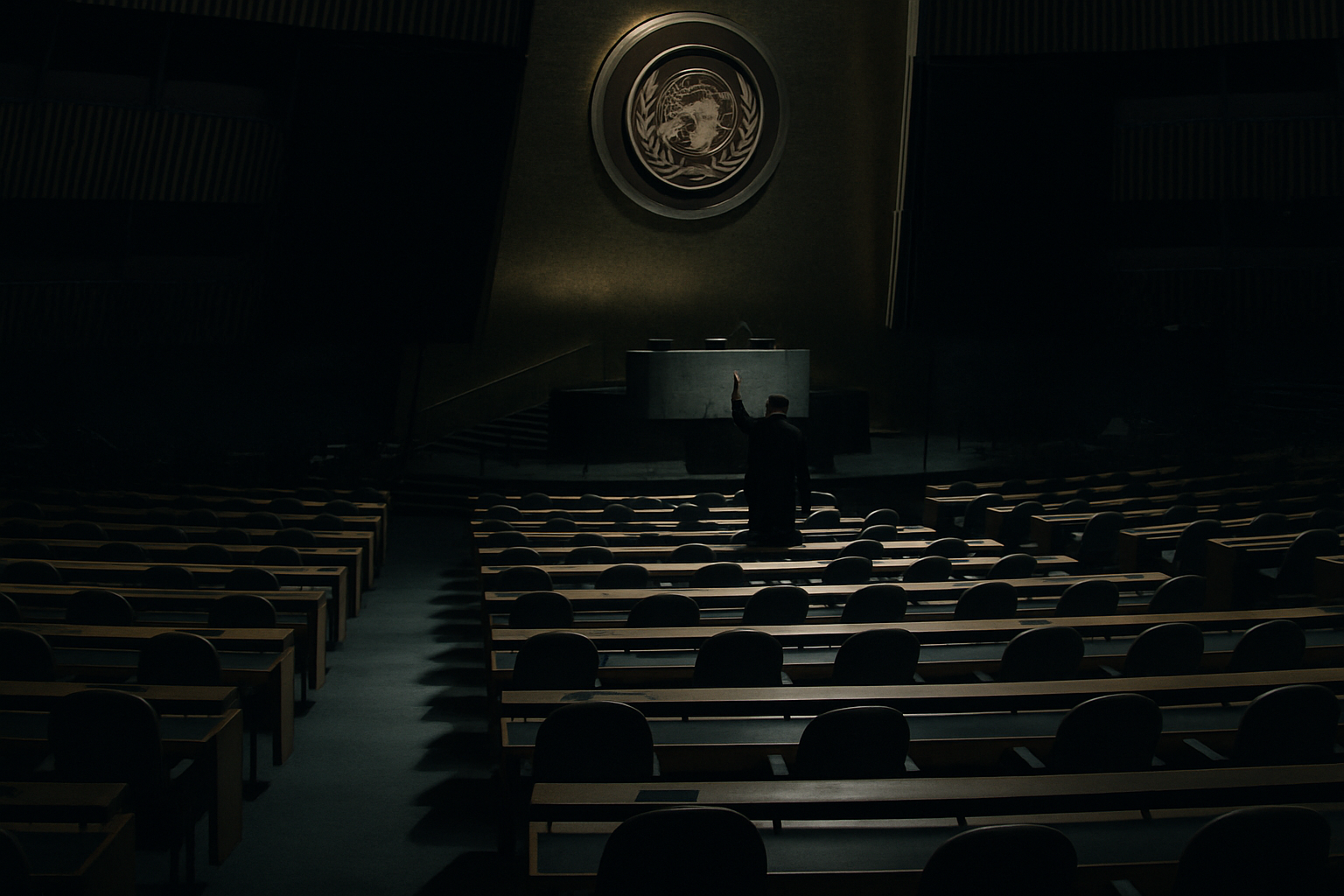
A Global Call for Ceasefire: UN General Assembly Demands Immediate End to Gaza Fighting
The United Nations General Assembly has delivered its most emphatic demand yet for an end to the war in Gaza. On [date of adoption, not specified in research], the 193-member body voted overwhelmingly—149 in favour, 12 against, and 19 abstentions—to adopt a resolution demanding “an immediate, unconditional and permanent ceasefire in Gaza by all parties.” The text, passed during an emergency special session on the Question of Palestine, also calls for the immediate release of all remaining hostages, the lifting of Israel’s blockade, and the unimpeded flow of humanitarian aid into the shattered territory.
Yet the resolution is non-binding. And on the ground, the fighting continues. The war, which erupted with Hamas’s devastating attack on Israel on 7 October 2023, has now entered its third year. More than 54,000 Palestinians have been killed, according to Gaza health authorities, and the humanitarian crisis is described by UN agencies as catastrophic—marked by widespread hunger, mass displacement, and the systematic destruction of civilian infrastructure. The new resolution explicitly condemns the use of starvation as a method of warfare, a charge that Israel and its allies reject, but one that has increasingly defined the international debate.
This article examines what the latest UN vote means, why it matters, and the formidable obstacles that remain to translating global political will into a durable ceasefire.
---
What Is Happening Right Now
Despite a cascade of UN resolutions—including previous General Assembly emergency-session texts and multiple Security Council ceasefire demands—Israeli military operations continue across Gaza, particularly in areas described by the Israel Defense Forces as remaining Hamas strongholds. Armed groups, including Hamas, remain active, and a subset of hostages taken on 7 October 2023 is still believed to be held in the Strip, even after several partial exchanges under earlier truce agreements.
The humanitarian picture is grim. The UN’s latest reports describe a territory where more than half the population is on the brink of famine, where hospitals have been repeatedly struck or forced to close, and where over 1.9 million people have been displaced, many of them multiple times. The destruction of Gaza’s housing stock is near-total in the north, and large swathes of the south, particularly around Khan Younis and Rafah, have been levelled by air and artillery strikes.
Aid delivery remains severely restricted. The new resolution demands that Israel immediately lift its blockade, open all border crossings, and allow “full, safe and unimpeded” humanitarian access across the entire Strip. But Israel has long argued that it must inspect all incoming goods to prevent arms reaching Hamas, and it has rejected the idea of unconditionally opening crossings while hostilities continue. The US, Israel’s closest ally, has consistently shielded Israel from binding Security Council action, vetoing ceasefire texts even when backed by 14 of 15 Council members.
Mediation efforts continue, led by Egypt, Qatar, and the United States, operating under UN auspices. These talks have attempted to broker a negotiated deal that would link a ceasefire with the release of hostages and Palestinian prisoners, the withdrawal of Israeli forces from populated areas, and a surge in humanitarian aid. But no comprehensive agreement has been implemented to date. The latest General Assembly resolution explicitly “urges full implementation” of Security Council resolution 2735 (2024)—a past US-drafted text that laid out a roadmap for a phased ceasefire, hostage-prisoner exchanges, and the return of displaced persons, along with an eventual Israeli withdrawal from Gaza. That earlier resolution has also remained unimplemented.
---
The New Resolution: Content, Voting, and Legal Status
The text adopted by the General Assembly is the product of intense negotiations among member states, led by the Non-Aligned Movement and the Arab Group. It was tabled during the tenth emergency special session of the General Assembly, a mechanism used when the Security Council is deadlocked—as it has been throughout the Gaza war.
Key provisions include:
The vote was lopsided: 149 countries supported the resolution, 12 opposed, and 19 abstained. Among those voting against were the United States, Israel, Argentina, Hungary, and Paraguay. Abstentions included India, Georgia, Ecuador, Romania, and Ethiopia—countries that often seek to balance ties with both Israel and the Arab world.
General Assembly resolutions are not legally binding under the UN Charter. They are, however, powerful expressions of world opinion. The United Nations Secretary-General, António Guterres, has repeatedly called for a ceasefire, release of hostages, and a massive scale-up of aid. The vote amplifies that call but cannot compel compliance.
The latest text follows a pattern. In December 2024, the Assembly had already passed a resolution calling for an “immediate, unconditional and lasting ceasefire,” receiving an even larger majority of 158 votes in favour. That earlier resolution, too, was ignored on the ground. The non-binding nature of these votes means that the gap between international consensus and battlefield reality remains large.
---
Key People and Organisations Involved
At the UN, Secretary-General Guterres has been the most vocal advocate for a ceasefire. He has warned repeatedly that international humanitarian law is being “turned on its head” in Gaza and has urged both Israel and Hamas to agree to a cessation of hostilities.
In Israel, the government of Prime Minister Benjamin Netanyahu has consistently rejected UN resolutions that do not condition a ceasefire on the complete dismantling of Hamas’s military capabilities and the return of all hostages. Israeli officials have argued that an unconditional ceasefire would leave Hamas in power, allowing it to regroup and threaten Israel again—a scenario they say is unacceptable for national security.
Hamas, designated a terrorist organization by the US, EU, and others, has indicated willingness to accept a ceasefire that includes a full Israeli withdrawal and a comprehensive prisoner exchange, but it has not ceased its rocket attacks or underground activity. The group has been severely degraded militarily but remains capable of striking Israeli positions and launching rockets.
The United States, under the current administration, continues to provide diplomatic cover for Israel at the Security Council, vetoing binding ceasefire resolutions while simultaneously supporting the mediation track. US officials have argued that a negotiated deal between the parties is the only viable path to a sustainable peace—a position that critics say effectively enables the continuation of the war.
Mediators Egypt and Qatar maintain direct channels with both Israel and Hamas. Cairo has historically played a central role in brokering truces, while Doha has hosted Hamas’s political leadership and facilitated hostage release negotiations. Their efforts have secured short-term pauses and partial hostage exchanges but have yet to produce a permanent ceasefire.
---
Background and Context: A War in Its Third Year
The current war began on 7 October 2023, when Hamas-led gunmen breached the Gaza border fence, killing some 1,200 Israelis and taking over 250 hostages in a coordinated assault that caught the IDF off guard. Israel responded with a massive air and ground campaign aimed at destroying Hamas’s military and governing capabilities.
Since then, the conflict has widened. Hezbollah in Lebanon has exchanged fire with Israel across the Blue Line, though the main front remains Gaza. The war has drawn in Iran-backed militias in Syria and Iraq, and led to Houthi attacks on Red Sea shipping, disrupting global trade. The human toll in Gaza is staggering: over 54,000 Palestinians killed, according to the Gaza Health Ministry, which does not distinguish between combatants and civilians but reports that a high proportion are women and children. Thousands more remain buried under rubble.
Israel has faced growing international isolation over its conduct of the war. The International Court of Justice is considering a genocide case brought by South Africa, while the International Criminal Court has issued arrest warrants for senior Israeli and Hamas leaders. Several European countries have suspended arms sales, and even the United States has criticized specific military operations, such as the offensive in Rafah, while continuing to supply weapons.
The UN has repeatedly documented violations of international humanitarian law by both sides. The new General Assembly resolution underscores the obligation to ensure accountability, though the mechanisms remain weak.
---
Impact and Implications
The latest UN vote carries significant political weight, even if it lacks enforcement teeth. For the Palestinian Authority and the governments of the Global South, the near-universal support for an unconditional ceasefire reinforces their narrative that Israel’s actions are unacceptable under international law. For humanitarian organizations, the resolution provides a renewed mandate to pressure Israel and Hamas to allow aid and protect civilians.
For Israel and its supporters, the resolution is seen as one-sided and counterproductive. The Israeli mission to the UN has argued that it does not address the root cause of the conflict—Hamas’s attack and continued refusal to disarm—and that it rewards the group’s aggression. The US vote against the resolution reflects its view that the text fails to condition the ceasefire on hostage release and security guarantees, though it does contain a hostage-release demand.
The 19 abstentions point to a middle ground: countries that want an end to the war but are wary of isolating Israel or of legitimizing Hamas. India, for example, has traditionally maintained close ties with Israel while also supporting Palestinian statehood; its abstention signals discomfort with the resolution’s uncompromising language on a “permanent” ceasefire.
For the UN itself, the repeated failure to enforce its resolutions—both from the Security Council and the General Assembly—raises questions about the organization’s relevance in resolving major armed conflicts. The gap between what the international community demands and what actually happens on the ground is a recurring criticism.
---
What Happens Next
The resolution will now be forwarded to the Security Council, though it is non-binding and the Council has no obligation to act. The General Assembly can reconvene its emergency session if the situation warrants, but without a binding Chapter VII resolution, the means of implementation are limited to diplomatic pressure—naming and shaming, political isolation, and potential economic measures by individual states.
Mediation efforts in Cairo and Doha are expected to intensify as the human cost of continued fighting mounts. The Biden administration has expressed support for a deal based on Security Council resolution 2735, but there is no clear timeline. If negotiations fail, the war could continue indefinitely, further devastating Gaza and destabilizing the region.
Some analysts suggest that the sheer weight of the evidence of starvation and civilian death may eventually force a shift in US policy, but such a shift has not materialized in the nearly three years since the war began. Meanwhile, the International Court of Justice and the International Criminal Court are pursuing cases that could complicate diplomatic options.
For now, the people of Gaza—those still alive—wait in rubble, under bombardment, under blockade. The UN has spoken. The world has spoken. But without the power to enforce its words, the question remains: will anyone listen?