A Deadly Strike at Sea: The Rising Human Toll of the U.S. Counter-Narcotics Campaign in the Eastern Pacific
The latest chapter in America’s intensifying maritime war on drugs unfolded on Tuesday, when U.S. forces attacked a small vessel in the eastern Pacific Ocean, killing one man and leaving two survivors adrift in the water. U.S. Southern Command (SOUTHCOM) confirmed the strike, describing it as a legitimate action against a boat operating on “known smuggling routes,” yet acknowledged that no concrete evidence of drugs was presented publicly. The incident has added to a growing human toll that, according to military figures, now exceeds 200 lives lost since the campaign began in earnest last autumn.
This strike, and another that followed on Thursday—killing three more men on a second suspected drug boat—has intensified scrutiny of a lethal, ongoing campaign that critics say operates with insufficient transparency, questionable legal grounding, and a chilling disregard for civilian life. As the Biden administration continues to frame these operations as essential to protecting the U.S. homeland, lawmakers and human rights groups are demanding answers about the rules of engagement, the quality of human intelligence driving the strikes, and the fate of survivors.
What Happened: The Tuesday Strike and Its Aftermath
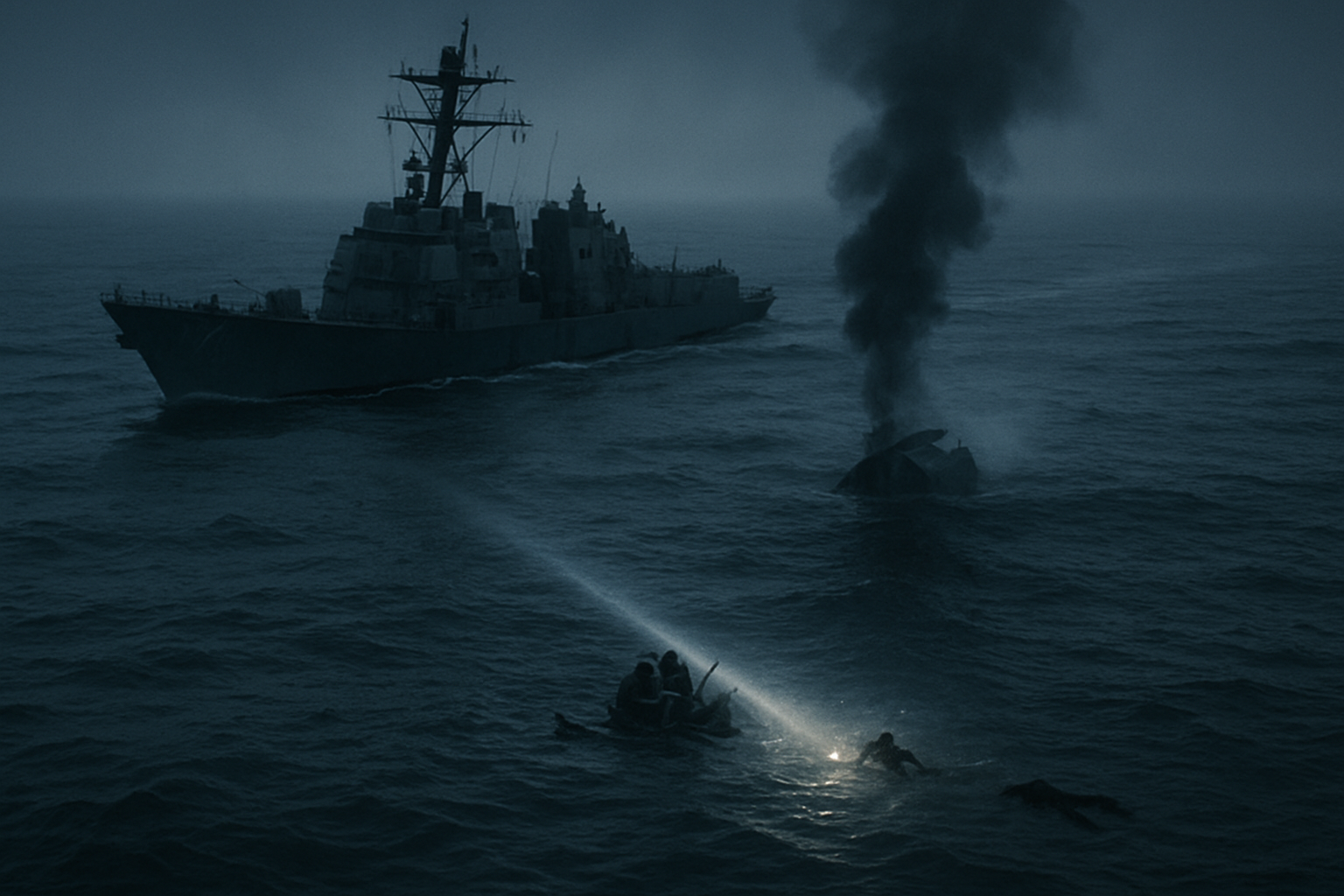
According to SOUTHCOM, the Tuesday attack was conducted by a specialized unit—Joint Task Force Southern Spear—against a small, fast-moving vessel in the eastern Pacific. Video released by the military on social media shows the boat traveling at speed before it is hit, bursts into flames, and begins to break apart. The strike killed one man. Two other individuals were left in the water.
“U.S. Southern Command promptly informed the U.S. Coast Guard to initiate the Search and Rescue protocol for the survivors,” the command said in a statement. As of the latest reporting, the two survivors were alive when rescue operations were triggered, but their identities, nationalities, injuries, or subsequent detention status have not been publicly disclosed. No U.S. service members were injured in the operation.
The military described the vessel as being on “known smuggling routes” but did not present physical evidence—such as a documented drug seizure—that it was carrying narcotics at the moment of the strike. This lack of public corroboration has become a recurring theme in the campaign, and a flashpoint for critics.
The Broader Campaign: A Year of Rising Deaths
The Tuesday strike is not an isolated event. It is the latest in a months‑long campaign that began in early September of the previous year. According to SOUTHCOM figures cited in reporting, at least 208 people have been killed in U.S. kinetic strikes on suspected narcotics‑related vessels in the eastern Pacific and Caribbean since the campaign started. With the Thursday strike—which killed three more men in the same general region—the cumulative death toll in the Pacific theater alone has risen to at least 211.
These operations are carried out by Joint Task Force Southern Spear, a specialized maritime strike force operating under the direction of SOUTHCOM Commander Gen. Francis L. Donovan. The task force uses aerial assets—likely armed drones or manned aircraft—to locate and attack small boats believed to be moving cocaine and other drugs from Latin America toward the United States. In many cases, the vessels are destroyed with no survivors, and bodies are rarely recovered.
The U.S. government describes these as “kinetic strikes” against “narcoterrorists” and “alleged traffickers,” and asserts they are conducted “in accordance with the law of armed conflict.” Officials argue that the operations are necessary to protect the U.S. homeland by disrupting smuggling networks before they reach U.S. waters. But the scale of the killing—over 200 deaths in less than a year—has raised alarms among human rights organizations and some members of Congress.
Legality and Transparency Under Fire
The legal framework for these strikes is a matter of intense debate. The U.S. government typically invokes the law of armed conflict (LOAC) and the right of self‑defense when targeting vessels on the high seas. But critics argue that drug trafficking, while a serious crime, does not meet the threshold of an armed attack that would justify lethal force under international law. Moreover, the lack of public evidence linking each targeted vessel to actual narcotics—such as visible drug bales, intercepted communications, or subsequent seizures—leaves the operations open to accusations of extrajudicial killing.
“The administration must explain how it is distinguishing between armed drug smugglers and innocent fishermen or other mariners,” said one congressional aide, speaking on condition of anonymity, in a briefing cited by news reports. Lawmakers have pressed the Pentagon for more detailed after‑action reports, including the intelligence that justified each strike. So far, those requests have yielded only general assurances of compliance with the law.
The issue is further complicated by the fact that many of the vessels targeted are small, unarmed or lightly armed fishing boats that may be coerced into smuggling. Survivors, when they exist, are typically taken into custody by the U.S. Coast Guard for processing and potential prosecution—but their stories of what happened, and whether they were aware of the cargo, are rarely made public.
The Human Toll: 211 Dead and Counting
The cumulative figure of at least 211 deaths in the Pacific alone represents a significant escalation in the use of lethal force in counter‑drug operations. For comparison, during the height of the drug war in the 1990s and early 2000s, the U.S. Coast Guard and Navy interdictions rarely resulted in such high body counts. The current campaign is markedly more aggressive, relying on precision strikes rather than boarding and seizure.
Each death is recorded by SOUTHCOM but the identities of the dead are often unknown. Bodies are seldom recovered. In the Tuesday strike, the single fatality has not been named. The two survivors—the first such survivors publicly acknowledged in recent months—may provide a rare window into the human dimension of this conflict, though their detention status remains unclear.
Human rights groups, including Amnesty International and the Washington Office on Latin America, have repeatedly called for an independent investigation into the strikes, arguing that the lack of transparency undermines accountability. “The U.S. military is killing people at sea without any meaningful oversight,” one advocate said in a statement. “We don’t know who they are, we don’t know if they were really smugglers, and we don’t know how many were innocent.”
Key Actors: Who Is Directing the Campaign?
The campaign is being executed by Joint Task Force Southern Spear, which operates under the command of Gen. Francis L. Donovan, the head of U.S. Southern Command. Donovan, a four‑star general, is the key decision‑maker approving targeting guidance and rules of engagement. His command has not publicly commented on the specific intelligence behind the Tuesday strike, nor on the broader criteria for using lethal force.
The U.S. Coast Guard, while not under SOUTHCOM’s command, plays an integral role in the aftermath. In the Tuesday case, SOUTHCOM stated that the Coast Guard was notified immediately to conduct Search and Rescue for the survivors. Typically, the Coast Guard also conducts subsequent boarding, evidence collection, and detainee handling when survivors or vessels are interdicted. However, in this case, the target vessel was destroyed, limiting the ability to gather physical evidence.
Background: How the Campaign Evolved
The current wave of lethal maritime strikes began in early September 2025, under the same administration. Prior to that, the U.S. had relied more heavily on intelligence‑led boardings by the Coast Guard and Navy, with shots fired only in self‑defense. The shift to pre‑emptive strikes—using aircraft to destroy boats before any law enforcement action—represented a significant doctrinal change.
Officials initially cited a surge in drug flows from South America, particularly from Venezuela and Colombia, as the rationale. They argued that traditional interdiction was insufficient and that “kinetic disruption” was necessary to keep pace with increasingly sophisticated smuggling networks. The strikes were publicly portrayed as surgical, with low collateral damage. But the rising death toll has belied that narrative.
Analysts note that the strategy carries inherent risks: without physical seizure, the military cannot confirm the cargo or the intent of the crew. Intelligence may be based on human sources, signals intercepts, or pattern‑of‑life analysis—all of which can be fallible. Errors, if they occur, are nearly impossible to detect because the evidence is destroyed.
Perspectives: Supporters and Critics
Supporters of the campaign, including many within the U.S. military and law enforcement communities, argue that the strikes are a necessary response to a transnational threat that kills tens of thousands of Americans each year. “These are not fishermen—they are part of a violent criminal enterprise that poisons our communities,” one former U.S. Navy official told the press, speaking on background. The legal justification, they say, is sound: under the law of armed conflict, the U.S. may use force against enemy combatants, and drug trafficking organizations that operate like insurgencies can be considered enemy forces.
Critics, however, counter that the designation of drug traffickers as “narcoterrorists” blurs the line between law enforcement and armed conflict. They point to the absence of formal armed conflict declarations and the lack of congressional authorization. “This is a war without borders, without a clear enemy, and without an exit strategy,” said a senior fellow at a Washington‑based think tank in a recent analysis.
The human rights angle is also gaining traction. The survivors from Tuesday—if they are brought to shore and processed—may provide testimony that could shape public opinion. But if they are quickly deported or held incommunicado, their stories may never be heard.
What Happens Next
The immediate future of the campaign appears set to continue. Gen. Donovan and SOUTHCOM have shown no signs of altering the operational tempo. The Thursday strike that killed three more men suggests that the forces are still actively hunting targets. With the congressional summer recess approaching, lawmakers may hold hearings to press for more transparency.
On the international stage, the strikes could strain relations with Latin American governments, who have already expressed concerns about U.S. military operations in their maritime domains without prior consultation. The Organization of American States has not yet formally commented, but human rights bodies within the inter‑American system may take up the issue.
For the families of the dead and missing—if they ever learn of their loved ones’ fates—the campaign represents an invisible war with devastating personal consequences. The U.S. government has not released any information on how it informs, if at all, the families of those killed in strikes.
As the body count climbs past 200 and into uncharted territory, the question is no longer whether these strikes are effective, but whether they are lawful, proportionate, and humane. The Tuesday strike, with its sole fatality and two survivors, may become a test case for that debate. The survivors—if they speak—could finally put a face to the statistics. And that, perhaps, is what the U.S. government most fears.