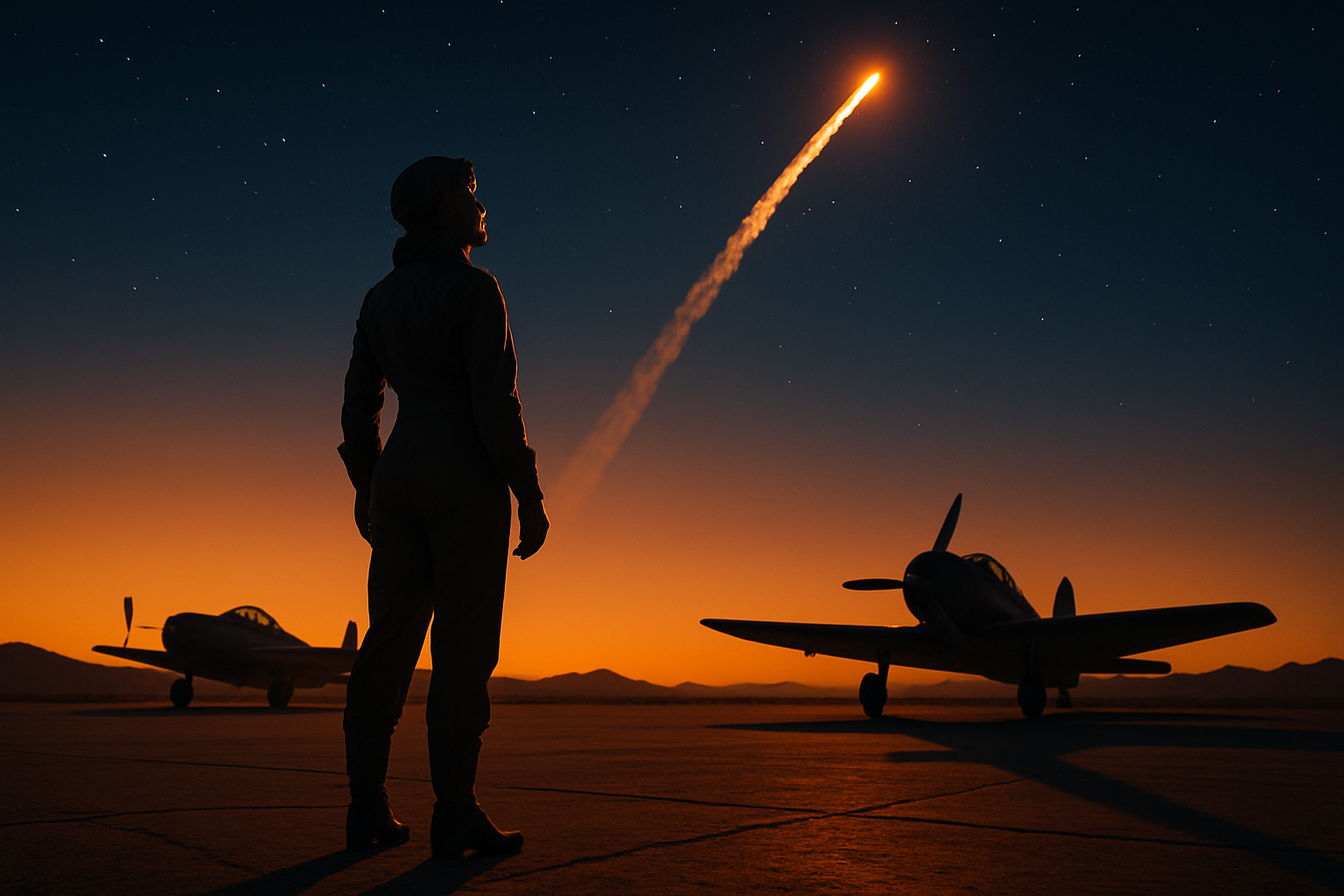
Wally Funk, the pioneering aviator who waited six decades to fulfill her dream of spaceflight and, at age 82, became the oldest woman ever to travel beyond Earth's atmosphere, has died. She was 87.
Funk died on July 8, 2026, at her home in Grapevine, Texas, according to city officials, who confirmed the news to reporters on July 9 and 10. No cause of death was disclosed. The announcement prompted an outpouring of retrospective coverage from major news organizations worldwide, all centering on a singular, remarkable life: a woman who refused to accept the limits placed on her, who trained for space in an era when NASA barred women from the astronaut corps, and who ultimately flew on a commercial rocket decades after her original candidacy was rejected.
Her death marks the end of an era for American aviation and for the trailblazing cohort of female pilots known as the Mercury 13 — a group of deeply qualified women who passed the same rigorous physical testing as the male Mercury astronauts but were never permitted to fly. Funk was the last of that group's most visible advocates, and the only one of its members who ever made it to space.
A life measured against the sky
The public confirmation of Funk's death came from Grapevine city spokesperson Mona Quintanilla, who announced that Funk had died at her home in the Dallas–Fort Worth suburb. The Associated Press reported that Councilwoman Duff O'Dell, a member of the Grapevine City Council, said she had been Funk's caregiver and was with her when she died. O'Dell told AP that Funk had recently suffered a fall and had been battling a leg infection, adding detail to the circumstances of her final weeks without specifying an official cause of death.
For a culture that had come to know Funk as an indomitable figure — all warmth, grit, and Oklahoma drawl — the news was a moment to reckon with a life that spanned nearly nine decades of aviation history. Born in 1939, Funk grew up in an era when women pilots were rare and female astronauts were considered, by official policy, an impossibility. She learned to fly as a teenager, earned her pilot's license, and went on to accumulate thousands of flight hours, becoming a professional flight instructor at a time when the cockpit was overwhelmingly male.
Those biographical contours are now central to how her legacy is being framed. Reuters, The Associated Press, NPR, CNN, and The New York Times have all published obituaries describing her as a trailblazer who spent decades pursuing spaceflight after her earlier astronaut training was rejected. The Washington Post and The Guardian have likewise emphasized her dual legacy: a storied aviation career and a historic place in the commercial space age.
The Mercury 13: tested, qualified, rejected
The chapter of Funk's life that most defines her place in history began in 1961, when she was invited to participate in a privately funded program testing women astronauts. The project, developed by physician William Randolph Lovelace II, subjected female pilots to the same rigorous physical and psychological examinations used to screen NASA's male Mercury astronauts.
Funk excelled. According to the historical record of that program, she performed exceptionally well across the battery of tests — and even claimed to have outperformed the men. But the program was abruptly shut down. The women were never allowed to enter formal NASA training. Members of Congress held hearings; the women testified; NASA officials insisted that astronaut requirements included military jet test-pilot experience, which was unavailable to women at the time.
The group of 13 women who completed the private testing became known as the Mercury 13 — a name coined decades later to retroactively parallel NASA's first class of male astronauts. Funk was among the youngest of them, and for the next six decades she became one of the group's most vocal and energetic advocates, insisting that she and her peers had been cheated of the chance to compete on equal terms.
The research coverage of her death consistently notes that she was the only member of the Mercury 13 to ever reach space. The distinction matters not only as a personal triumph but as a symbolic bookend: a woman long denied the chance to fly for her country finally flew, in the end, on the wings of a private company.
Decades of flight instruction and advocacy
While the spaceflight would come late in her life, Funk never stopped flying. Over the course of her career, she taught thousands of students to fly. As a flight instructor, she was renowned for her rigor and her passion, and she logged more than 19,000 flight hours — a figure frequently cited in earlier profiles of her, though the research provided for this article does not confirm the exact number.
What is clear from the obituary coverage is that Funk pursued spaceflight relentlessly throughout her adult life. She applied to NASA's astronaut corps multiple times across the decades, and was rejected each time. She funded private efforts to continue testing women for spaceflight in the 1960s. She later became a Federal Aviation Administration safety inspector and a National Transportation Safety Board investigator, roles that kept her deeply embedded in aviation culture.
In her later years, Funk became something of an aviation celebrity — an elder stateswoman of the skies who could be counted on to speak plainly about the barriers she faced. She never married, by the accounts in earlier profiles, and devoted herself fully to aviation. Her home in Grapevine, where she died, had been her base for decades, and she remained active and publicly engaged well into her eighties.
The 2021 flight: a lifetime of waiting, a moment of joy
The defining public moment of Funk's life came on July 20, 2021, when she strapped into Blue Origin's New Shepard spacecraft for a suborbital flight from the company's West Texas launch site. She was 82 years old. The flight made her the oldest person ever to travel into space — a record she held, briefly, before it was surpassed.
The circumstances of how she got that seat are themselves a testament to her persistence. Blue Origin founder Jeff Bezos had initially selected a different passenger for the flight's "guest" seat. When that passenger's schedule changed, the seat opened up. Funk had long been a vocal figure in space advocacy, and her name had circulated publicly as a candidate. According to the coverage around the 2021 flight, Bezos himself invited her to fly, describing it as a correction of a historic injustice.
Funk's response, widely quoted at the time in broadcast coverage, was pure Wally Funk: she said she had been waiting to go to space her whole life, and that when Bezos asked, she told him, "I want to go." She flew alongside a crew that included Bezos, his brother Mark, and Oliver Daemen, an 18-year-old Dutch student — a stark generational contrast that only underscored the symbolic weight of her presence.
The flight itself lasted just over ten minutes, reaching an altitude above the internationally recognized boundary of space. Funk experienced weightlessness, something she had trained decades earlier to tolerate. She emerged from the capsule ecstatic, and in the immediate aftermath she told crowds — and anyone with a microphone — that she had loved every second. Video of her laughing and weeping with joy inside the capsule became one of the defining images of the commercial spaceflight boom.
For Blue Origin, the flight was a public-relations triumph. For Funk, it was the fulfillment of a promise she had made to herself as a young woman in the 1960s. And for historians of the space age, it was a moment of quiet justice: a woman systematically excluded from the early space program had outlasted every barrier placed in her path.
A record broken, a legacy intact
The record Funk set in July 2021 did not stand unchallenged for long. Later that same year, actor William Shatner — best known for playing Captain James T. Kirk on "Star Trek" — flew on another Blue Origin New Shepard launch at age 90, taking the title of oldest person in space. In 2024, artist and former Air Force test pilot Ed Dwight, who had been the first Black American candidate for NASA's astronaut corps, flew at an even more advanced age, according to Washington Post and Guardian coverage of Funk's death.
Those subsequent flights, however, did not diminish Funk's singular status. She remains the oldest woman ever to have flown in space, a record that the research coverage confirms has not been broken. And she remains the only member of the Mercury 13 ever to have reached space — a fact that gives her 2021 flight enduring historical weight.
The coverage of her death has been careful to note this distinction: while she was no longer the oldest person to have gone to space, she retains the women's record and the Mercury 13 distinction. For those who followed her story, the nuance matters. Her flight was not merely a stunt or a record-breaker; it was the culmination of a personal campaign that stretched across more than half a century.
A broader commercial spaceflight context
Funk's death comes at a moment when the commercial spaceflight industry she helped popularize is itself undergoing transformation. Her 2021 flight was part of the early wave of crewed suborbital tourism, a period when Blue Origin and Richard Branson's Virgin Galactic were racing to carry their first paying and guest passengers over the edge of space.
The research context notes that Funk's flight belongs to this broader commercial spaceflight story. Her presence on New Shepard helped legitimize the fledgling industry's claim that space was opening to a wider demographic — not just professional astronauts, but teachers, artists, celebrities, and octogenarian pioneers. At 82, she proved that age was no barrier to spaceflight, and her flight was widely interpreted as a rebuke to the historical exclusion of women from the astronaut corps.
Since then, the commercial sector has evolved. Suborbital flights have continued, though at a slower and more deliberate pace than early boosters predicted. Orbital commercial missions, such as the private Axiom Space missions to the International Space Station, have expanded the definition of who gets to call themselves an astronaut. Funk, who held that distinction by virtue of crossing the Kármán line — the commonly cited boundary of space — was among the first wave of civilians whose flights forced a reconsideration of that term.
Her death, therefore, is not merely an obituary for a beloved figure; it is also a moment to assess what the commercial space age has become. The research shows that as of early August 2026, the news cycle has settled into retrospective coverage, with no unfolding investigation or institutional response in the offing. The story now is legacy — and the legacy is considerable.
Remembering a trailblazer
The tone of the obituary coverage, as reflected in the research, is uniformly respectful and admiring. Reuters, AP, NPR, CNN, The New York Times, The Washington Post, and The Guardian all describe her as a trailblazer who spent decades pursuing spaceflight after earlier astronaut training was denied. The Aircraft Owners and Pilots Association (AOPA), the general aviation advocacy group, published a longer tribute emphasizing her aviation career and her status as the only Mercury 13 member to reach space.
Notably, the research does not include direct quotations from Funk's family, friends, or colleagues in the immediate aftermath of her death — the coverage has relied primarily on official confirmation and on the substantial archive of her own public statements over the years. In lieu of fresh tributes, the coverage has leaned on her own words, her own career, and the long arc of her life.
That arc is remarkable in its consistency. Funk was the same person at 82 that she had been at 22: direct, competitive, warm, and utterly convinced that she belonged in the sky. That conviction was vindicated, loudly and publicly, in her final years. She received honors and recognition that had been denied to her mid-career. She was celebrated in documentaries, at aviation conventions, and on the stage of spaceflight itself.
Duff O'Dell's account of Funk's final days — that she had fallen, suffered a leg infection, and was being cared for at home — suggests a peaceful conclusion to a life that had been spent in motion. The research states that O'Dell was with Funk when she died, and that no cause of death has been released.
A legacy written in the clouds
What happens now is, by the logic of such stories, the work of historians and archivists. But it is also the work of a new generation of women and girls who will learn Funk's name not as an obscure footnote of the 1960s, but as a headline figure of the commercial space age. Her story offers a rare combination of narratives: a civil rights–era injustice, a lifetime of quiet professional excellence, and a late-life triumph that made her a global celebrity.
For the aviation community, her death closes a chapter. She was among the last of a generation of pilots who began flying in the 1950s, at a time when aviation was still glamorous, dangerous, and dominated by men. She outlasted the barriers, and she lived long enough to see them fall — not only in NASA's astronaut corps, which now trains and flies women routinely, but in the commercial sector, where her own flight demonstrated that access to space was no longer the exclusive province of the young, the male, or the government-employed.
For the spaceflight community, her death is a reminder of how young the era of civilian spaceflight remains, and how much of its early symbolism was carried by one woman from Oklahoma who just wanted to fly. Her flight in 2021 was, in many ways, an apology — offered not by NASA, which never formally acknowledged the Mercury 13, but by a private company that simply gave her a seat.
Funk, for her part, never seemed to carry bitterness. She was too busy flying, teaching, and pushing forward. In the final accounting of her life,