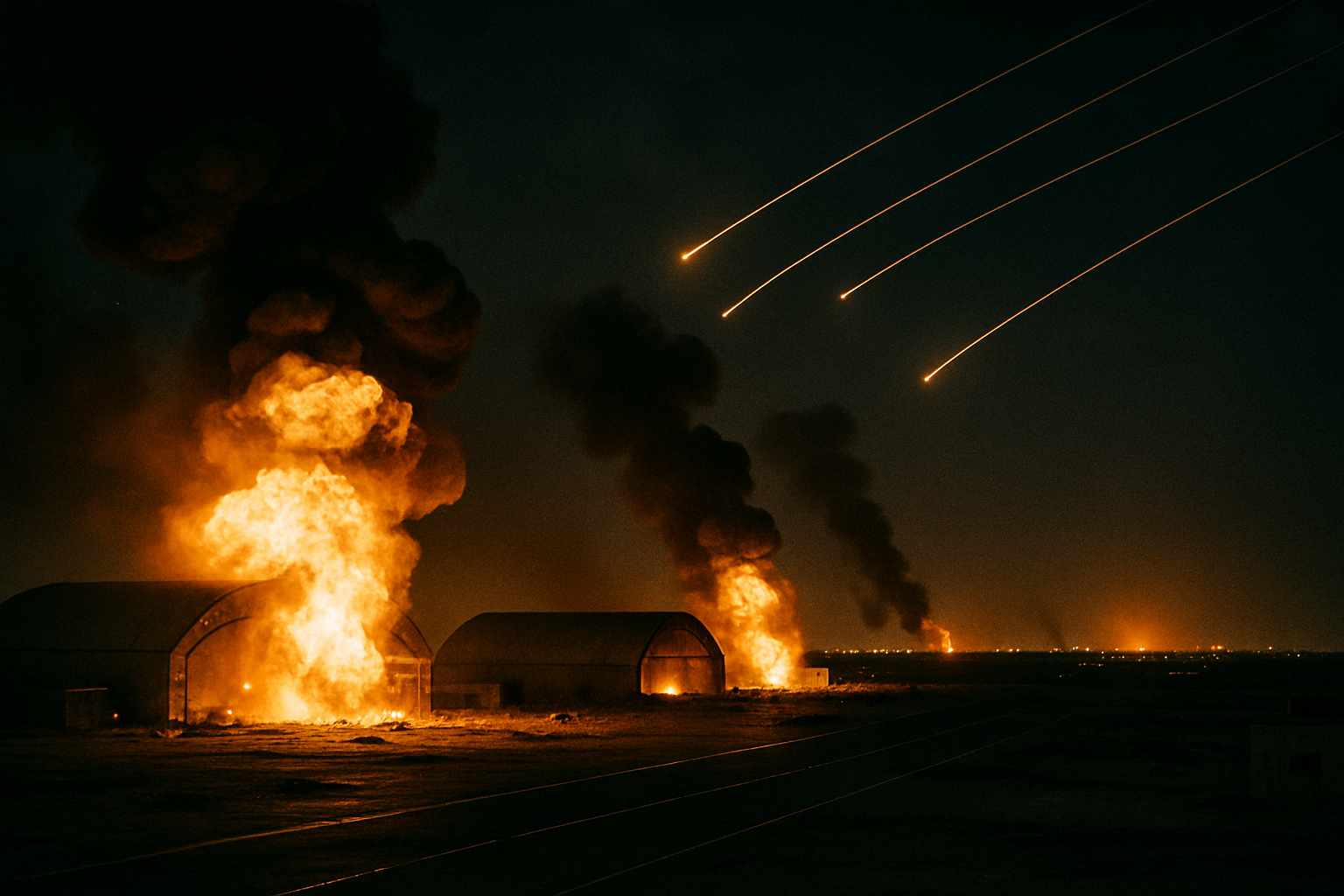
The Persian Gulf is bracing for further escalation as Iran continues to launch intermittent missile and drone salvos at military targets in Kuwait and Bahrain, directly threatening U.S. bases and allied infrastructure in the region. Early August 2026 has seen a steady rhythm of attacks and interceptions, with Gulf air-defense systems repeatedly engaging incoming projectiles and civilian populations in both countries periodically urged to take shelter.
The strikes, claimed by both Iran’s Islamic Revolutionary Guard Corps (IRGC) and its regular army, come in response to sustained U.S. military action against Iranian territory. While no single, contained incident defines the current crisis, the pattern is unambiguous: Iranian projectiles are still flying, Gulf defenses are actively responding, and the risk of a wider regional conflagration remains acute.
What is happening now
The current phase of the 2026 Iran war has entered a new and dangerous chapter, marked by what Gulf militaries describe as repeated confrontations with Iranian missiles and drones in their airspace. Kuwait and Bahrain, both host to significant U.S. military infrastructure, have emerged as primary flashpoints in the latest round of tit-for-tat strikes between Iran and the United States and its Gulf partners.
Kuwait’s Army Headquarters recently announced that its air defenses were "confronting hostile aerial targets within Kuwaiti airspace," a statement that signaled fresh interceptions following earlier waves of attacks. The wording was notable both for its clarity and its timing, coming as residents across the country reported hearing explosions — sounds that Kuwaiti authorities have publicly attributed to interceptions rather than impacts.
Bahrain’s Interior Ministry, meanwhile, activated air-defense sirens in the early hours of a recent Monday, urging residents to seek shelter even before new strikes had been publicly confirmed. The move underscored the heightened state of alert across the island kingdom, where U.S. naval and air assets are heavily concentrated.
In practical terms, the situation is one of ongoing, intermittent attacks rather than a single coordinated barrage. According to recent Kuwaiti statements, one salvo alone involved the interception of multiple ballistic missiles, one cruise missile and around 10 drones, with some projectiles getting through and causing damage and fires at power and desalination plants as well as an oil facility. Bahrain’s air-defense systems have also "intercepted and destroyed several" Iranian aerial attacks, though there have been instances of damage to residential buildings near the capital, Manama, and to infrastructure targets, including an alleged strike on an artificial intelligence center.
The persistence of the attacks has transformed daily life along parts of the Gulf coast, where air-raid alerts have become a recurring feature of the summer of 2026. For the U.S. personnel stationed at bases in both countries, the threat is direct and ongoing, though as of early August there have been no confirmed recent U.S. fatalities in Kuwait or Bahrain. U.S. service members have, however, been killed elsewhere in the theater, including in Jordan, underscoring the broader geographic reach of the conflict.
Targets under fire
The target sets named by Iran in connection with the latest salvos are almost exclusively American. The Iranian Army (Artesh), which operates separately from the IRGC, has explicitly claimed strikes on Camp al-Adiri, Ali Al Salem Air Base and Ahmad al-Jaber Air Base in Kuwait, as well as on U.S. facilities at Sheikh Isa/Shakir Air Base in Bahrain. In its statements, Tehran has emphasized attacks on aircraft shelters, satellite communication systems, navigation systems, radar installations and early-warning sites — a list that suggests a deliberate effort to degrade the U.S. military’s airpower and command-and-control capabilities in the region.
The IRGC Aerospace Force, the principal entity claiming responsibility for the missile and drone operations, has described the attacks as phases of a "punitive response" to American military action. In its own communiqués, the IRGC has specified targets including depots of U.S. drones, Patriot air-defense systems, fuel storage sites, power generators and navigation systems. The specificity of these claims — and the repeated mention of Patriot systems in particular — points to an Iranian strategy aimed at challenging the very defensive architecture that Gulf states and the United States have deployed to protect their airspace.
For Kuwait and Bahrain, the collateral consequences have been significant. The damage to power and desalination plants in Kuwait is especially sensitive in a region where freshwater production is almost entirely dependent on energy-intensive desalination. Any sustained disruption to these facilities carries immediate humanitarian implications, even if the primary military targets remain American installations. Similarly, the reports of residential damage near Manama highlight the risks inherent in launching projectiles toward densely populated areas, even when the intended targets are military.
Independent verification of the full scope of damage remains difficult amid the ongoing hostilities. Iranian claims of successful strikes on specific bases cannot be independently confirmed, and Gulf authorities have been cautious in their public disclosures, balancing the need for transparency with operational security and public morale. What is clear is that the salvos are being launched with regularity and that both defensive interception and some ground-level damage are occurring.
Iran's stated rationale
Tehran has framed the attacks in explicitly defensive terms, casting them as retaliation for U.S. strikes on Iranian territory that have continued despite what Iran describes as a "fragile ceasefire." The Iranian Foreign Ministry has publicly characterized American actions as violations of that ceasefire and has justified Iran’s missile and drone operations as a lawful response to ongoing aggression.
The language coming out of Tehran has grown sharper as the exchange of fire has continued. Iranian officials have threatened a "complete halt" to negotiations to end the war if U.S. attacks persist — a warning that injects a further note of uncertainty into any diplomatic pathway out of the current crisis. The threat is not idle: it suggests that continued U.S. military activity in the Gulf could close off the very channels through which a de-escalation might eventually be negotiated.
The division of responsibility for the strikes between the IRGC Aerospace Force and the regular Iranian Army is itself significant. Iran has frequently used its parallel military structures to signal different levels of escalation, and the involvement of both in the current operations suggests a coordinated national strategy rather than a rogue or factional initiative. The Artesh’s explicit claims of strikes on Kuwaiti air bases give the attacks a degree of official imprimatur that might be absent if they were attributed solely to the IRGC.
Iran’s reference to "punitive response" phases also implies a graduated approach, one in which Tehran may be calibrating the scale and target selection of its attacks in response to U.S. actions. This is a common feature of Iranian military doctrine, which has historically sought to control escalation while demonstrating a credible capacity to inflict pain on adversaries. The challenge for U.S. and Gulf commanders is discerning whether the current salvoes represent a plateau — a demonstration of capability designed to deter further American strikes — or a precursor to a more intensive campaign.
The U.S. and Gulf response
U.S. Central Command (CENTCOM) has reported shooting down Iranian missiles and drones launched toward the Strait of Hormuz and U.S. Gulf allies, while also conducting retaliatory strikes on Iranian coastal surveillance radar sites and military infrastructure. The U.S. posture is thus twofold: defensive, in the form of active interception of incoming projectiles, and offensive, in the form of strikes on the Iranian systems enabling the attacks.
The choice of coastal surveillance radar sites as a target is telling. These installations are crucial to Iran’s ability to track maritime traffic in the Strait of Hormuz — one of the world’s most vital shipping lanes — and to coordinate strikes on targets across the Gulf. By degrading these sites, the United States appears to be attempting to reduce the precision and effectiveness of future Iranian salvos while also signaling a willingness to strike at the enabling infrastructure of Iran’s missile and drone campaign.
For Kuwait and Bahrain, the immediate priority is the protection of their populations and territory. Kuwait’s military has taken the unusual step of issuing public warnings that explosions heard in the country are the product of air-defense interceptions rather than impacts — a messaging effort designed to prevent panic and misinformation. Bahrain’s Interior Ministry has similarly moved to manage public expectations, activating sirens and instructing residents to seek shelter even in instances where strikes have not yet been confirmed.
The Gulf states’ participation in the defensive effort is not merely passive. Their air-defense systems are actively engaging incoming Iranian projectiles, a fact that carries its own diplomatic weight. By intercepting missiles and drones over their own territory, Kuwait and Bahrain are not only protecting themselves but also aligning themselves operationally with the United States in a manner that Iran is likely to view as hostile — a dynamic that could make them continued targets for Iranian retaliation.
There is also a broader coalition dimension to consider. The research indicates that Iranian strikes have extended beyond Kuwait and Bahrain, with the IRGC claiming responsibility for attacks on U.S. bases in Qatar and Jordan as well. The spread of the attacks across multiple host nations transforms the conflict from a bilateral U.S.-Iran confrontation into a regional crisis involving several Gulf and Levantine states, each of which must weigh its own security interests, its relationship with Washington, and the risks of being drawn deeper into the fight.
Background: the broader 2026 war
The current attacks cannot be understood in isolation. They are the latest manifestation of a wider 2026 Iran war that has already seen sustained U.S. strikes on Iranian territory and an ongoing Iranian campaign of retaliation against American assets and allies across the region. The "fragile ceasefire" referenced by Iran’s Foreign Ministry is evidently holding in name only, with both sides continuing to exchange fire even as negotiations — or the threat of their collapse — proceed in parallel.
The geographic scope of the conflict is striking. Iran has launched attacks not only across the Persian Gulf toward Kuwait and Bahrain but also toward Qatar and Jordan, while the United States has conducted strikes on Iranian coastal infrastructure and military targets. The Strait of Hormuz, through which a substantial share of the world’s oil and liquefied natural gas flows, looms over the entire confrontation. CENTCOM’s reported interception of projectiles headed toward the strait suggests that Iran may be attempting to threaten or disrupt this vital maritime chokepoint, a move that would have immediate and severe consequences for global energy markets.
For the Gulf states hosting U.S. forces, the war presents an acute dilemma. Their territories are being used as launchpads for American operations against Iran, and they are now absorbing Iranian retaliation in the form of missiles and drones aimed at U.S. bases. This is precisely the scenario that Gulf leaders have long feared: being caught between their security dependence on the United States and their geographic proximity — and in some cases, commercial and diplomatic ties — to Iran. The current crisis has rendered abstract fears concrete, with Kuwaiti and Bahraini civilians living under the threat of Iranian projectiles intended for American service members.
Regional and global stakes
The implications of the ongoing attacks extend far beyond the immediate battlefield. The damage to power and desalination infrastructure in Kuwait touches on issues of basic human welfare, while strikes near residential areas in Bahrain raise serious questions about the protection of civilians in a conflict that is, at its core, being fought between Iran and the United States on foreign soil.
The energy dimension is equally significant. Reports of damage to an oil facility in Kuwait, even if limited, will reverberate through global markets already nervous about supply disruptions in the Gulf. The threat to the Strait of Hormuz, whether real or implied by the trajectory of the interceptions, adds a further layer of risk to maritime shipping and energy prices. For a global economy still adjusting to the shocks of recent years, a sustained conflict in the world’s most important energy-producing region carries profound consequences.
There is also a humanitarian dimension to consider. The periodic air-raid alerts in Bahrain and Kuwait, the urging of residents to seek shelter, and the reports of residential damage near Manama all point to a civilian population living under the direct threat of attack. The governments of both countries face the challenge of maintaining public order and confidence while the war continues to intrude on their territories.
Competing narratives
The war is being fought not only with missiles and drones but also with words, and the competing narratives from the parties involved could hardly be more divergent.
Iran presents itself as the aggrieved party, responding defensively to American violations of a ceasefire and conducting precisely targeted strikes on military infrastructure. Tehran’s public