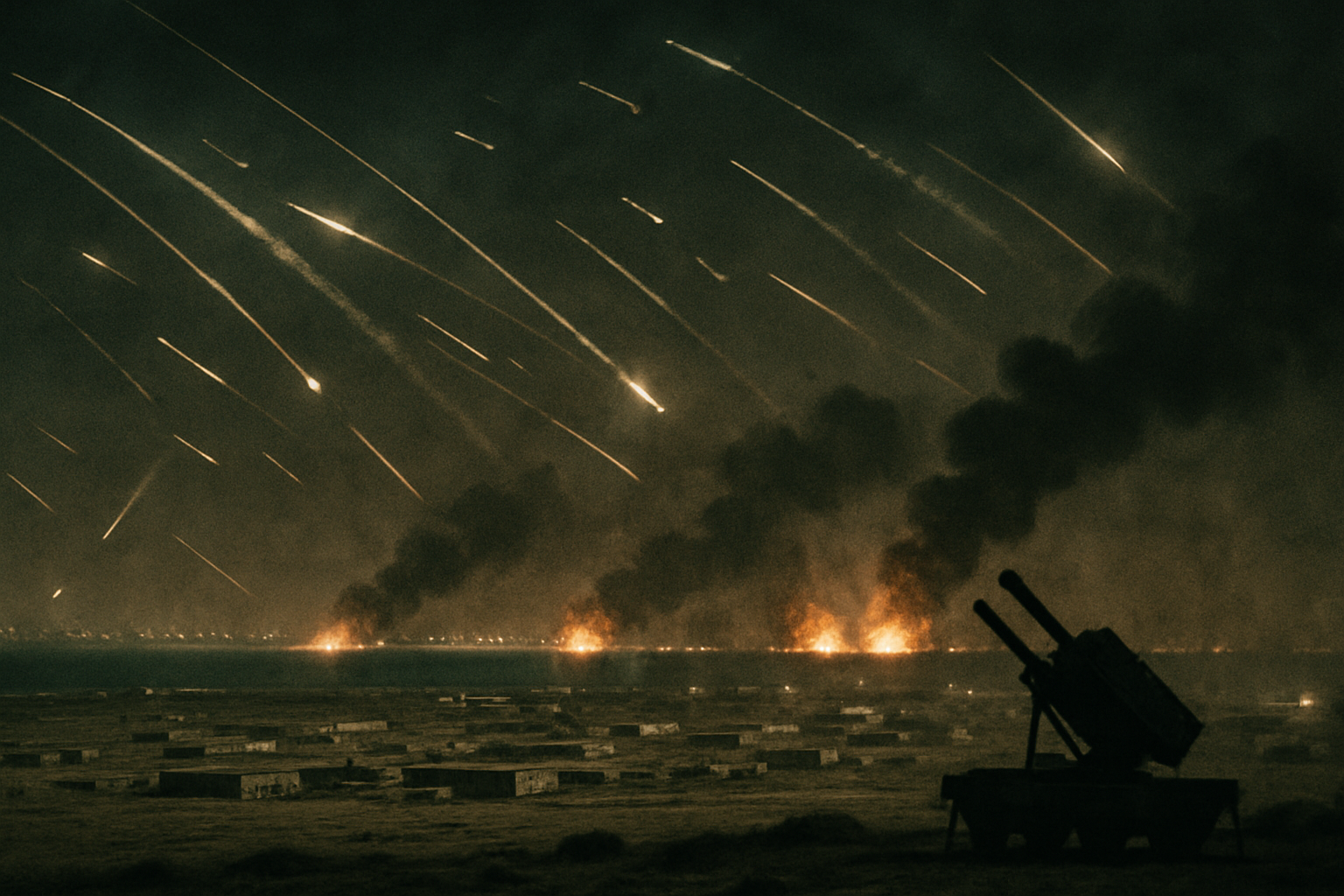
The Persian Gulf is once again on a war footing. Through the final weeks of July 2026, Iran has continued to launch waves of missiles and drones at U.S. military installations in Kuwait and Bahrain, according to multiple reports from the period, keeping a fast-moving and volatile confrontation with Washington firmly in the headlines. While local authorities in both Gulf states say they intercepted at least some of the incoming projectiles, and U.S. officials have reported no major confirmed hits on American personnel in the most recent waves described, the exchanges show no signs of abating. The attacks are part of a broader, unresolved U.S.-Iran escalation that has drawn in targets across the region, triggered claims and counterclaims about damage and casualties, and left the Gulf's U.S. military infrastructure squarely in the crosshairs.
The most recent coverage available paints a picture of an active and dangerous standoff: Iran's Islamic Revolutionary Guard Corps (IRGC) and the Iranian military have repeatedly declared they are striking U.S. facilities in Kuwait and Bahrain in retaliation for American attacks, while Kuwaiti and Bahraini forces scramble to shoot down incoming munitions and sift through the debris for damage. No durable ceasefire has been confirmed. Instead, the rhythm of the conflict has been one of strike, intercept, and reaffirm — a cycle that shows no sign of breaking.
What is happening right now
As of the latest reporting in late July 2026, the conflict remained active and unresolved. Iran has continued to launch missile and drone attacks on U.S.-linked military sites in Kuwait and Bahrain, with both countries saying they intercepted at least some of the projectiles. U.S. officials, for their part, have said there were no major confirmed hits on U.S. personnel in the most recent waves described in the search results.
The details of the most recent attacks underscore the pattern. On July 31, 2026, Iran again said it targeted U.S. military assets in Kuwait, including Ahmad al-Jaber Air Base, one of the major American airfields in the country. Kuwaiti officials responded by saying drones were destroyed in the engagement, with falling shrapnel causing material damage but no injuries in that incident. It was a familiar script: Iran announces a strike, the host nation reports an interception, and the damage assessment lands somewhere in between.
A week earlier, on July 24, Iran's military said it had targeted U.S. bases in Bahrain, Jordan, and Kuwait, with reporting naming a list of specific facilities including Isa Air Base, Camp Udairi, Camp Doha, Camp Arifjan, Ali Al Salem Air Base, and a U.S. Fifth Fleet watchtower. Bahrain's government said Iranian projectiles were intercepted in one of the latest attacks, and the U.S. military said it had no reports of harm to U.S. personnel in at least one recent round. Kuwaiti authorities separately said they intercepted drones and missiles in their airspace, with falling shrapnel causing material damage and, in one earlier incident, at least one injury.
The attacks are not new. They follow a pattern established earlier in the conflict. On July 8, 2026, the IRGC said it struck U.S. military facilities in Bahrain and Kuwait using missiles and drones. By July 13, reporting described Iran's latest round of retaliatory strikes as including targets in Bahrain, Oman, Jordan, and Kuwait — a sign of how wide the theater of operations had become. The July 24 and July 31 strikes were simply the latest turns of a screw that has been tightening since early June.
The targets: America's Gulf military footprint
At the heart of the escalation are some of the most strategically significant U.S. military installations in the Middle East. In Kuwait, the bases named in Iranian statements and U.S. assessments include Ali Al Salem Air Base, a sprawling airfield in the northwest of the country that hosts U.S. Air Force assets and personnel, and Ahmad al-Jaber Air Base in the south, another key hub for American air power. The research also identifies Camp Arifjan, a major U.S. Army logistics and support base south of Kuwait City, and Camp Udairi, a training and staging area near the northern border. Camp Doha, long associated with U.S. Army operations and armor in the Gulf, is also named in the reporting.
In Bahrain, the focal point is even more significant. The island kingdom hosts the U.S. Navy's Fifth Fleet, the principal American naval command in the Middle East, which oversees maritime security operations across the Gulf, the Arabian Sea, and beyond. The research specifically references a U.S. Fifth Fleet watchtower as one of the targets claimed by Iran on July 24, along with Isa Air Base, a Royal Bahraini Air Force base that has also hosted U.S. and coalition aircraft. Striking at these facilities is not just a military act; it is a direct challenge to the architecture of American power projection in the region.
The choice of targets matters. U.S. Central Command (CENTCOM) is the main U.S. military command cited as assessing strikes, intercepts, and damage in the region, and its area of responsibility includes both Kuwait and Bahrain. The fact that Iran is deliberately naming these bases in its statements suggests a calculated effort to demonstrate reach and resolve, even when the actual damage inflicted is limited by missile defenses. For the U.S. military, the bases represent both critical infrastructure and a vulnerability: they are large, fixed, and difficult to hide, making them natural targets for a Tehran seeking to raise the cost of American presence in the Gulf.
How the conflict escalated
The current round of attacks did not emerge from a vacuum. According to the research, the escalation began in earnest in early June 2026, when attacks on Kuwait and Bahrain were reported as part of a broader Iran-U.S. confrontation. The early weeks of the conflict were already deadly. Kuwait's health ministry said 63 people were injured in one incident and at least one person died — a sobering indicator that, despite the success of air defenses, Iranian munitions have exacted a human toll. Bahrain, for its part, reported intercepting Iranian missiles and drones aimed at civilian locations, raising concerns about the risk to non-combatants.
The casualty count has since grown. On July 18, 2026, Reuters reported that the United States said two military personnel had been killed by an Iranian attack in the Gulf. The research notes that this underscored the fact that the conflict had produced fatalities in the broader theater, even if the specific location and circumstances of that attack are not detailed in the available material. Two American service members killed is a significant escalation marker, one that historically has forced Washington to weigh its options between retaliation and de-escalation.
The broader picture is one of a region-wide exchange. Iran's strikes have not been limited to Kuwait and Bahrain. The July 13 reporting listed targets in Oman and Jordan as well, and the July 24 wave included Jordan alongside Bahrain and Kuwait. This widening of the theater suggests that Iran is seeking to demonstrate that nowhere in the U.S. regional network is safe, while also complicating the defensive task facing U.S. and allied forces. For Jordan and Oman, both of which host U.S. military personnel in various capacities, the spillover of the conflict onto their territory adds a dangerous new dimension to a already tense regional security environment.
Claims and counterclaims: a fog of war
One of the defining features of this conflict, according to the research, is the competing narratives surrounding damage and casualties. The IRGC and Iranian military have repeatedly claimed responsibility for striking U.S. facilities, presenting their actions as successful retaliation for American attacks. U.S. officials and local authorities in Kuwait and Bahrain, by contrast, have emphasized the effectiveness of air defenses, reporting interceptions, falling shrapnel, and material damage rather than direct hits on American personnel.
This is not unusual in modern warfare, where the first casualty is often the accurate assessment of what actually happened. The research explicitly notes that the exchange has involved "repeated claims and counterclaims about damage and casualties." In the absence of independent verification, outside observers are left to weigh the statements of the parties involved — a task complicated by the fact that both Washington and Tehran have clear incentives to shape the narrative. For Iran, claiming successful strikes bolsters domestic credibility and projects strength. For the United States and its Gulf partners, emphasizing interceptions and the absence of American casualties reassures allies and domestic audiences alike.
The available evidence suggests a middle ground: Iran is launching real attacks, some of which are being intercepted, and some of which are getting through in the form of falling debris and shrapnel. The material damage reported in Kuwait — including the July 31 incident in which drones were destroyed but shrapnel caused damage on the ground — is consistent with a defense system that is catching most but not all of what comes its way. The earlier casualty figures, including the death and 63 injuries reported by Kuwait's health ministry, are a reminder that even "successful" interceptions can have lethal consequences when munitions break apart over populated or built-up areas.
Why this matters: the strategic stakes
The ongoing attacks on U.S. bases in Kuwait and Bahrain matter far beyond the immediate damage assessments. Kuwait and Bahrain are not just host nations for American troops; they are anchor points of the U.S. military presence in the Gulf, a presence that has been central to regional security for decades. Bahrain's Fifth Fleet headquarters is the nerve center for U.S. naval operations in the Middle East, overseeing the waters through which a significant share of the world's oil supply transits. Kuwait's bases have served as staging grounds for American operations across the region, from the 1991 Gulf War to the 2003 invasion of Iraq and the ongoing campaign against the Islamic State.
An Iran capable of launching sustained missile and drone barrages at these facilities — even if most are intercepted — raises serious questions about the viability of the U.S. posture in the Gulf. If Tehran can force the U.S. military to devote ever-greater resources to force protection, air defense, and base hardening, it can impose costs that extend far beyond the physical damage of any single strike. The psychological and strategic impact of knowing that key bases are under routine attack cannot be overstated, for both American personnel and their Gulf hosts.
There is also a domestic political dimension. The research identifies Donald Trump as the President of the United States and the top U.S. political decision-maker referenced in the reporting about the escalation. For any American president, the loss of U.S. military personnel to enemy fire is a moment of high political stakes. The July 18 report of two U.S. service members killed in the broader theater raises the pressure on the administration to respond decisively, even as it seeks to avoid being drawn into a wider war. The balancing act between deterrence and restraint is one of the most difficult challenges in modern statecraft, and the Gulf is currently the stage on which it is being tested.
Regional perspectives: caught in the middle
For Kuwait and Bahrain, the conflict represents an unwelcome and dangerous predicament. Both countries host U.S. forces as part of long-standing security arrangements, but both are also neighbors of, and in some cases uneasy interlocutors with, Iran. Their governments have found themselves in the unenviable position of defending their airspace against Iranian attacks while trying to manage relations with a powerful and assertive Tehran.
The official responses from both countries, as reflected in the research, have emphasized the professionalism of their air defenses and the limited nature of the damage. Kuwaiti authorities have reported intercepting drones and missiles, assessing the consequences as material rather than human in the most recent incidents. Bahrain's government has similarly highlighted interceptions, and the U.S. military has echoed their assessments. This coordinated messaging serves a dual purpose: reassuring domestic populations that the threat is being managed, and signaling to Iran that the cost of continued attacks is low in terms of damage inflicted but high in terms of regional solidarity against Tehran's actions.
At the same time, the human cost has been real. The early June incident in Kuwait, which left one person dead and 63 injured, was a stark reminder that these attacks are not abstract exchanges between distant militaries. They have consequences for ordinary people — civilians going about their daily lives, workers near military installations, and residents of areas where falling debris lands. Bahrain's report of intercepting missiles and drones aimed at civilian locations suggests that the risk to non-combatants is a genuine concern, even if Iranian statements claim to be targeting military assets.
###