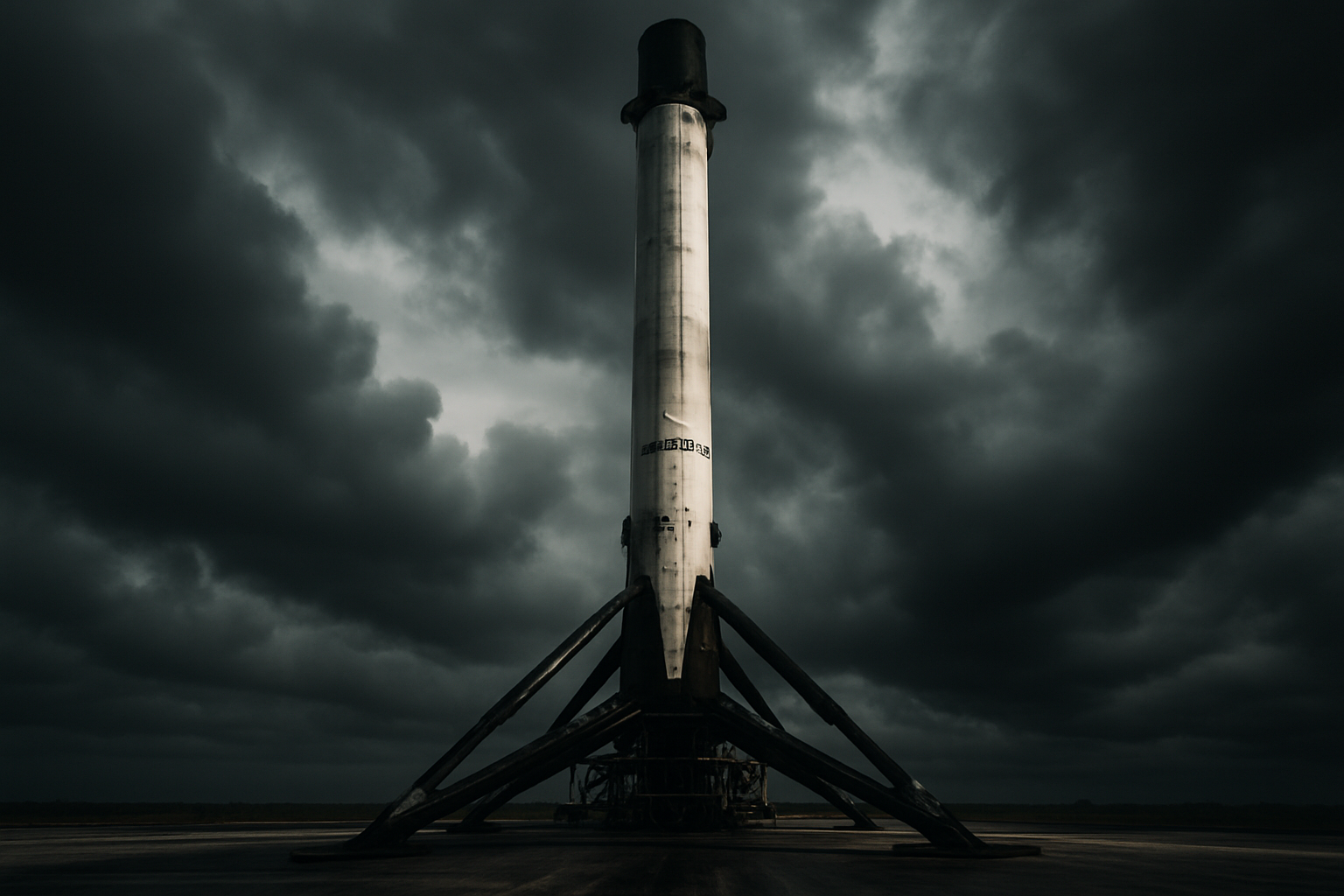
SpaceX continues to push the boundaries of rocketry with a relentless cadence of Starlink launches from California’s Vandenberg Space Force Base, each mission flying on a flight‑proven Falcon 9 first stage and underscoring the company’s mature reusable‑launch paradigm. In the span of just a few days in late June 2026, two separate Starlink deliveries have lifted off from Space Launch Complex 4E, each carrying 24 V2 Mini satellites and each landing its booster on the droneship “Of Course I Still Love You” in the Pacific. These missions—Starlink Group 17‑28 on June 21 and Starlink 17‑45 on June 24—represent SpaceX’s 655th overall Falcon 9 flight and the 74th launch of the year as of June 26. With another Starlink launch already on the books for June 28 from the same pad, the company is rapidly expanding its low‑Earth‑orbit constellation while simultaneously demonstrating that deep reuse of the Falcon 9 fleet is not merely a trick but a routine operational reality.
The Latest Missions from Vandenberg
The first of the two most recent missions lifted off at 09:39 PDT (16:39 UTC) on June 21, 2026, from Space Launch Complex 4E. The booster, designated B1063, was flying for at least the 33rd time—one of the most heavily used Falcon 9 first stages in active service. After delivering its payload of 24 Starlink V2 Mini satellites into a sun‑synchronous low Earth orbit, the booster performed a precision landing on the droneship stationed off the California coast about eight minutes after liftoff. The mission was designated Starlink Group 17‑28, a name that indicates the specific orbital shell and batch number within SpaceX’s growing constellation.
Just three days later, on June 24, SpaceX repeated the feat. At 20:30 PDT (03:30 UTC the following day), Falcon 9 booster B1081 launched from the same pad on its 25th flight. It carried another 24 Starlink V2 Mini satellites on a south‑southwesterly trajectory to low Earth orbit. The first stage again touched down on the droneship “Of Course I Still Love You” about 8.5 minutes after liftoff, while satellite deployment occurred just over an hour into the flight. By this point, SpaceX had already executed seven of the eight West Coast Starlink launches planned for June 2026, according to the company’s manifest. The lone remaining launch for the month, from California, is scheduled for June 28.
The rapid turnaround between these missions—a mere three days—highlights the logistical efficiency SpaceX has achieved at Vandenberg. The company maintains a fleet of droneships in both the Atlantic and Pacific, allowing it to recover boosters and rapidly return them to port for inspection, refurbishment, and relaunch. The use of reusable first stages has dramatically lowered the per‑launch cost of Falcon 9, enabling the high cadence needed to build out the Starlink network, which already numbers thousands of satellites and aims to provide global broadband coverage.
The Significance of Booster Reuse
The revival of booster reusability has been one of the defining achievements of SpaceX under CEO Elon Musk and COO Gwynne Shotwell. When Falcon 9 first landed on a droneship in 2015, many industry observers were skeptical that the technology would translate into meaningful cost savings or operational efficiency. Nearly a decade later, the skeptics have been quieted. Boosters such as B1063, now on its 33rd flight, and B1081, on its 25th, are examples of a fleet that routinely flies multiple times with minimal refurbishment between launches.
SpaceX’s reuse strategy is built around rigorous post‑flight inspections, component replacements when necessary, and a design that allows engines and avionics to withstand the extreme thermal and mechanical stresses of repeated launches. The company has steadily increased the number of flights per booster over the years; the current record holder has flown over 40 times. This deep reuse dramatically reduces the cost of launching a Falcon 9. While SpaceX keeps exact figures proprietary, analysts estimate that a new Falcon 9 first stage costs around $30 million to manufacture, whereas the cost of a refurbished, reused booster is closer to $10–15 million per flight, including inspections and refurbishment. With launch prices to customers around $62 million per dedicated flight (and even lower for Starlink internal missions), the savings are substantial.
The economic model has allowed SpaceX to operate at a cadence that would have been unthinkable in the early 2010s. As of late June 2026, the company has launched 74 times this year, and with a typical launch rate of about one every four days, it is on track to exceed 100 launches for the second consecutive year. The vast majority of these missions are dedicated to Starlink, with the rest carrying commercial satellites, government payloads, and crew or cargo missions to the International Space Station.
From a technical perspective, the ability to reuse boosters so many times also provides operational benefits. SpaceX has accumulated extensive data on how components degrade over many flights, allowing engineers to predict maintenance needs and schedule booster rotations. Boosters that have flown 25 or 33 times are still considered fully capable, and the company rarely decommits a booster after a mishap; instead, it retires them after they reach a predetermined lifetime or if inspection reveals significant wear. The rapid return of boosters to the droneship and subsequent port operations mean that a single booster can fly again within weeks, enabling the kind of high‑cadence launch campaign seen from Vandenberg this month.
Starlink Constellation Growth and Implications
Each Falcon 9 launch from Vandenberg adds 24 Starlink V2 Mini satellites to the constellation. These second‑generation satellites are larger and more capable than the original Starlink spacecraft, offering improved throughput and reduced latency. They also include advanced inter‑satellite laser links that allow the network to operate without reliance on ground stations in remote areas. With every launch, SpaceX fills another slot in its orbital shells—a carefully planned array of altitudes and inclinations designed to provide seamless coverage, especially at high latitudes.
As of June 2026, the Starlink constellation consists of well over 6,000 operational satellites, with applications for millions of users across the globe. The service is especially valuable in rural and remote areas lacking terrestrial broadband infrastructure. It has also proven critical for disaster response, military communications, and maritime and aviation connectivity. SpaceX continues to scale up production of the satellites at its facility in Redmond, Washington, and has recently begun launching a new “V3” variant on Starship, though Falcon 9 remains the primary workhorse for Starlink deployment.
The rapid expansion, however, does not come without challenges. Astronomers and space debris experts have repeatedly raised concerns about the impact of large satellite constellations on astronomical observations and the risk of orbital collisions. While SpaceX has taken steps to mitigate these effects—such as adding darkening coatings to reduce reflectivity and implementing automated collision‑avoidance maneuvers—the sheer number of satellites in low Earth orbit continues to grow. The International Astronomical Union and other organizations have called for tighter regulation and international coordination. SpaceX has engaged with those groups, and the U.S. Federal Communications Commission requires the company to adhere to debris‑mitigation rules. Still, the debate is likely to intensify as the Starlink constellation moves toward its planned total of tens of thousands of satellites in various orbital shells.
Impact on Space Industry and Competitors
SpaceX’s combination of reuse and high launch cadence has fundamentally reshaped the launch services market. Competitors such as United Launch Alliance, Arianespace, and Roscosmos have struggled to match Falcon 9’s price point, even with their own investments in reusability or cost reduction. The European Ariane 6, which debuted in 2024, still uses an expendable first stage, making it difficult to compete on price for commercial launches. Similarly, Japan’s H3 and India’s LVM3 have not yet achieved the reuse maturity or flight rate of Falcon 9.
For the broader space ecosystem, SpaceX’s reliability and availability mean that customers can secure a launch slot with confidence, often within months of signing a contract. This has lowered barriers to entry for small satellite operators and enabled constellations like Starlink to grow rapidly. It has also spurred investment in complementary technologies, such as satellite manufacturing, ground terminals, and user‑terminal electronics, as well as new services like direct‑to‑cellular connectivity that Starlink is beginning to test.
The accelerated launch pace from Vandenberg also highlights the strategic importance of the West Coast facility for polar and sun‑synchronous orbits. Unlike Florida, which is better suited for low‑inclination equatorial orbits, Vandenberg allows Falcon 9 to launch directly into polar and highly inclined orbits optimal for Earth‑observation and communications constellations. The U.S. Space Force and its Guardians and Airmen at Vandenberg have supported these launches as part of the base’s mission to provide assured access to space for national security and civil payloads.
What Happens Next
SpaceX’s manifest for the coming weeks signals no slowdown. The next Starlink mission from Vandenberg is scheduled for June 28, 2026, likely using yet another flight‑proven booster. Beyond that, the company plans to maintain its high launch rate for the remainder of the year, with additional Starlink missions from both Cape Canaveral and Vandenberg. The summer months often see an uptick in launch activity as weather conditions improve on both coasts.
Looking further ahead, SpaceX is preparing for a ramp‑up of Starship launches from its Starbase facility in Texas. Starship, when fully operational, is expected to carry even larger batches of Starlink satellites—potentially hundreds at a time—which could accelerate the constellation’s growth dramatically. However, Starship’s development has faced delays, and as of late June 2026, it has not yet entered regular commercial service. Falcon 9, therefore, remains the backbone of both Starlink deployment and SpaceX’s commercial launch business.
For the Starlink service itself, the additional satellites mean improved capacity and coverage, especially in high‑latitude regions that were previously underserved. Users in northern Canada, Scandinavia, and Alaska have reported lower latency and higher speeds as more satellites come online. The network’s ability to handle peak‑hour congestion is also expected to improve with each batch of V2 Minis, which feature advanced digital beamforming antennas.
In parallel, SpaceX continues to monitor and manage orbital debris. The company has committed to deorbiting satellites that fail within five years and to ensuring that all Starlink spacecraft are end‑of‑life capable of atmospheric reentry. With each launch, the risk of a collision increases slightly, but SpaceX’s autonomous collision‑avoidance system—which adjusts satellite orbits based on shared tracking data—has so far prevented any major incidents. Industry observers note that the overall debris environment remains a concern, and that the long‑term sustainability of large constellations will depend on continued cooperation among operators and regulators.
Conclusion
The successful Starlink launches on reused Falcon 9 boosters from Vandenberg in late June 2026 are not just routine missions; they are testaments to a decade of investment in reusability, operational efficiency, and mass‑production of satellites. SpaceX is proving that a high‑cadence launch campaign using flight‑proven hardware can be sustained indefinitely, enabling the rapid expansion of a global broadband network that is already transforming internet access in underserved areas. Yet the same success raises legitimate questions about orbital congestion and astronomical interference that will require ongoing dialogue and innovation. For now, SpaceX shows no sign of slowing down—the next booster is already on the pad, the next batch of satellites is in the clean room, and the next launch window is just days away. The world watches as space becomes more accessible, and more crowded, than ever before.